Select a plating barrel by the actual part family and a trial load, not by nominal barrel volume. Perforation must retain the parts while allowing solution exchange; mass, volume fill and electrical load must each be checked. Accepted pieces per load and cycle time then provide the capacity basis.
Scope and limits: plating-barrel loading
- Parts that must not tumble: if the proposed load exceeds the rated barrel/drive duty, or tumbling cannot meet the drawing's damage and marking limits, assess a rack or fixture route. A heavy part is not excluded by its name alone.
- Very small parts below practical perforation limits: vibratory or other fine-part routes may serve better; ask for the assessment rather than forcing the barrel.
- Assuming output from barrel volume: accepted output depends on usable load, deposition/handling cycle, scheduling and station availability; volume alone is insufficient.
- One barrel for every family: a hole that retains a small pin may still trap a hook on another part family. Check retention and snagging separately; different panels or barrels may be needed.
What does perforation actually do?
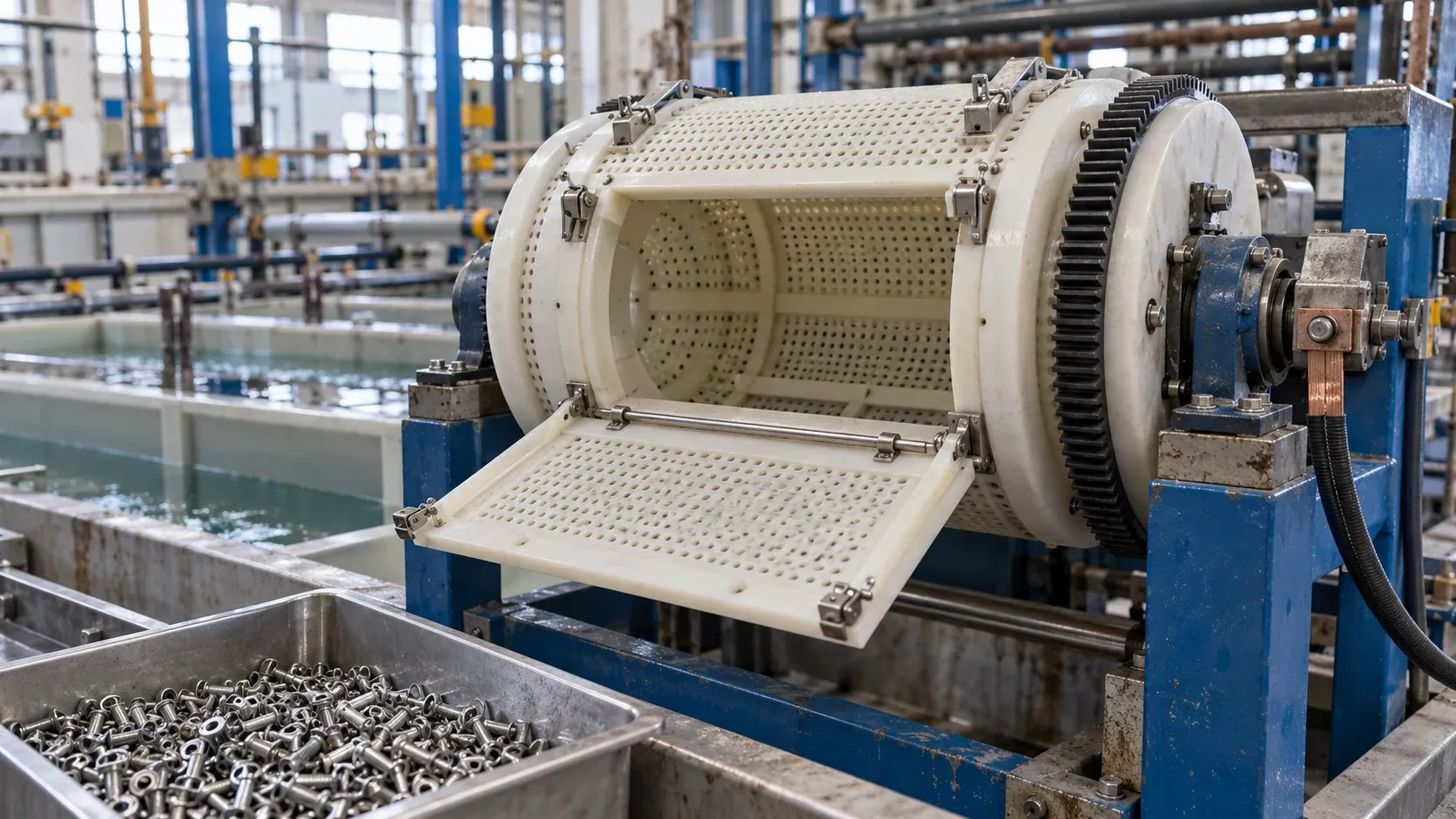
The barrel wall holds the parts while letting solution exchange through its perforations; the current reaches the parts through dedicated contact devices and through the mass of parts themselves — the plastic barrel wall is not the conductor. Perforation sets the solution exchange and shapes the ionic current path. Perforation geometry is selected to retain the smallest parts and avoid trapping or snagging their features, while providing adequate open area for solution exchange — hole size, shape, wall thickness and usable loading are confirmed with trials on the actual part family, not by formula. When a product range spans fine parts and chunky ones, that set of constraints is the reason shops run different barrels on one line.
Perforation also influences deposit character: whether a barrel arrangement leaves contact or shadowing marks on significant surfaces is a question for the trial on real parts. Where the drawing restricts marks, the route may need inserts, doors or different handling. That restriction belongs in the inquiry before the barrel is quoted.
How should a plating barrel's usable load be established?
Usable load is not a single number. Three different loads matter, and they must not be confused: the mass the barrel and drive carry, the volume fill that lets parts tumble rather than ride, and the electrical load the contact arrangement carries. Overfilling can reduce tumbling effectiveness; an underfilled barrel changes the contact pattern and the current the load presents. Neither effect justifies a universal percentage — what the productive load is, for a given part family, is established by trial.
The planning inputs are the part families with weights, dimensions and nesting behavior, and the accepted output per hour — plus a trial-loading record on real parts: parts per load, mass, packed volume as defined for that barrel, total surface area, barrel and contact arrangement, observed tumbling, damage or nesting, thickness measurement points and accepted output. With those records, the assessment can size barrel dimensions, number of barrels per station and the transfer rhythm instead of guessing from tank count.
What do rotation and contact decide?
Barrel rotation affects tumbling and changes which parts are exposed or in electrical contact during the process. Rotation, current, load, chemistry and part geometry affect thickness distribution; the process owner defines the target, and the equipment must hold it.
Electrical contact in a barrel is indirect: current reaches parts through the mass itself and through contact devices such as danglers or button contacts. Intermittent contact and movement require a separate barrel trial; equal nominal current does not establish the same thickness distribution as a rack load. Include the contact arrangement in the proposal. Our barrel versus rack comparison explains the handling choice; this page is about making the chosen barrel work.
Connect the accepted trial load to the handling and support-system boundary in the equipment buyer's guide.
Which barrel configuration belongs in the RFQ?
Treat these as options to assess, not a statement that every configuration is offered. Provide an existing barrel drawing or measurements when replacing equipment; record both internal working dimensions and the external handling interface.
On small screens, scroll the configuration table sideways.
| Configuration | Record with explicit units | What changes in the proposal |
|---|---|---|
| Shell and shape | Round or polygonal candidate; complete chemical exposure and operating temperature; proposed shell/panel material | Requires compatibility assessment of the shell, joints and wear components; shape alone does not establish tumbling quality. |
| Working size and fit | Inside diameter/across flats and inside working length in mm or inches; outside envelope, hanger/support spacing and tank clearances | Separates usable working space from machine fit. A replacement with similar nominal volume may not fit the same drive or carrier. |
| Perforated panels | Smallest escape feature, hooks/recesses, hole/slot or mesh candidate, wall thickness and open-area information | Defines retention and snagging trials together with solution exchange and drainage checks. |
| Door and loading access | Door/closure type, clear opening, loading/unloading method and required safe access | Changes handling tools, unloading arrangements and the safeguards the equipment assessment must include. |
| Drive interface | Existing drive/coupling/gear drawings if retained; required rotation range and its control; electrical supply | Determines whether the barrel is tank-driven or has a dedicated drive, and what must be integrated or replaced. |
| Cathode pickup and service | Proposed contact type, required current envelope, connection interface, inspection access and replaceable wear items | Defines contact-duty assessment, maintenance access and the spares boundary; equal rectifier ratings do not prove equivalent contact performance. |
The mechanical-fit checklist is an engineering RFQ aid. It does not set chemical limits, rotation speeds, current settings or a supplier rating.
How does a trial load become a capacity estimate?
Use accepted pieces, not pieces loaded. As a deliberately hypothetical arithmetic example, trial A yields 150 accepted pieces in a complete 30-minute cycle, or 300 accepted pieces/hour. Trial B yields 220 in 50 minutes, or 264/hour. A larger load can therefore provide fewer accepted pieces per hour. These numbers are teaching inputs, not recommended process settings, ES-PRO output ratings or customer results.
Record plating dwell separately from the complete elapsed cycle, including loading, preparation, rinsing, unloading and any allocated waiting time. For a line with overlapping loads, use the validated bottleneck cadence rather than dividing by one barrel's total residence time. Apply the actual working calendar, product mix, changeovers and availability assumptions before comparing a monthly demand with the proposed line capacity.
Plating-barrel trial-loading record
Use this as a blank project worksheet. Enter actual requirements and observations; the blanks are not process limits or completed production results.
- Part and requirement baseline
- Record for this projectPart family/lot, material, drawing and coating specification/revision; barrel/contact/panel IDs: ____
- How this changes the decisionMakes each run traceable and prevents comparison of different part or acceptance requirements.
- Acceptance plan
- Record for this projectThickness limits and units, method and measurement locations, sample count, allowed surface defects and approval owner: ____
- How this changes the decisionDefines what counts as an accepted part before the output figure is used.
- Recorded process conditions
- Record for this projectChemistry/analysis reference, temperature with units, rotation rpm, current A/voltage V and plating dwell: ____
- How this changes the decisionShows which conditions were held or intentionally varied. Changed chemistry or settings cannot be attributed to loading alone.
- Three load measures
- Record for this projectParts/load; mass and units; fill volume and its definition; total active area and required electrical load: ____
- How this changes the decisionChecks mechanical ratings, tumbling space and contact duty separately. Include carrier/assembly mass when assessing lifting duty.
- Observed behavior
- Record for this projectTumbling, tangling, lodged parts, contact marks, damage, drainage observation and evidence record: ____
- How this changes the decisionIdentifies whether the part family needs another panel, load, contact arrangement or handling route.
- Timing and accepted output
- Record for this projectPlating dwell ____; complete elapsed cycle ____; pieces loaded/accepted/rejected ____; recorded thickness results ____
- How this changes the decisionSeparates process residence from accepted production. For an overlapping line, identify the bottleneck load cadence.
- Repeatability and sign-off
- Record for this projectRun IDs, agreed repeat count, ranges/variation, deviations, corrective action and trial sign-off owner: ____
- How this changes the decisionPrevents one favorable run becoming an unsupported production rating; the approval plan sets the required evidence.
- Monthly operating demand
- Record for this projectAccepted pieces/month or plated area/month with units, product mix, working calendar, changeovers and availability assumption: ____
- How this changes the decisionConverts the approved load/cadence into a capacity comparison without assuming every calendar hour is productive.
Copy this project worksheet
Select the text in the read-only field and copy it into your RFQ document or project notes. Complete the requirements, owner and status for each item.
Questions You May Have:
How full should a barrel be loaded?
That is what the trial-loading record establishes: mass load, volume fill and electrical load are three different things, and the productive combination depends on part geometry and tumbling behavior. Give the assessor the actual part families and a trial record so the answer is calculated, not defaulted.
Why do barrel-plated parts show different thickness on flat faces than rack parts?
Current reaches barrel parts through the mass, so distribution differs. Agree measurement locations that reflect the real part, and let the trial demonstrate the distribution.
Can one line run several barrel sizes?
A line can be designed for more than one barrel size. The transfer system and hoist program must handle the changeover — put that in the brief.
Which plating-barrel components need inspection and replacement?
Doors, perforated panels, contacts and drive components are the usual wear items. Ask the proposal to list wear parts and access for replacement; a barrel that cannot be serviced quickly sets the line's real availability.
Get Proposal and Demo
Introduce your barrel plating project with company, name, email and project country. Technical fields are optional. Provide the part families, smallest part, weight range and accepted output when available, and ask which barrel configuration and demonstration apply.
Drawings can follow by sales email, or chat on WhatsApp. The quotation scope guide helps compare which handling and maintenance duties each offer includes.
Official references
- Illinois WMRC Research Report RR-95, Effect of Barrel Design on Dragout Rate (2002), hosted by NMFRC: printed Methodology pp. 5-7 and Discussion/Conclusions. The WMRC-funded study compared eight barrel designs in two size groups with a documented dragout method. It supports comparing drainage under recorded conditions; it does not certify current equipment, coating quality or a universal fill ratio.
- U.S. EPA — Preliminary Review of the Metal Finishing Category (2018): field-observed rack/barrel and wastewater context. It is not a source of barrel speed, current or loading setpoints.
The configuration checklist, capacity arithmetic and trial worksheet are original engineering planning aids. Their blanks must be completed with the approved process, equipment ratings and part acceptance criteria.
Image note: AI-generated editorial imagery illustrates equipment or workpiece contexts; it is not an ES-PRO installation, customer reference or evidence of coating conformity.