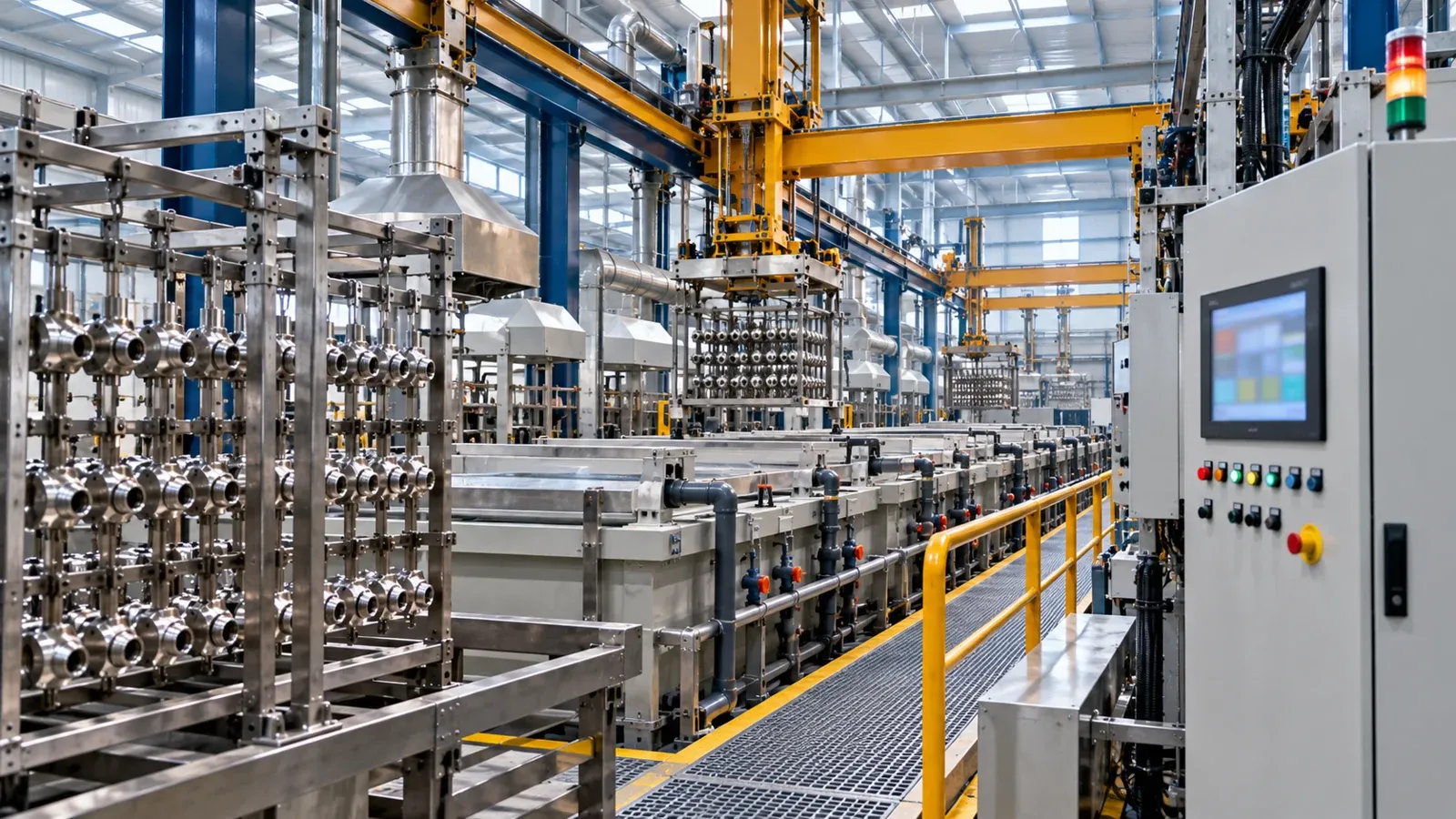
Automated metal finishing needs a defined operating sequence, clear operator responsibilities and records that connect each load to its processing history. Specify the controls, traceability and recovery rules alongside the handling equipment. An automatic transfer system can move parts, but the project brief must also explain how interrupted or abnormal loads are handled.
Use this guide when comparing line-control proposals or upgrading an existing system. For the initial choice of rack, barrel or continuous handling, see our electroplating machine guide. This article concerns the operating evidence and responsibilities after that handling choice has been made.
In this guide
Which metal-finishing operations will the controls automate?
Write the sequence as individual operations: identify the load, load the carrier, select the recipe, transfer between stages, apply the process settings, unload and release the finished work. Ask suppliers to mark each operation as automatic, operator-confirmed or manual.
Include product changes and maintenance activities in the discussion. A demonstration with one repeated recipe does not show what happens when a different rack, mixed order or interrupted load arrives. Request an explanation of recipe selection, permissions and checks against the intended part family.
Record the operator tasks that remain. They influence capacity, training and workstation access. A quotation describing an “automatic line” without those tasks is difficult to compare with another proposal using the same label.
What should an automated plating load record contain?
Begin with the question the plant needs to answer: which load was processed, under which approved recipe, and what happened during its route? Specify the identifier and the information to associate with it. The project does not automatically require every conceivable sensor or data field.
Agree on the origin of each record. Some information comes from the controller, some from an instrument and some from an operator or laboratory result. Distinguish a commanded setpoint from a measured value. Recording that the controller requested a temperature is different from recording the temperature reported by the agreed instrument.
| Record element | Question to resolve before ordering |
|---|---|
| Load identity | How is the carrier or batch identified, and who checks the part family? |
| Recipe | Which version was selected and how are changes authorized? |
| Stage history | Which events and timestamps are retained for the actual load? |
| Process values | Are records setpoints, measurements or both, and from which instruments? |
| Exceptions | How are alarms, acknowledgements and recovery actions associated with the load? |
| Inspection | How is the finished-part decision linked to the process record? |
| Export | Who can retrieve records, in which format and for what retention period? |
This editorial specification table defines questions, not a claim about a standard ES-PRO control package. Confirm the functions and supply boundary for the proposed system.
How should plating controls handle an interrupted cycle?
Ask for a recovery scenario as part of the control discussion. Examples include a process-stage alarm, unavailable downstream tank, incorrect load identification or interrupted power. The process owner must decide the acceptable response and the conditions for resuming or segregating work.
Specify which decisions the software can take automatically and which require authorized intervention. Identify the information an operator sees before making that decision. Avoid accepting an unexplained “resume” button as the complete recovery strategy.
The record should preserve the interruption and subsequent action. Agree whether the load is held, reprocessed, diverted or rejected under the approved procedure. Do not let a restart silently create a record that appears to represent an uninterrupted cycle.
How does plating automation affect accepted production output?
Require a capacity calculation based on actual load sizes, process residence times, transfer schedules and manual work. Include product mix and changeover. A fast transfer motion is only one input; it does not establish the interval between completed, accepted loads.
For a repeated recipe, request the proposed interval C between completed loads, in minutes, and the planned production window T in the same units. A simple steady-state upper-bound check is floor(T/C) loads. It ignores start-up, drain-down, changeovers and interruptions, so request a time schedule that accounts for those losses before using the result as a production commitment. Multiplying by parts per load describes loaded parts, not accepted parts.
For a mixed schedule, compare the supplier's projected completion times with the agreed mix, loading labor and inspection capacity. In an acceptance run, reconcile each completed load with its actual part count, held or rejected work, and the inspection decision. Accepted output is the sum of released parts over the stated observation period; use the same period and acceptance basis when comparing proposals. Do not assume a default yield or count a reworked part twice.
For an upgrade, identify the current bottleneck using recorded production information. Changing controls cannot be assumed to remove a limitation caused by tank capacity, process time, loading or downstream inspection. Present the baseline and the intended change separately.
Our line quotation guide helps align the proposed controls with the rest of the supply scope. Include field instruments, software licenses, interfaces, commissioning and operator documentation as explicit items rather than assuming they accompany the controller.
What should an automated plating-line demonstration prove?
Prepare a short demonstration schedule around the buyer's operating questions. It might cover a normal load, authorized recipe selection, a planned alarm scenario, recovery under the agreed procedure and retrieval of the resulting record. Agree the safe test method with the supplier before the demonstration.
Ask who provides the sample parts and who verifies the process result. Demonstrating software screens is useful for the controls assessment, but finished-part acceptance needs its own agreed checks. Keep both in the commissioning plan.
The European Commission JRC surface-treatment reference provides EU context for electrolytic and chemical installations and associated activities. The page lists the adopted 2006 reference and a review draft; neither is an automation-package certificate. Plant requirements and applicable permissions remain project-specific.
An example of a plating load record through a hold
Fictional example for proposal comparison: EXAMPLE-01 is linked to carrier EXAMPLE-R1 and recipe REF-A. The identifiers and clock times below are invented; they are not process durations or an installation result.
| Record link | Illustrative entry | What to demonstrate |
|---|---|---|
| Work and carrier | Batch EXAMPLE-01 linked to carrier EXAMPLE-R1 and a part family | Reusing a carrier preserves the earlier load identity |
| Recipe authority | Approved recipe REF-A; selected revision retained with the load | Authorized edits produce distinguishable versions without rewriting completed records |
| Exception | Downstream stage unavailable; transfer held under the agreed response | Actual hold and affected stage remain identifiable, rather than an invented uninterrupted cycle |
| Disposition | Authorized decision to resume, rework or segregate under the process procedure | Person, decision and resulting route stay linked to the load |
| Inspection and retrieval | Inspection reference added; record exported for review | Complete chain is readable, including missing-data flags, outside a supplier-only screen |
The following sample event rows extend that same load. An inspection reference links a decision record; it is not itself an acceptable test result.
| Example time | Load / event | Recorded evidence | Authorized disposition or reference |
|---|---|---|---|
| 09:00:00 | EXAMPLE-01 identified on EXAMPLE-R1 | Selected recipe REF-A revision recorded | Operator role confirms the load family |
| 09:01:00 | Transfer request held: downstream stage unavailable | Affected stage and hold reason retained | No automatic production release implied |
| 09:01:05 | Agreed instrument channel unavailable during hold | Measured value marked MISSING; not zero or copied setpoint | Review flag linked to the load |
| 09:03:00 | Process owner records segregation decision | Decision, role and actual route retained | Hold record EXAMPLE-H1; no unapproved resume |
| 09:05:00 | Record exported with inspection reference | Original exception and missing-data flag remain visible | EXAMPLE-Q1 decision pending; load remains unreleased |
A setpoint, a sensor reading and an inferred value should remain distinguishable. Agree units, instrument identity, timestamps, missing-data handling, retention and export format for the information your process requires. Assign responsibility for reviewing exceptions.
A plating controls acceptance and handover schedule
Agree a safe test method before demonstrating an interruption. This is an acceptance checklist, not instructions to disable protection or interrupt a live chemical process. Equipment protection, process disposition and production release have separate approval owners.
| Scenario | Demonstration to agree | Record to retain |
|---|---|---|
| Representative normal load | Identity, approved route and remaining operator tasks | Load record and agreed finished-part inspection reference |
| Unavailable stage or planned alarm | Agreed hold and authorized recovery using a safe method | Alarm, acknowledgement, affected load and disposition |
| Communication or power interruption | Approved recovery method and information retained across interruption | Exceptions, outstanding loads and authorized restart decision |
| Export and configuration restore | Retrieval and agreed safe backup/restore test | Readable export, software/configuration versions and handover sign-off |
Assign PLC/HMI programs, recipes, instruments, software licenses, backups, documentation and training to named supply-boundary items. Identify who retains access after handover and what an update can change.
Where do plating-line records cross into factory systems?
PLC/HMI operation, an on-line historian and a factory MES or quality system can be different supply items. Seeing a record on a control screen does not establish an included export or integration. Use this responsibility table to agree the boundary; the project may need a readable file export rather than a live interface.
| Boundary | Question to agree | Who must confirm it |
|---|---|---|
| Load ID input | Plant order system, scanner or operator entry; duplicate and replacement handling | Plant production owner with controls supplier |
| Recipe identity | Approved revision source and permission to select or change it | Process owner with controls supplier |
| Record storage | Controller, historian or other agreed store; capacity, retention and access | Controls supplier with plant OT/IT owner |
| Export / receiving system | Fields, units, format, delivery trigger, receiving endpoint and acknowledgement | Sending and receiving system owners |
| Network interruption | Buffering, missing/duplicate flags and later reconciliation; identify limits | Both interface owners with process owner |
| Final release link | Inspection reference, decision authority and work that remains on hold | Plant quality owner |
Request one normal-load export and one safely simulated exception record at acceptance. Have the intended plant recipient retrieve and interpret both. Retention, offline behavior and integration are requirements to agree, not features assumed to be included in every control package.
Who controls access to plating recipes and production records?
Agree operator, supervisor, maintenance and supplier responsibilities for recipe edits, remote support, exports and configuration changes. Do not place operating credentials in a public enquiry.
NIST SP 800-82 Revision 3, published in 2023, supplies OT-security planning context. Its page also identifies a 2026 Revision 4 draft; a draft is not presented as a final requirement here. Discuss access and recovery with the plant OT owner, without implying that an equipment package is NIST-certified.
Questions You May Have:
Does automatic handling mean every operator task disappears?
No. Loading, identification, inspection and maintenance can remain manual. Request the operation-by-operation boundary and use it when estimating staffing and output.
Is a PLC event log the same as full traceability?
Not necessarily. Determine whether events can be associated with the actual load, recipe version and inspection decision. Define the records your plant needs to retrieve.
Can an existing line receive a control upgrade?
It may be possible after checking the equipment, instruments, interfaces and operating procedures. Provide the current diagrams, control functions and constraints before assuming compatibility.
Should every alarm stop the entire line?
The appropriate response depends on the equipment and approved process. Agree the response matrix and test plan with the responsible engineering team rather than applying one generic rule.
Get Proposal and Demo
Send your automation brief with the existing sequence, desired records and known bottleneck. Ask for a demonstration of the relevant operating and recovery functions. Drawings and control diagrams can follow at sales@electroplating-equipment.com.
For first contact, only company name, your name, email and project country are required. Phone, city and all technical fields are optional; supporting files can follow by email.