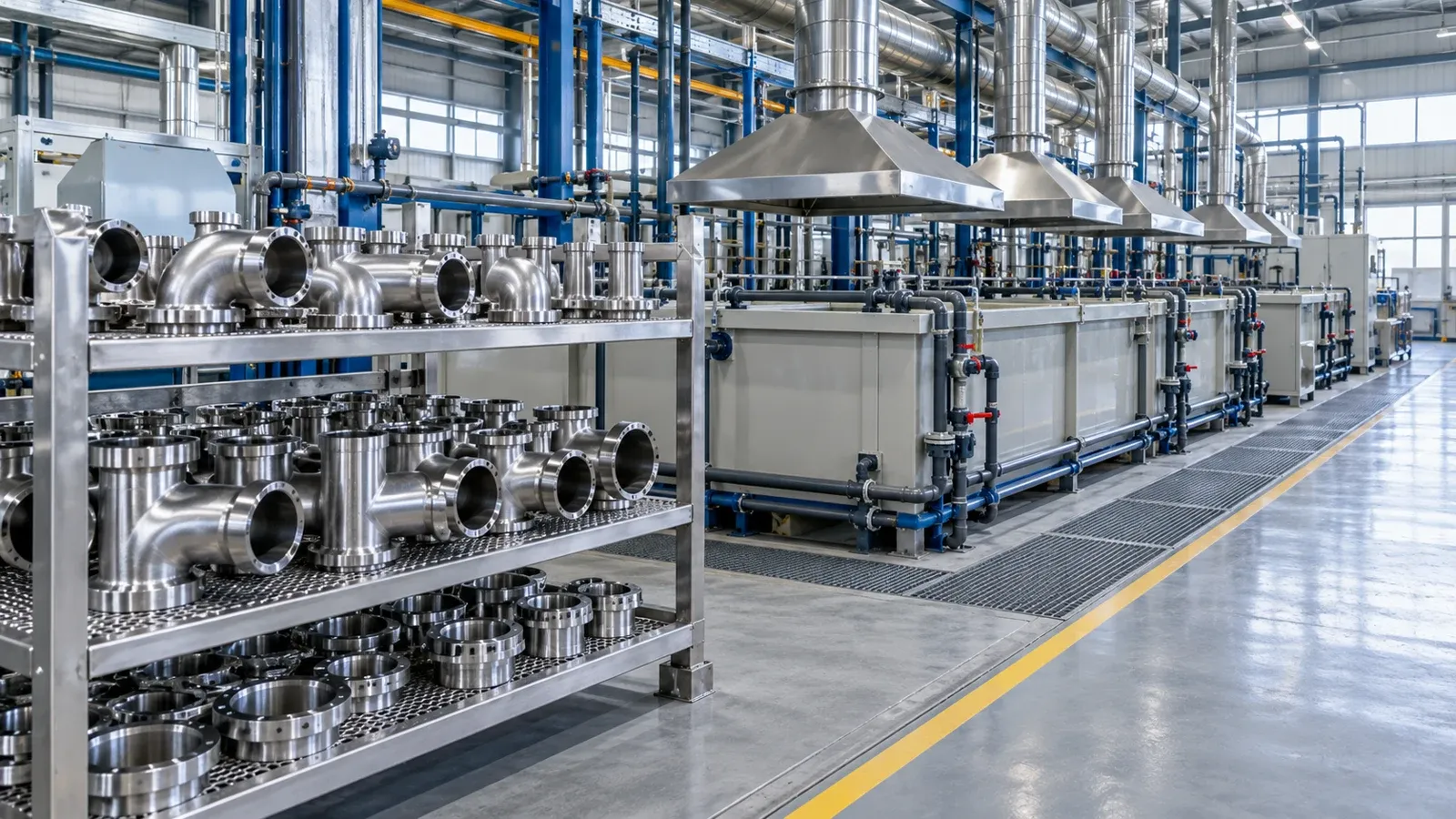
A stainless steel passivation line should be planned from the part grade, surface condition, specified treatment and verification requirements. Define cleaning, treatment, rinsing, drying and handling separately. The equipment brief should show what each stage must accomplish and how the finished parts will be accepted, rather than starting with a fixed tank count.
This guide helps a factory team convert a customer or internal specification into an equipment enquiry. It concerns stainless steel passivation. Electroplating, pickling and electropolishing can involve different objectives and equipment duties; those processes should not be combined under a vague surface-treatment label.
In this guide
Which stainless steel surface treatment does the drawing require?
Identify the stainless steel grade and manufacturing condition, then provide the surface requirement. Machining residues, welding condition, heat tint and prior finishing operations should be described to the process specialist. The required preparation sequence needs assessment against those actual parts.
If the customer calls up a passivation standard, record its designation and agreed edition. The ASTM A967/A967M official record identifies a specification for chemical passivation treatments for stainless steel parts. The full specification and customer requirements determine the applicable treatment and verification; a catalogue title is not a complete process instruction.
Should the stainless steel passivation line use citric or nitric treatment?
State the treatment already approved by the process owner or customer. If it has not been chosen, request a process assessment using the material grade, contamination, finish and acceptance requirements. Do not choose chemistry only because a supplier can fit fewer tanks into the proposed layout.
Give the equipment supplier the approved process datasheets, relevant safety information and operating windows once available. These inputs support review of wetted materials, temperature control, ventilation and effluent interfaces. This guide does not provide acid concentrations, immersion times or a substitute recipe.
Treat rinsing, drying and inspection as part of the route. Agree which stages are separate equipment duties and which operations remain manual. Include any cleanliness or handling requirements after the treatment, so the accepted condition can be maintained through unloading and packing.
Which passivation requirements apply to either approved treatment?
ASTM A967/A967M-25 identifies alternative chemical treatments and verification practices; it does not select a suitable treatment for every application. Complete this comparison with the process owner. Neither acid name alone settles equipment compatibility or the required inspection.
| Compare | Citric-route proposal | Nitric-route proposal |
|---|---|---|
| Authority and parts | Approved treatment designation, stainless grade and starting condition | Same contract inputs; confirm whether this route is accepted for those parts |
| Equipment duty | Chemistry datasheet, wetted materials, heating and controls to be assessed | Review the actual formulation and window separately; do not transfer the other route's assumptions |
| Rinse and discharge | Required rinse endpoint, supply quality and waste-stream review | Define the same interfaces against this route's residual chemistry |
| Exposure controls | Site hazard assessment and applicable ventilation requirements | Site hazard assessment for this formulation, concentration and operating conditions |
For U.S. installations, OSHA 29 CFR 1910.124 addresses dip-tank construction and exposure/ventilation duties. It does not make either treatment automatically acceptable for a specific installation.
What determines passivation handling and tank dimensions?
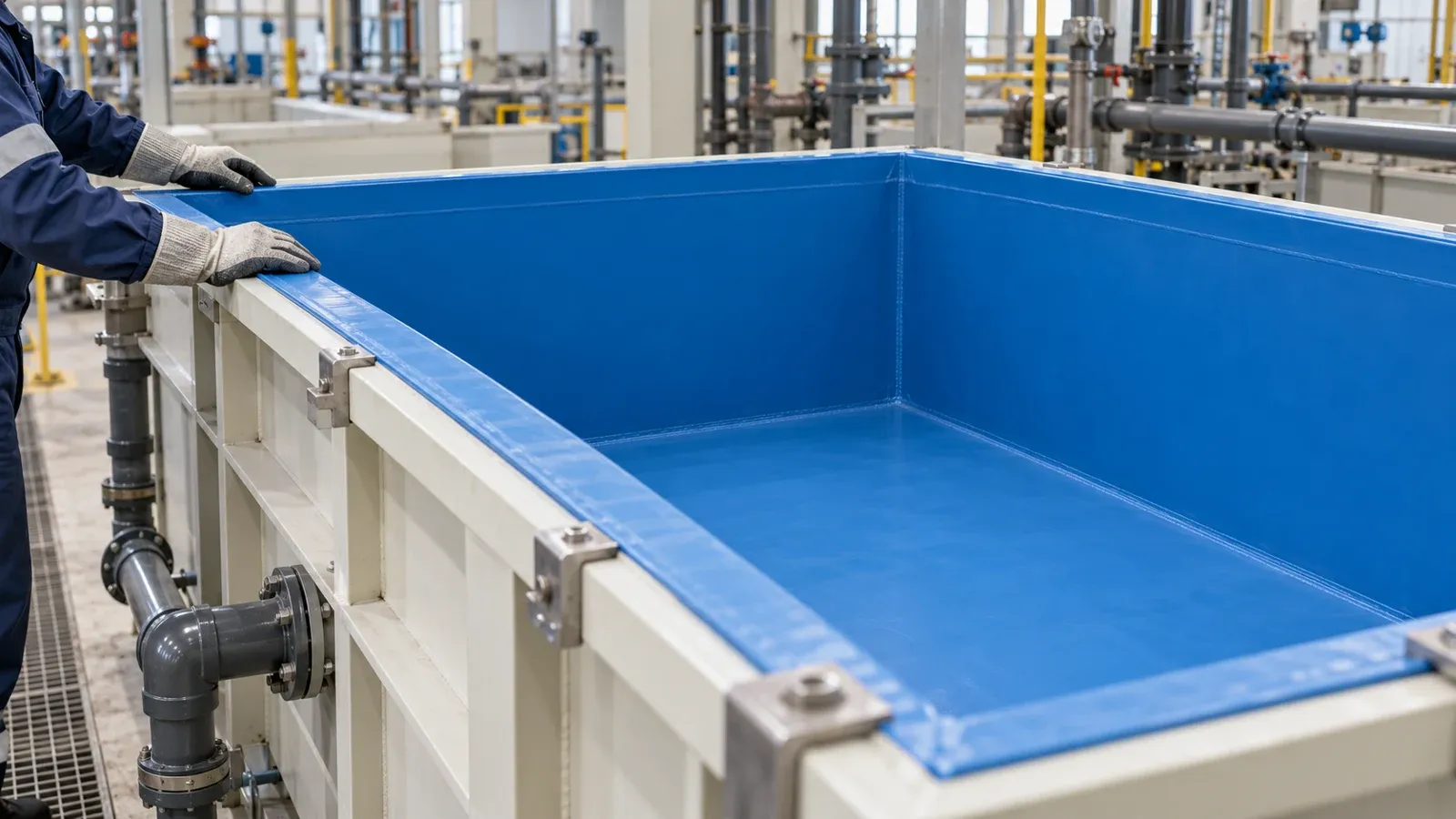
Provide maximum part dimensions, weight, the intended basket or rack arrangement and restrictions on contact. Include smaller parts and mixed loads as well as the largest item. A vessel that fits the longest part may still be unsuitable for the proposed loading arrangement or draining orientation.
Describe the monthly accepted output and working schedule. Then ask the supplier to explain load size, cycle assumptions and operator work behind the capacity proposal. The planning approach in our line setup checklist can be used without assuming that a stainless steel treatment route is identical to an electroplating line.
How should stainless steel passivation capacity claims be compared?
For arithmetic only, suppose a buyer needs 4,800 accepted pieces per month over 20 days of 8 scheduled hours. That requires 30 accepted pieces per scheduled hour. At an illustrative 95% acceptance yield, the gross processing requirement becomes about 31.6 pieces/hour. With 8 pieces in a representative load, that is about 3.95 completed loads/hour, or one load every 15.2 minutes.
These are invented planning inputs for explaining the calculation, not an ES-PRO rating, customer result or recommended production target. Replace them with plant records. Then ask the supplier to reconcile usable time, loading/unloading, changeovers, transfer conflicts and the limiting stage. The completed-load interval is not necessarily the residence time in one treatment tank.
Which passivation handling arrangement should be evaluated?
These are candidate arrangements to discuss, not a list of standard ES-PRO products.
| Arrangement | Evaluate when | Operator/supplier boundary to compare |
|---|---|---|
| Manual or assisted basket transfer | Variable part families and a schedule allowing operator-attended moves | Basket lifting/transfer assessment, timing responsibility, access and protection during movement |
| Programmed hoist transfer | Repeatable load envelopes and staged residence times justify a scheduled route | Loading/unloading tasks, transfer sequence, recipe permissions and recovery after an interruption |
| Enclosed part station with fluid transfer | A supplier proposes processing parts in place rather than moving them between open tanks | Part wetting, fluid separation, drainage, rinse exchange and access for inspection/maintenance |
For each option request the representative load, layout, remaining manual tasks and accepted-output assumptions. A motion demonstration establishes handling function; it does not establish passivation effectiveness.
A stainless steel passivation line brief
| Project input | What to supply | What to clarify with the supplier |
|---|---|---|
| Material | Grade, manufacturing condition and mixed-material features | Which part families need separate assessment |
| Surface condition | Photos, residue description and previous operations | Required preparation before passivation |
| Specification | Customer drawing, treatment designation and agreed edition | Treatment and verification responsibilities |
| Load | Part dimensions, weight and proposed basket or rack | Immersion, contact and drainage arrangement |
| Production | Accepted monthly output, shifts and product mix | Loading time, cycle and changeover assumptions |
| Water and drying | Site water data and final-condition requirement | Rinse supply, monitoring and drying scope |
| Site interfaces | Layout, services and effluent destination | Included equipment and work by others |
The table is a procurement framework, not a claim that every listed function is offered as standard equipment. Ask for an itemised supply boundary and record unresolved questions before comparing prices.
What evidence should passivation commissioning produce?
Agree the representative parts, loading arrangement, treatment route and finished-part checks before commissioning. Identify who supplies samples and who performs or witnesses each verification. A visual demonstration of the hoist does not establish that the surface requirement has been met.
Ask which operating records will be retained for each load and how they relate to the inspection result. Define responses to an interrupted cycle or out-of-range stage with the process owner. These operating decisions help determine control and record functions without promising a particular customer approval.
Water supply and discharge responsibilities should be visible in the offer. Our water treatment equipment page provides a starting point for discussing the water systems alongside the main treatment equipment.
A stainless steel passivation commissioning evidence schedule
Use one part/lot identifier and drawing revision across the records. The following is an illustrative schedule; the contract and process owner select actual methods, sampling and acceptance limits.
| Requirement | Evidence to agree | Owner and retained record |
|---|---|---|
| Handling and controls | Representative basket/rack route, stage timing, approved alarm/recovery demonstration | Equipment supplier and plant witness; signed functional test and exceptions |
| Rinsing and final condition | Agreed water/part endpoint, measurement location and drying/handling assessment | Plant process owner; results and load-linked operating record |
| Passivation effectiveness | Governing A967 practice or other customer-approved method, material applicability and acceptance criteria | Named inspection party; sample identity, method, actual results and release decision |
The public A967 scope names water immersion and copper sulfate among its alternative qualitative practices. These are examples to identify the missing inspection decision, not instructions to apply both to every grade. Record the invoked practice/designation, material applicability, sampling and acceptance criteria with the process owner.
Questions You May Have:
Is passivation a metal coating process?
It is a different treatment objective from depositing a metal coating. Confirm which surface requirement the drawing calls for before selecting equipment or naming the route.
Can the same line process every stainless steel grade?
That needs assessment. Provide the full material and part-family list so preparation, treatment compatibility and verification can be checked.
Can I begin without a finished factory layout?
Yes. Provide the part range, intended output, available space and known services. Ask which missing dimensions and interfaces prevent a layout proposal from being confirmed.
Does ordering an automatic line establish compliance?
No. Equipment functions, the approved process and the required verification are separate. Request the records and tests agreed for your project rather than a generic compliance promise.
Get Proposal and Demo
Send your stainless steel treatment brief with the grade, surface condition, specification and production target. Ask which handling configuration and demonstration would help assess the project. In Workpiece & project notes, enter the stainless grade, starting surface condition, invoked standard/edition and treatment designation when known. The technical fields are optional for a first contact. Drawings and technical files can follow by email to sales@electroplating-equipment.com.