A plating tank liner should be specified against the actual bath, operating temperature, cleaning method and supported tank structure. A material name alone is insufficient. For replacement work, include the tank's condition, connections and shutdown constraints so the offer covers inspection, installation and restart as well as the liner.
This guide is for a production manager or maintenance buyer preparing an enquiry. It does not prescribe a liner material for an unidentified chemical bath. The useful starting point is a service-condition schedule shared with the process owner and tank supplier.
In this guide
Which chemical and thermal duties must a plating tank liner withstand?
List the liquids the liner will contact during production, cleaning and maintenance. Include the chemistry supplier's approved concentration range and temperature range, foreseeable cleaning agents, suspended solids and any exposure when a tank is emptied. Locate rack, anode and workpiece contact where present, the loading path and any abrasion or impact zones on a drawing or photograph. A liner that suits a process solution still needs assessment against cleaning and abnormal operating conditions.
Provide the current process datasheet instead of copying a generic compatibility chart. Ask the supplier to identify the material, joining method and conditions supporting its recommendation. Any restriction should appear in the quotation and maintenance instructions, where operators can find it later.
The public guidance for ASTM D543-21 explains that plastics-resistance evaluation depends on the actual reagent, concentration, exposure, temperature and stress. Short tests do not directly establish long-term immersion service. Use comparable evidence and obtain a written recommendation for the complete service conditions.
How should plating tank liner construction options be compared?
Separate the material grade from the way the lining is made and supported. The following construction questions do not rate a material for an unidentified bath.
| Candidate construction | What to identify | Evidence before choosing | When to investigate |
|---|---|---|---|
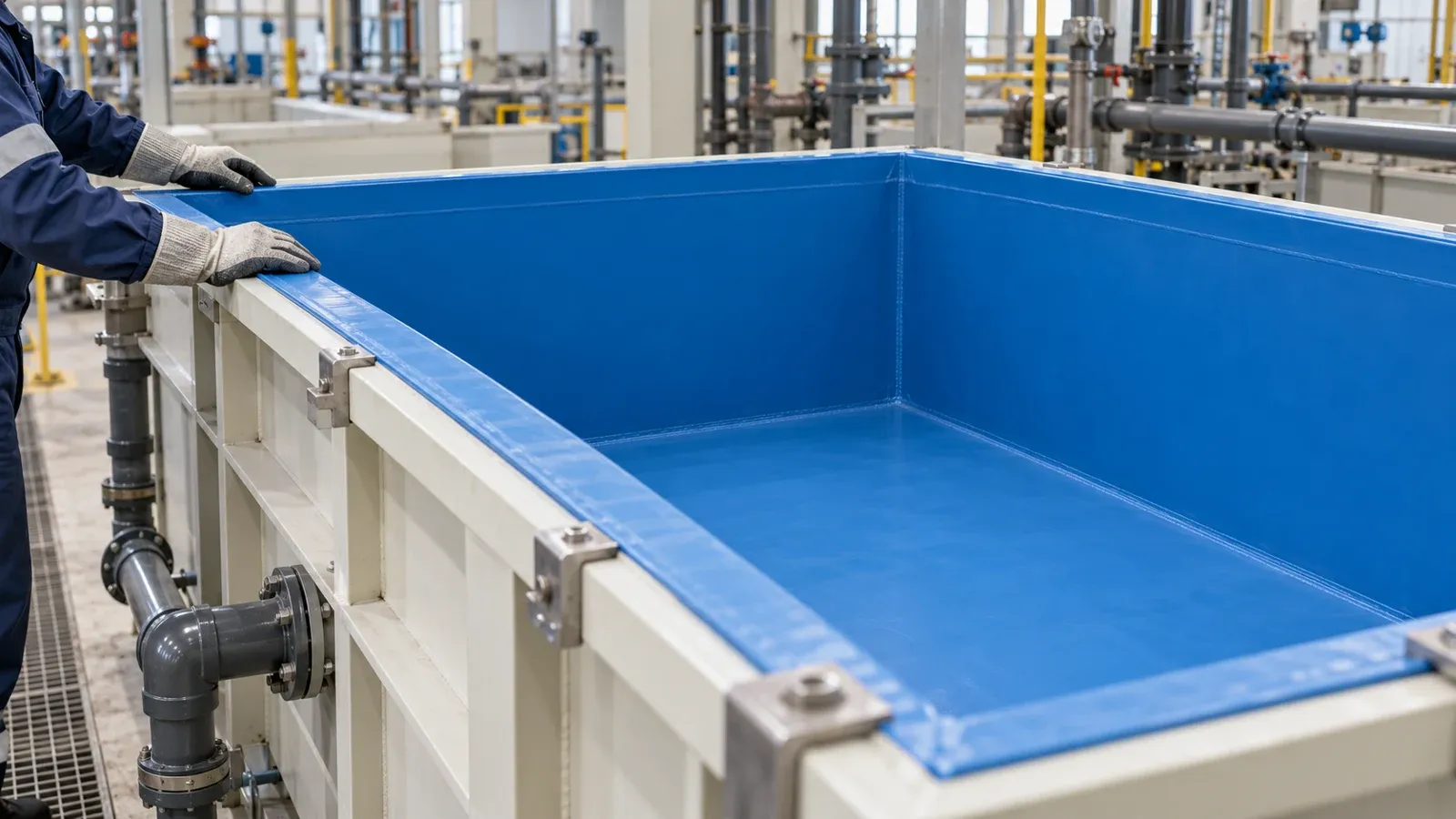
| Flexible drop-in sheet liner | Sheet grade, seams, retention, supports and connections | Complete bath/cleaning exposure review and a drawing showing fit and termination details | Access permits fitting/removal inside an assessed supporting shell; review penetrations and future repair access |
| Welded thermoplastic sheet lining | Polymer grade, weld details, expansion allowance and supporting shell | Fabrication procedure, representative joint evidence and the agreed inspection plan | Tank geometry and support permit the designed sheet/fitting joints, expansion allowance and inspection access |
| Bonded/cured lining | Compound, adhesive system, surface preparation and cure requirements | Compatibility basis plus preparation/cure and inspection records for the specified assembly | Shell condition allows specified preparation, bonding/cure and inspection within the planned work window |
A PVC, PP, PVDF or rubber name is not an interchangeable construction specification. Ask the fabricator to identify the complete system and document service restrictions. Do not transfer test results between different formulations, joints or support arrangements.
Does the plating tank liner provide structural support?
Distinguish a lining inside a supported vessel from a tank whose wall is itself a structural thermoplastic component. Specify the supporting shell, braces, foundation and operating liquid level. Include the weight and location of installed heaters, pipe connections and other attachments.
The lining and support need a common assessment. Do not order a new lining while assuming the existing shell remains acceptable. For a replacement, request inspection of the shell and connection areas before finalising the installation scope. Agree how unexpected damage found after draining will be documented and priced.
The U.S. OSHA dipping and coating provisions include tank construction requirements. Their relevance depends on the installation's jurisdiction and operation. The buyer's practical action is to name the responsible structural and installation reviewer in the project brief.
What belongs in a plating tank liner replacement enquiry?
Use a tank-by-tank schedule, even when several vessels appear identical. A rinse tank, cleaning tank and process tank can have different service conditions.
| Enquiry item | Information to provide | Decision it supports |
|---|---|---|
| Process duty | Bath identity, current datasheet and cleaning procedure | Compatibility assessment |
| Mechanical duty | Rack/anode contacts where present, loading path and abrasion/impact map | Protection, access and wear assessment |
| Operating conditions | Approved temperature range, liquid level and operating schedule | Material and construction review |
| Tank geometry | Internal dimensions, shell drawings and connection locations | Installation fit and usable space |
| Supporting structure | Shell condition, supports and mounted equipment | Responsibility for the complete assembly |
| Existing problems | Dated pictures, leakage location and repair history | Investigation of the failure mechanism |
| Installation boundary | Removal, disposal, shell repair, lining and reconnection | Comparable quotations |
| Inspection | Agreed inspection procedure, records and acceptance criteria | Handover before filling |
This is an editorial procurement checklist. It is not a compatibility certification or an engineering drawing. Missing conditions should be recorded as questions for assessment, rather than filled with a convenient assumption.
Should a damaged plating tank be relined, repaired or investigated?
Use observed condition to define the assessment scope. This is a purchasing triage aid, not permission to keep damaged equipment operating or to repair it without a qualified procedure.
| Observation to document | Assessment needed before ordering |
|---|---|
| Local damage with an identified handling incident | Condition of surrounding lining and shell; whether a qualified local repair and reinspection are appropriate |
| Repeated leakage, seam failure or widespread cracking/blistering | Failure history, exposure changes and the case for complete replacement or a different construction |
| Corroded/distorted shell or damaged connections | Structural and connection assessment; a new liner alone does not resolve the supporting-vessel problem |
| New bath, cleaning agent or operating temperature | Re-evaluate compatibility and the full service envelope before copying the old liner |
Photographs and repair history help locate a problem; they do not prove its cause. Ask the assessor to distinguish observed damage from unverified explanations in the offer.
A service record for each plating tank liner
Keep normal conditions, exceptional exposures and unknowns separate. Use one record per tank; attach the current datasheet rather than filling a gap from a generic compatibility chart.
| Field | Entry to obtain from plant records |
|---|---|
| Tank identity and duty | Tank number, process stage and responsible process contact |
| Chemistry | Bath identity, formulation/datasheet revision and approved concentration range |
| Thermal exposure | Normal, minimum and maximum operating temperatures; foreseeable excursions separately |
| Cleaning/empty periods | Cleaning agents, contact conditions, draining/empty exposure and approved procedures |
| Geometry | Internal dimensions, shell/support drawing, operating level and connection map |
| Mechanical contact | Loading path and located rack/anode/workpiece contact or abrasion zones |
| Existing condition | Dated photographs, leakage location, inspection and repair history |
| Unresolved items | State the missing evidence, responsible party and decision required before fabrication |
How should a plating tank relining shutdown be planned?
Agree who empties and isolates the tank, handles residues, removes the old lining and assesses the shell. Identify whether other tanks or common pipework will remain in operation. The contractor needs the site's access and isolation requirements before committing to a programme.
Ask for separate durations and dependencies for survey, fabrication/delivery, installation, cure where applicable, inspection hold points and restart. Record which work can occur before shutdown and the contingency for concealed shell damage.
Separate the planned installation work from repairs that can only be defined after inspection. Specify who authorises additional work, which records are required and what must happen before reconnecting services. Photograph the exposed shell and connection areas for the handover file.
Tank entry and work on used equipment need the site's established procedures and responsible specialists. Do not treat an empty process tank as ready for access or hot work. This article intentionally provides a purchase and responsibility checklist, not a tank-entry procedure.
What should be checked before restarting a relined plating tank?
Agree the acceptance plan before installation. It can identify dimensional checks, accessible joins and penetrations, the supplier's inspection method, reconnection checks and the records required before filling. The test method and pass limits must come from the approved construction specification.
Then plan restart with the process owner. Include the permitted filling sequence, observations to record and response to a suspected leak. Retain the installation records alongside the operating and cleaning limits. A successful installation inspection does not remove the need for routine checks in service.
For a wider line project, the equipment checklist helps assign tanks and support systems to the supply scope. The line quotation guide provides a common way to separate included items from site responsibilities.
Which plating tank liner handover documents should be supplied?
| Deliverable | Evidence to request | Responsibility to assign |
|---|---|---|
| Material and service limits | Material/compound identity, traceable supply records and approved chemical/temperature/cleaning envelope | Fabricator and process owner |
| Installed geometry and joints | As-built dimensions, penetration/termination map, joint procedure and relevant preparation/cure records | Installer and inspecting party |
| Integrity inspection | Agreed visual, joint or discontinuity method where applicable; instrument settings, coverage and results | Qualified executor under the approved construction specification |
| Controlled restart | Reconnection sign-off, authorised filling/restart plan and observations linked to the tank | Plant owner with the process specialist |
A holiday or spark-test setting cannot be copied generically across lining systems: applicability and settings belong to the approved method, material/thickness and substrate arrangement. Keep inspection evidence separate from any promised future service life.
Questions You May Have:
Can I specify the replacement by copying the old liner material?
Use the old specification as evidence, but confirm whether the chemistry, temperature or cleaning conditions have changed. Ask why the earlier liner failed before repeating its construction.
Should all tanks on the line have the same lining?
Only if the service assessment supports it. Prepare separate duty records so a shared material choice is a documented decision rather than a purchasing shortcut.
Can a liner quotation include repairs to the existing shell?
It can, if the condition is sufficiently known. Otherwise separate defined work from inspection-dependent repairs and agree the approval process for additional work.
What should I send if the tank drawings are missing?
Start with clear photographs, measured dimensions, connection locations, process duties and known repair history. Ask which survey is required before the construction can be confirmed.
Request a plating tank liner scope review
Use the project brief to describe the tank duty, the existing problem and the wider line project. Ask which equipment and installation responsibilities ES-PRO can assess. Put the tank-specific service record in Workpiece & project notes; the general workpiece fields are optional. Company, name, email and project country are required. Drawings and chemistry datasheets can follow at sales@electroplating-equipment.com; documents are optional for the first enquiry.