Plating Lines & Equipment
Selective Plating Brush Equipment
Selective plating (also called brush plating or swab plating) is the electroplating equivalent of a precision tool — it deposits metal on a defined area of a part without immersing the whole component
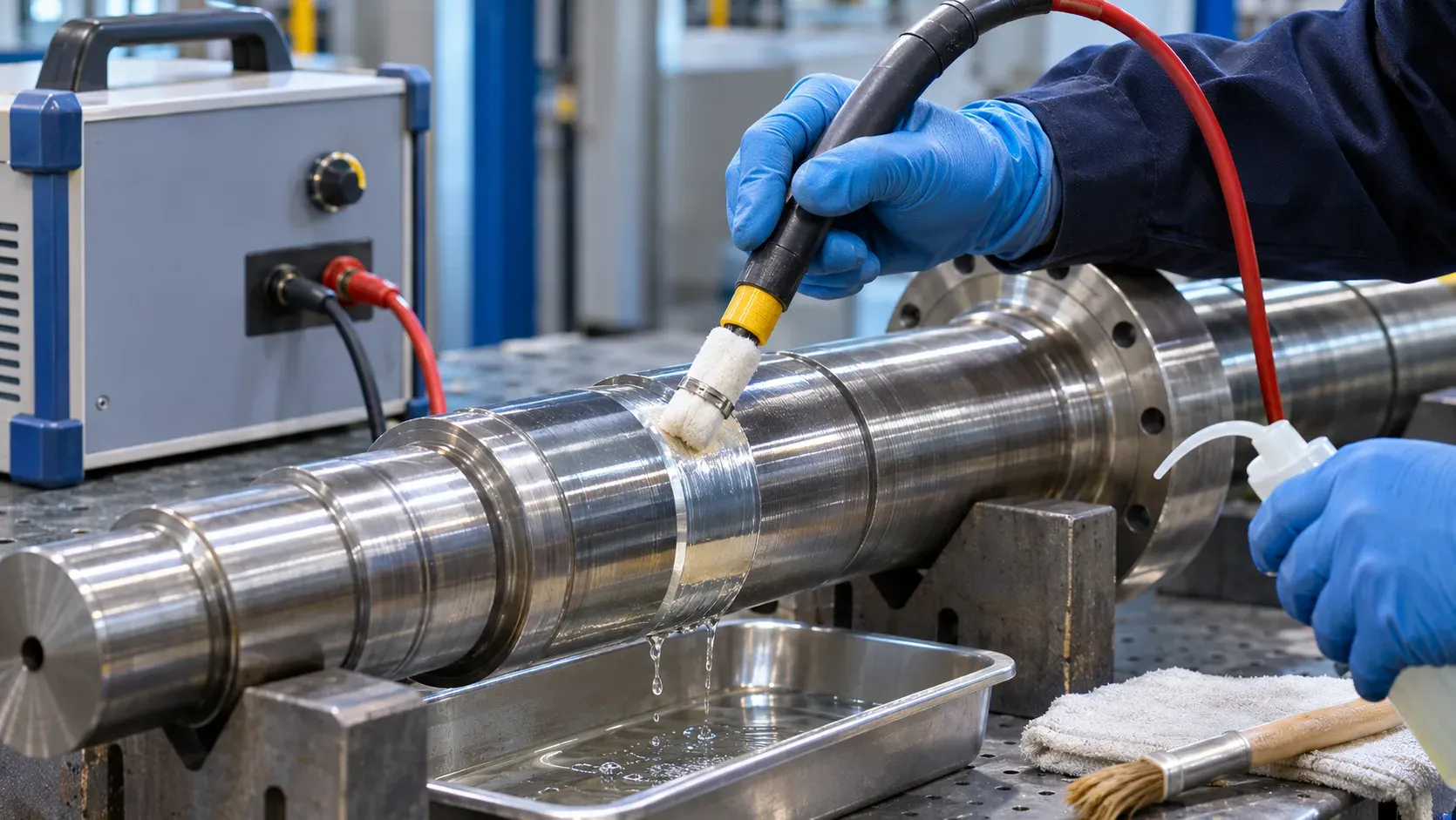
Selective plating (also called brush plating or swab plating) is the electroplating equivalent of a precision tool — it deposits metal on a defined area of a part without immersing the whole component in a tank. It is used for repair, dimensional restoration, localised corrosion protection and on-site plating where tank plating is impractical. This guide covers the equipment scope, the applications and the specification points.
Technical planning document — confirm chemistry parameters with your selective plating equipment supplier.
What selective plating does that tank plating cannot
Scenario | Why tank plating fails | Why selective plating works |
|---|---|---|
Repair a worn bearing journal on a machine that cannot be disassembled | The machine cannot be put in a tank | Portable equipment deposits metal on-site |
Restore a local dimension on a precision part | Tank plating coats the whole part — masked areas and tolerance risk | Only the worn area is plated, with precise thickness control |
Repair damage on a small area of a large component | Whole-part immersion wastes chemistry and time | Local treatment, minimal masking |
Field repair where no plating shop exists | No tank infrastructure available | Portable kit with everything in one case |
The equipment scope
Item | What to specify |
|---|---|
Power pack | Portable DC rectifier with current control, typically 5–100 A, with built-in ampere-hour counter for thickness control |
Stylus handles | Insulated handles with interchangeable anode styluses wrapped in absorbent material |
Anode styluses | Platinum-coated or graphite anodes in shapes matching the repair geometry: flat, cylindrical, internal, pointed |
Solution range | Pre-cleaner, activator, plating solutions (copper, nickel, chrome, zinc, cadmium, gold) — each with its own bottle and pump |
Absorbent wraps | Cotton, dacron and synthetic wraps that hold solution against the part and prevent anode-to-cathode shorting |
Masking materials | Tapes, plugs, lacquers for masking areas adjacent to the repair |
Accessories | Micrometer for thickness verification, beakers, brushes, PPE |
The process sequence
Selective plating follows the same chemistry sequence as tank plating — clean, activate, plate — but each step is applied manually with a stylus instead of by immersion:
- Electroclean. Use the cleaning solution with the stylus at cathodic polarity to remove surface soil.
- Activate. Use the activating solution to remove the oxide layer and prepare the surface for adhesion.
- Plate. Use the plating solution at reverse polarity to deposit metal. The ampere-hour counter controls thickness — solution chemistry determines the deposition rate per ampere-hour.
The deposition rate is much faster than tank plating (50–100 µm per pass is possible) because the current density at the stylus contact area is very high. The deposit quality is also different: brush-plated deposits are denser and harder than tank-plated deposits of the same chemistry because of the high current density.
Key takeaways
- Selective plating deposits metal on a defined area without tank immersion.
- The ampere-hour counter controls thickness — this is the primary process control.
- The equipment is portable: one case contains everything needed for on-site repair.
- The deposition rate is faster than tank plating because of the high local current density.
- The process sequence mirrors tank plating: clean, activate, plate — applied with a stylus.
Your next five steps
- Identify the repair scenarios in your operation where selective plating saves downtime or cost.
- Select the power pack size based on the repair area and required thickness.
- Obtain the solution range for the metals you need to deposit.
- Train operators on the process sequence and thickness control.
- Build a repair documentation routine for quality and traceability.
FAQ
How thick can we plate with selective plating?
Deposits up to 0.5 mm are possible with multiple passes. The practical limit depends on the geometry and the deposit quality requirement — thicker deposits may need machining after plating.
What metals can we deposit?
Copper, nickel, hard nickel, chrome, zinc, cadmium, gold, silver, tin and various alloys. Each metal has its own solution chemistry and deposition parameters.
Can we use selective plating on-site?
Yes — the equipment is portable and designed for on-site use. The power pack runs from mains power or a generator. Many repair shops carry a full kit for field service.
Image note: AI-generated editorial photography illustrates equipment or workpiece contexts; it is not an ES-PRO installation, customer reference or evidence of coating performance.