
Oct 4, 2026Plating Lines & Equipment
Barrel vs Rack Plating: How to Choose
Barrel and rack plating suit different part mixes. Compare cost, throughput, finish quality and line design — then pick the right line format.
Barrel plating tumbles small parts for bulk economics; rack plating fixtures each part for finish control. About a 7-minute read.
Most plants need both — the real decision is which format each product family runs on.
Written by Ivy Deng · Engineering reviewed by Eayon · Published 2 October 2026 · Updated 2 October 2026
How Each Format Works
Barrel plating loads parts into a barrel (perforated drum) that rotates in the process solution. Parts make intermittent electrical contact through the mass of parts and contact buttons inside the barrel. The barrel is the load carrier, the cathode connection and the mixing mechanism in one — which is why barrel plating is so economical for small parts, and also why delicate or tangling parts can suffer.
Rack plating fixes parts in a specific orientation on a conductive rack with contact points. Every part stays where the rack designer put it, so current density, drainage and appearance are engineered per part. Racks cost money to build and maintain, and loading is manual labour — the price of control.
Comparison Table
Aspect | Barrel plating | Rack plating |
|---|---|---|
Best for | Small, robust bulk parts (fasteners, stamps, small castings) | Larger, delicate, cosmetic or spec-critical parts |
Handling cost per part | Lowest — bulk loads | Higher — manual loading/unloading per part |
Finish consistency | Good, but part-on-part contact marks possible | Excellent — engineered presentation, no part-on-part contact |
Thickness control | Statistical across the load | Specifiable per location with shielding/thieving |
Risk profile | Tangling, nesting, part damage in the drum | Rack contact marks; rack maintenance cost |
Typical line format | Automatic barrel lines with hoist transport | Automatic rack lines (gate / side-arm hoist) |
Selection Rules That Hold Up in Practice
- Part geometry first. Parts that nest, tangle, or deform (springs, thin stampings, threaded small parts with finish requirements) push toward rack plating; robust bulk parts with modest finish requirements are barrel economics.
- Specification second. If a drawing specifies thickness at defined locations or a cosmetic class, rack plating is usually the only compliant answer — barrel loads are measured statistically.
- Volume decides the economics. High volume of tolerant small parts makes barrel plating's low handling cost decisive; low-to-medium volume of engineered parts amortizes rack cost.
- Mixed product families → both. A barrel line and a rack line side by side is the normal end state for a growing job-shop; trying to force one format onto the wrong parts shows up as rework and rejects.
How the Line Format Changes
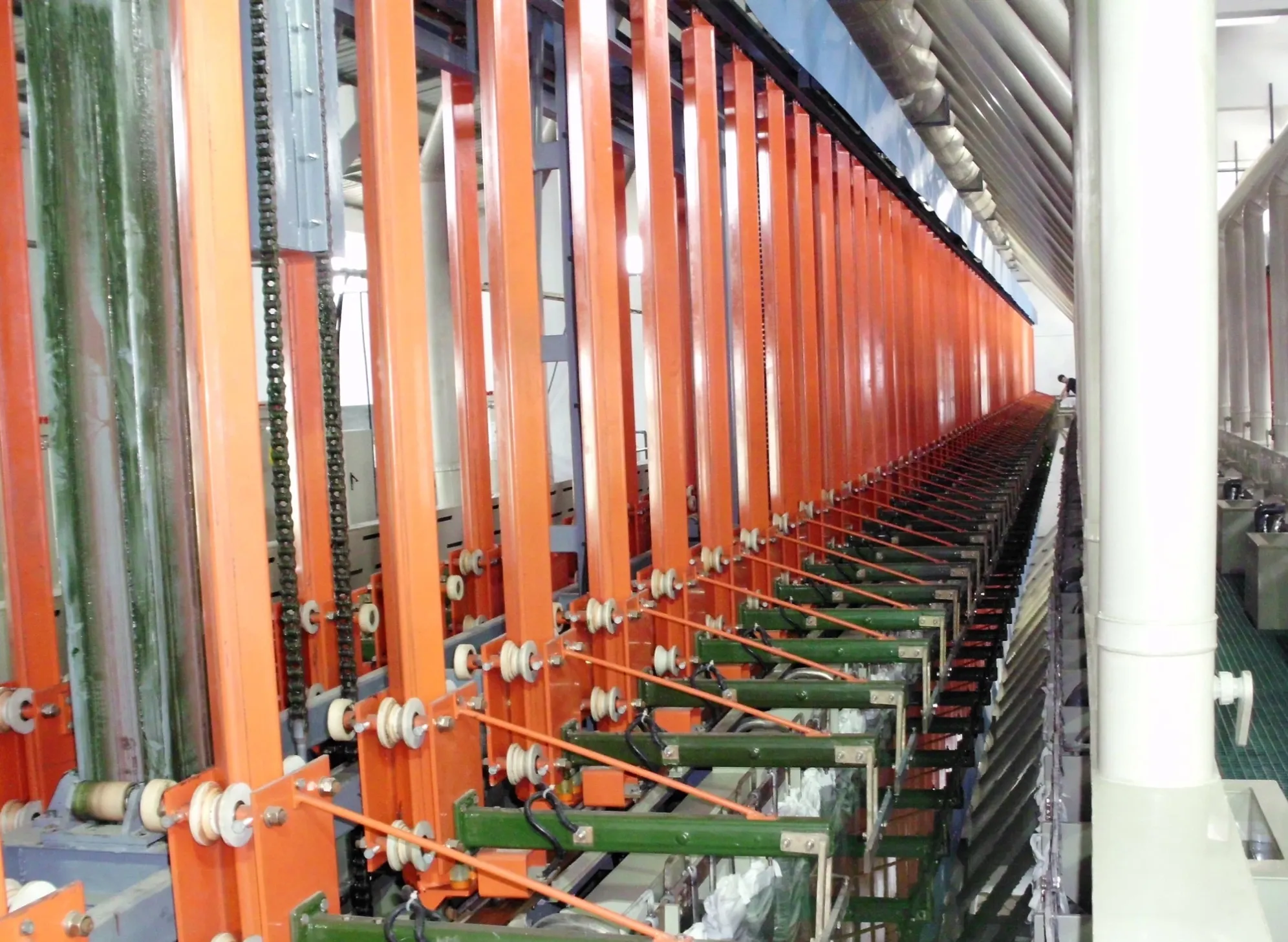
The tank chemistry may be identical, but everything around the tanks differs. Barrel lines transport drums with hoists or lift-and-shift mechanisms, size rectifier current for the whole drum load, and design rinse and drying stages around wet barrels. Rack lines move racks on gate or side-arm hoists, size current per rack, and invest in rack maintenance (stripping, recoating contact points).
Automation multiplies the difference: a manual line can start with either format, but automatic transport pays for itself first on the format your volume actually runs. The process sequence stays the same — the load carrier changes.
Standards and Evidence Boundary
- ISO 2080 — the shared vocabulary for barrel and rack plating terms across suppliers and audits.
- Drawing-specific coating specs (e.g., ASTM B633 for zinc on steel with its barrel/rack thickness classes) — thickness classes differ by format, and the spec governs.
- Your part mix — the decisive evidence is the actual part families, their specs and volumes, not generic tables.
Evidence boundary: this article gives selection guidance at industry-general level. Thickness classes, finish requirements and economics come from your drawings, volumes and the applicable standards — not from this page.
FAQ
Is barrel plating always cheaper?
Per part, for tolerant small parts at volume — usually yes, because bulk handling amortizes across thousands of pieces. For a low volume of engineered parts, rack plating can be cheaper overall once rework and rejects are counted.
Can the same parts run both ways?
Often yes — many fastener families run in barrels, and the same geometry can be racked when specs tighten. The line format follows the specification and the volume, not habit.
What parts should never go in a barrel?
Parts that nest or tangle, delicate threads and finished surfaces that cannot tolerate part-on-part contact, and very large or very flat parts that do not tumble. Those belong on racks.
Do barrel and rack lines share tanks?
Some plants run separate tank sets; others design shared pre-treatment and rinse sections with separate plating lines. The cleaner separation is at the plating stage, where current and load carriers differ — a line designer can lay out both options against your floor plan.
Related Reading
- Adjacent decision: Setting up a plating line — where barrel-vs-rack sits among the five decisions.
- Pillar guide: The Electroplating Process, Step by Step — the tank sequence both formats run.
- Next step: browse automatic plating lines to compare line formats for rack and barrel work.
Diagnostic CTA: What to Send Us — and What You Get Back
Send your part families through our RFQ form — geometry, size range, finish requirements and weekly volume per family. ES-PRO returns: a recommended barrel/rack split per family, a line configuration with tank sequence and automation level, a quotation, and an explicit list of open questions — we state what is missing rather than assuming it.
References & Authorities
- ISO 2080 — Electroplating and related processes: vocabulary — International Organization for Standardization (ISO).
- ASTM B633 — Electrodeposited coatings of zinc on iron and steel (barrel and rack thickness classes) — ASTM International.
- Industry associations — e.g., NASF (National Association for Surface Finishing, US) and IMF (Institute of Materials Finishing, UK) publish supplementary guidance and training for the surface-finishing industry.
Standards are cited for identification; always use the current edition from the issuing body. Process parameters are governed by the datasheets for the specific chemistry.