
Plating Process
Type I Chromic Acid Anodizing: Callout and Line Inputs
Type I chromic acid anodizing: where the thin chromic film is specified, how it differs from Types II and III, and the ventilation and effluent inputs.
# Type I Chromic Acid Anodizing: Callout and Line Inputs
ES-PRO editorial team �� Updated 27 October 2026
Type I is the thin-film member of the anodizing family: a chromic-acid electrolyte grows a thin oxide on aluminum that serves corrosion protection and paint adhesion while consuming very little of the part's dimensional budget. That thin-film character �� plus decades of aerospace qualification history �� is exactly why fatigue-conscious and closely toleranced parts still carry Type I callouts. It is also the anodizing route whose ventilation and effluent boundary is least negotiable.
What is Type I, and when is it called up?
The military anodizing framework (MIL-PRF-8625 family �� designation mentioned; the invoked edition governs) structures aluminum anodizing by electrolyte and film character: chromic-acid thin films, sulfuric films, and hard coats. On the ASTM side, B580 covers anodic oxide coatings on aluminum; its classes and verification are in the controlled edition.
Type I's niches follow from its film:
- Fatigue-conscious parts where a thicker oxide's dimensional and mechanical budget would be felt.
- Closely toleranced assemblies where the film must stay thin.
- Paint-base duty �� the thin film is an excellent bonding surface for coating systems.
- Legacy aerospace and defense callouts with long qualification histories attached to the part's requirement.
The environmental reality sits beside the technical one: hexavalent-chromium chemistry faces restriction, and aerospace work proceeds under specific exemptions and approved non-chromic alternatives within the framework. The requirement decides what a given part may carry.
What does a Type I line involve?
Element | Why it matters for Type I specifically |
|---|---|
Chromic electrolyte management | Bath control and analysis follow the validated route; the electrolyte is the process |
Fume ventilation and treatment | Chromic-acid mist is the first-order hazard; extraction and scrubbing are core scope, not options |
Effluent with hexavalent chromium | The waste stream's hexavalent chemistry drives treatment design |
Heated process tanks | The electrolyte runs heated, with level and temperature control |
Sealing stage | The callout's sealing requirement completes the coating; verify per the invoked edition |
Racking and contacts | Aluminum or titanium furniture with a deliberate contact strategy |
What belongs in the brief?
Input | What to provide | What the proposal should clarify |
|---|---|---|
Callout | Type I (and any variant the framework names), class, thickness expectation | What the invoked edition requires at each step |
Substrate | Alloy families, heat-treatment condition | Route parameters and etch allowance handling |
Duty | Paint base vs unpainted protection | Sealing and verification plan |
Fatigue/dimensional constraints | Where the thin film matters | Process confirmation approach |
Effluent boundary | Site's treatment capability | Hexavalent-chromium stream handling in scope |
Throughput | Parts per period | Tank fleet and handling format |
Where this does not fit
- Confusing Type I with Type II or III: the sulfuric routes are separate processes; our Type II guide covers that family.
- Treating it as decorative anodizing: Type I films are thin and service-driven, not appearance-driven.
- Assuming hexavalent chemistry is interchangeable with alternatives: approved non-chromic substitutes exist within the framework, and switching them is a qualification event.
- Reading this as bath control instruction: analysis and cycles belong to the validated route and the invoked edition.
Questions You May Have:
Is chromic acid anodizing still allowed?
It remains qualified for aerospace and defense callouts under specific regulatory provisions, while consumer-facing restrictions push other work to approved alternatives. The applicable requirement and the site's environmental permits decide what a line may run �� both belong in the brief.
Why not use Type II sulfuric anodizing instead?
Where the requirement allows it, sulfuric routes are cheaper and more common �� but the thin-film budget, fatigue considerations and existing qualifications keep Type I callouts alive on the parts they were written for. The design authority decides.
What does the class in a Type I callout mean?
The framework distinguishes painted from unpainted duty at the class level: the class pairs the coating with the verification and sealing expectations of its intended use. Read it from the invoked edition.
Does Type I need sealing?
Where the callout requires it, sealing is part of the coating �� and verification includes it. Unsealed and sealed variants verify differently; the invoked edition governs.
Technical references
- ASTM B580 �� Standard Specification for Anodic Oxide Coatings on Aluminum (ASTM catalogue). Classes and verification are in the controlled edition.
- MIL-PRF-8625 designation mentioned for the military framework; the contract-invoked edition governs all type and class requirements.
- Process and equipment practice description. Electrolyte management follows the process owner's validated route.
Get Proposal and Demo
Introduce your anodizing project with company, name, email and project country. Technical fields are optional. Describe the alloys, the Type I callout and your ventilation and effluent boundary when available, and ask which line scope the assessment recommends.
Details can follow by sales email, or chat on WhatsApp. The three-route finishing comparison places Type I among the aluminum finishing routes.
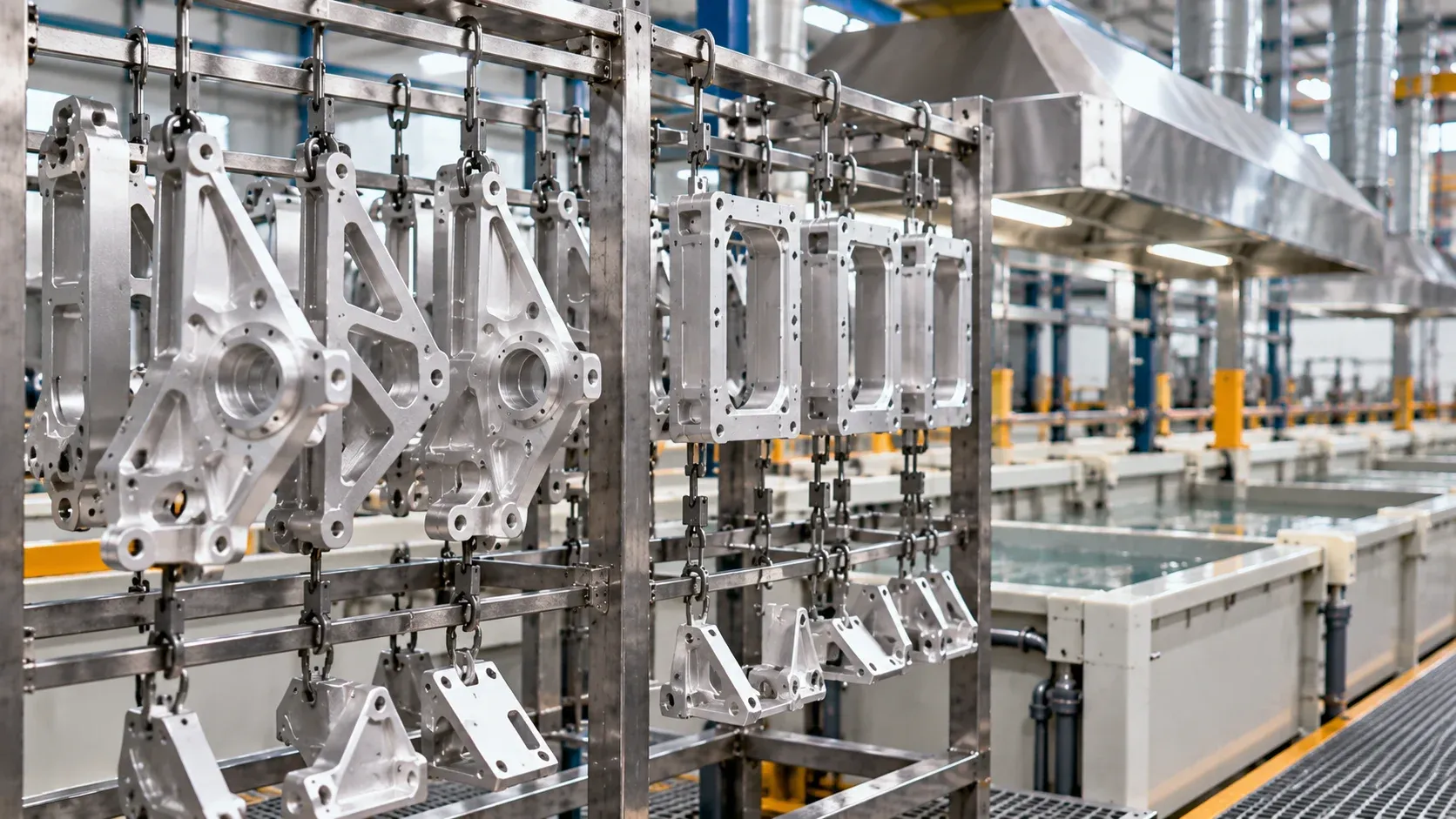
Image note: AI-assisted conceptual diagrams illustrate equipment or workpiece contexts; they are not an ES-PRO installation, customer reference or evidence of coating performance.


