Plating Process
Ultrasonic Cleaning Before Plating Equipment
Ultrasonic cleaning before electroplating is not an optional upgrade — for parts with blind holes, threaded features, complex geometry or oil contamination, it is the difference between a coating that

Ultrasonic cleaning before electroplating is not an optional upgrade — for parts with blind holes, threaded features, complex geometry or oil contamination, it is the difference between a coating that adheres and one that fails. This guide covers what ultrasonic cleaning does that spray and immersion cleaning cannot, and how to specify the equipment.
Planning document, not a process datasheet — confirm chemistry and frequency parameters with your supplier.
Why ultrasonic cleaning matters for plating
Conventional spray cleaning and immersion soaking remove gross soils from accessible surfaces. They cannot reliably remove machining oil from blind holes, lapping compound from threaded features, or polishing compound from recesses — and any residual soil becomes a coating failure point. Ultrasonic cavitation reaches these geometries: the microscopic bubbles collapse against every surface the liquid touches, dislodging soil by mechanical action rather than relying on chemical contact alone.
The consequence for plating: parts cleaned ultrasonically show fewer adhesion failures, fewer blisters and fewer pinholes than parts cleaned by spray or soak alone. The improvement is most dramatic on parts with internal features, threads and complex geometry.
Equipment specification
Parameter | What to specify | Why it matters |
|---|---|---|
Frequency | 25–40 kHz for gross cleaning; 40–80 kHz for fine cleaning before final plating | Lower frequency = more aggressive cavitation; higher = gentler, reaches finer features |
Power density | 10–25 W/L of tank volume (typically 6–12 kW for a production tank) | Too low = ineffective; too high = part erosion |
Tank material | 316L stainless steel with welded transducers on the underside or external immersible transducers | Must resist the cleaning chemistry temperature and concentration |
Heating | Thermostatic heater to 50–70°C — cavitation improves with temperature | Chemistry-specific; confirm the optimum with your detergent supplier |
Filtration | Continuous filtration of the cleaning solution to remove displaced soil | Extends bath life and prevents re-deposition |
Multi-stage | Soak → ultrasonic → ultrasonic → rinse → rinse (typical 5-stage line) | Each stage has a defined duty; single-stage cleaning cannot match a staged line |
Agitation | Mechanical part oscillation or solution circulation | Helps dislodge loosened soil from cavitation shadows |
Frequency selection: the most common mistake
Buyers often specify one frequency for all cleaning. This is the most common specification error. Low-frequency ultrasonics (25–28 kHz) produce larger, more energetic bubbles — they strip heavy soil but can erode soft substrates like aluminum or brass. High-frequency ultrasonics (60–80 kHz) produce smaller, denser bubbles — they reach finer features and are gentler, but they cannot strip heavy grease.
The correct specification for a plating line is usually a two-stage ultrasonic process: a lower-frequency stage for gross soil removal, followed by a higher-frequency stage for fine cleaning before the activation or plating stage. Single-tank, single-frequency systems compromise one duty to serve the other.
Key takeaways
- Ultrasonic cleaning removes soil from blind holes, threads and recesses that spray cleaning cannot reach.
- Two-stage frequency selection (low then high) outperforms single-frequency systems.
- Power density of 10–25 W/L is the working range — underpowered systems waste investment.
- A multi-stage line (soak → ultrasonic → ultrasonic → rinse) is the production-proven configuration.
- Continuous filtration extends bath life and prevents re-deposition of displaced soil.
Your next five steps
- Inventory the soil types on your parts: machining oil, polishing compound, lapping paste, oxide scale.
- Identify the difficult geometries: blind holes, threads, recesses, internal features.
- Select frequencies: low for gross, high for fine — or specify a two-stage system.
- Size the tank for your largest part plus fixture clearance.
- Confirm detergent chemistry compatibility with the ultrasonic parameters and the downstream plating chemistry.
FAQ
Can ultrasonic cleaning replace electrocleaning?
No — they do different things. Ultrasonic cleaning removes physical soil; electrocleaning removes the last molecular layer of oxide and soap by electrolytic gas scrubbing. A production line needs both: ultrasonic for gross soil, electrocleaning for the final activation.
What frequency for stainless steel medical parts?
40–80 kHz in a multi-stage system, with the final stage at the higher frequency. Medical applications may also specify additional ultrasonic passes after electropolishing.
How do we know the ultrasonic is working?
Aluminum foil test: immerse a small piece of aluminum foil for 10–30 seconds. Effective cavitation produces visible pitting. This simple test verifies power distribution across the tank.
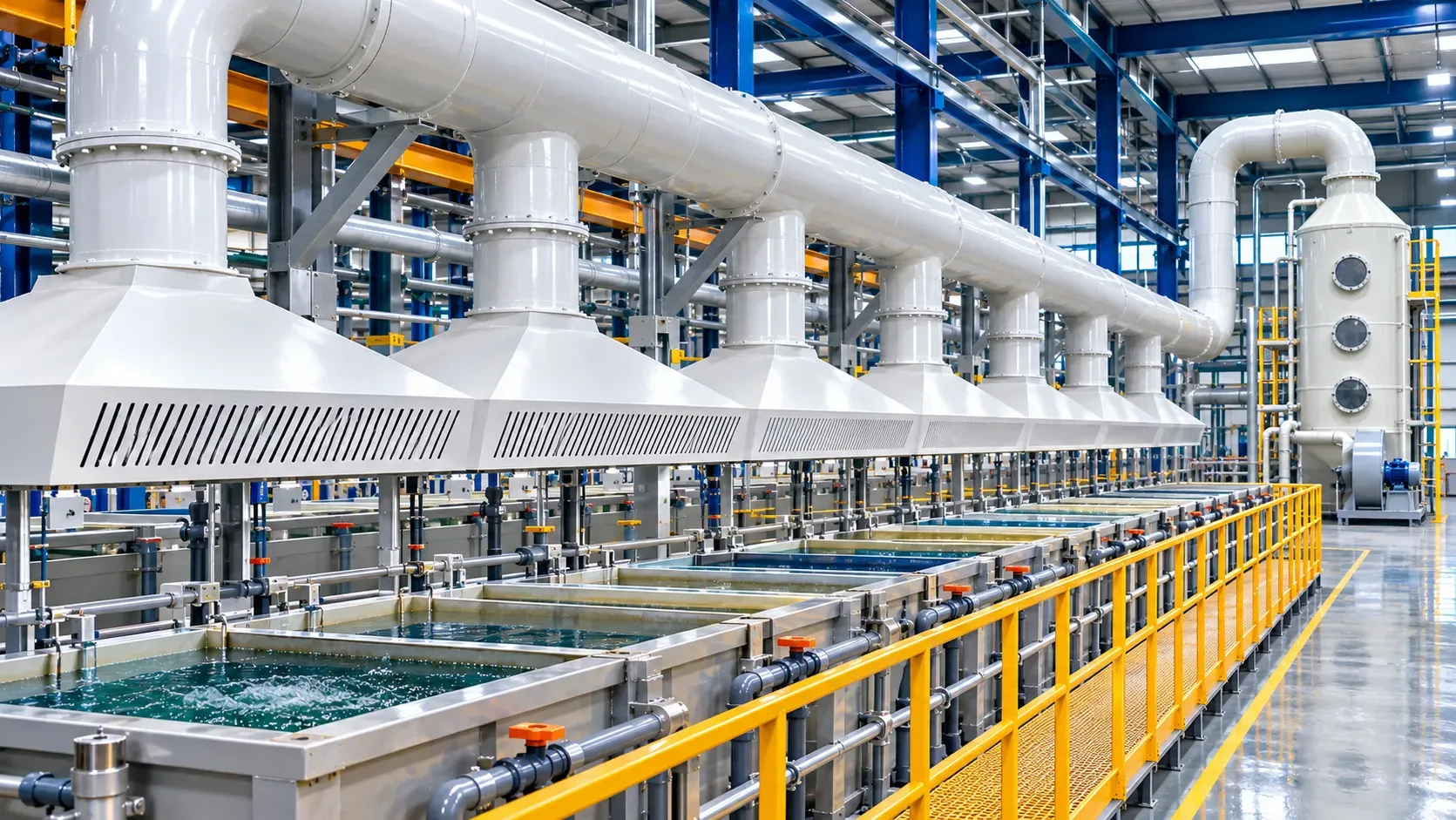
Image note: AI-generated editorial photography illustrates equipment or workpiece contexts; it is not an ES-PRO installation, customer reference or evidence of coating performance.