Plating Process
Salt Spray Corrosion Testing Equipment
Salt spray testing is the most widely cited corrosion test in plating specifications — and the most misunderstood. Buyers often ask for "1000 hours salt spray" without knowing which standard, which ap
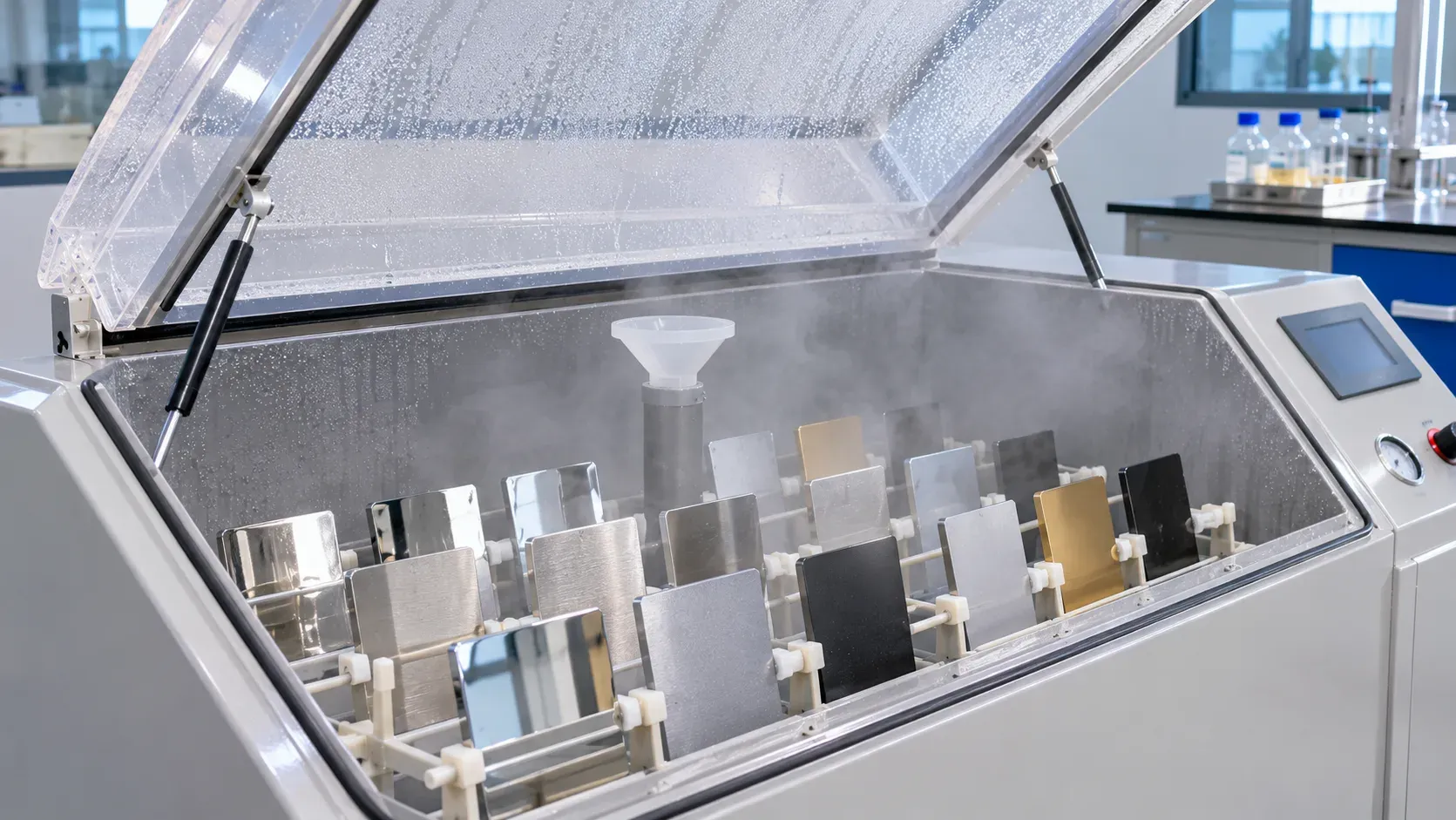
Salt spray testing is the most widely cited corrosion test in plating specifications — and the most misunderstood. Buyers often ask for "1000 hours salt spray" without knowing which standard, which apparatus, or what the result actually proves. This guide covers the test standards, the equipment to run them in-house, and what the results mean for your plating line.
Technical planning document — confirm test parameters against your customer specification and the relevant ISO/ASTM standard.
The standards that matter
Standard | Test type | What it measures |
|---|---|---|
ISO 9227 / ASTM B117 | Neutral Salt Spray (NSS) | General corrosion resistance under continuous 5% NaCl fog at 35°C |
ISO 9227 (AASS) | Acetic Acid Salt Spray | Faster corrosion for decorative coatings — modified pH |
ISO 9227 (CASS) | Copper-Accelerated Acetic Acid Salt Spray | Aggressive test for decorative nickel-chrome systems |
ISO 11476 / various | Cyclic corrosion tests | More realistic simulation: wet/dry/humidity cycles |
ASTM B117 is the most commonly referenced standard, but cyclic tests (such as ASTM D5894 or VDA 621-415) correlate better with real-world service for many applications. Your customer specification should state which standard and duration.
Salt spray chamber equipment specification
Item | What to specify |
|---|---|
Chamber volume | Sized for your part count — typical production chambers range from 270 L to 2000 L |
Atomisation | Pneumatic nozzle producing 1–2 mL of solution per 80 cm² per hour; fog must be uniform |
Solution reservoir | 5% NaCl in deionised water; pH 6.5–7.2 for NSS; monitored and topped up |
Temperature control | 35°C ± 2°C for NSS; chamber, solution reservoir and saturator all controlled |
Part positioning | 15–30° from vertical, non-overlapping; must not contact each other or the chamber |
Collection and verification | Collection funnels to verify fog rate and pH; daily verification records |
Air saturator | Humidifies compressed air at the nozzle — critical for fog uniformity |
Timer and data | Exposure timer, temperature logs and inspection records per standard |
Interpreting the results honestly
Salt spray hours are a comparative test, not a guarantee of service life. A part that passes 500 hours in a salt spray chamber will not necessarily survive 500 hours in a coastal environment — real service adds UV, rain, mechanical wear and pollution that the chamber does not simulate. Use the results to:
- Compare plating systems against each other under identical conditions
- Verify process consistency across production batches
- Demonstrate compliance with a customer specification that cites the standard
Do not use the results to promise service life — use service-environment testing for that.
In-house testing vs external laboratory
Factor | In-house chamber | External laboratory |
|---|---|---|
Response time | Same day — test as parts come off the line | Days to weeks for scheduling |
Cost per test | Low marginal cost after chamber investment | Per-test fee |
Chamber cost | €8,000–€25,000 depending on size and features | No capital investment |
Calibration | Your responsibility — annual verification | Accredited calibration included |
Best for | Production QC, process development, rapid feedback | Formal customer submissions, accreditation requirements |
Most production shops benefit from an in-house chamber for routine QC plus an external lab relationship for formal submissions.
Key takeaways
- Know which standard your specification cites — B117, CASS and cyclic tests give different results.
- Chamber size depends on your part count; fog uniformity is the quality-critical parameter.
- Salt spray hours compare coatings, not service life — use them comparatively.
- An in-house chamber gives rapid QC feedback; external labs handle formal submissions.
- Verify fog rate and pH daily — non-compliant fog invalidates the entire test.
Your next five steps
- Identify the test standard and duration your customers specify.
- Decide in-house vs external based on test frequency and volume.
- If in-house, size the chamber for your part count and specify fog verification.
- Train operators on part positioning and result evaluation.
- Build a routine that tests samples from each production batch.
FAQ
Is B117 the same as ISO 9227?
They describe the same neutral salt spray test but have minor procedural differences. Confirm which standard your customer specification cites — the results are comparable but not identical.
How long should we test?
The duration comes from your customer specification — common durations are 24, 48, 96, 240, 500 and 1000 hours depending on the coating system and application.
Can salt spray predict service life?
Not reliably. It is a comparative test under controlled conditions. Real service adds UV, thermal cycling, mechanical wear and pollution that the chamber does not simulate. Use it comparatively, not as a service-life guarantee.
Image note: AI-generated editorial photography illustrates equipment or workpiece contexts; it is not an ES-PRO installation, customer reference or evidence of coating performance.