
Oct 4, 2026Plating Process
Plating vs Anodizing vs Electropolishing
Three electrochemical surface treatments, three different results. See what plating, anodizing and electropolishing each change on a part — and how to choose.
All three are electrochemical, but they do different things: plating adds metal, anodizing grows oxide, electropolishing removes surface. The part's threat picks the method. About a 6-minute read.
Written by Ivy Deng · Engineering reviewed by Ben Yuan · Published 4 October 2026 · Updated 4 October 2026
These three treatments get compared constantly — usually because the names sound alike. They answer different problems, and the fastest way to choose is to ask what physically changes on the part.
Three Different Changes
Plating deposits a different metal onto the surface: zinc on steel for sacrificial corrosion, nickel for barrier and wear, tin for solderability, copper for underlayers. The substrate stays; a new metallic layer carries the function. Thickness classes are specified and measured — the core process is in what is electroplating.
Anodizing grows an oxide layer out of an aluminium (or titanium) surface: the part is the anode, the oxide builds from its own metal. The layer is hard, corrosion-resistant and can be dyed — but it is not a deposited metal, and it only forms on oxide-forming substrates.
Electropolishing removes metal electrochemically: the surface smooths and brightens as peaks dissolve, micro-roughness drops dramatically, and stainless gains a chromium-enriched passive layer. Nothing is added — the improvement comes from taking material away cleanly.
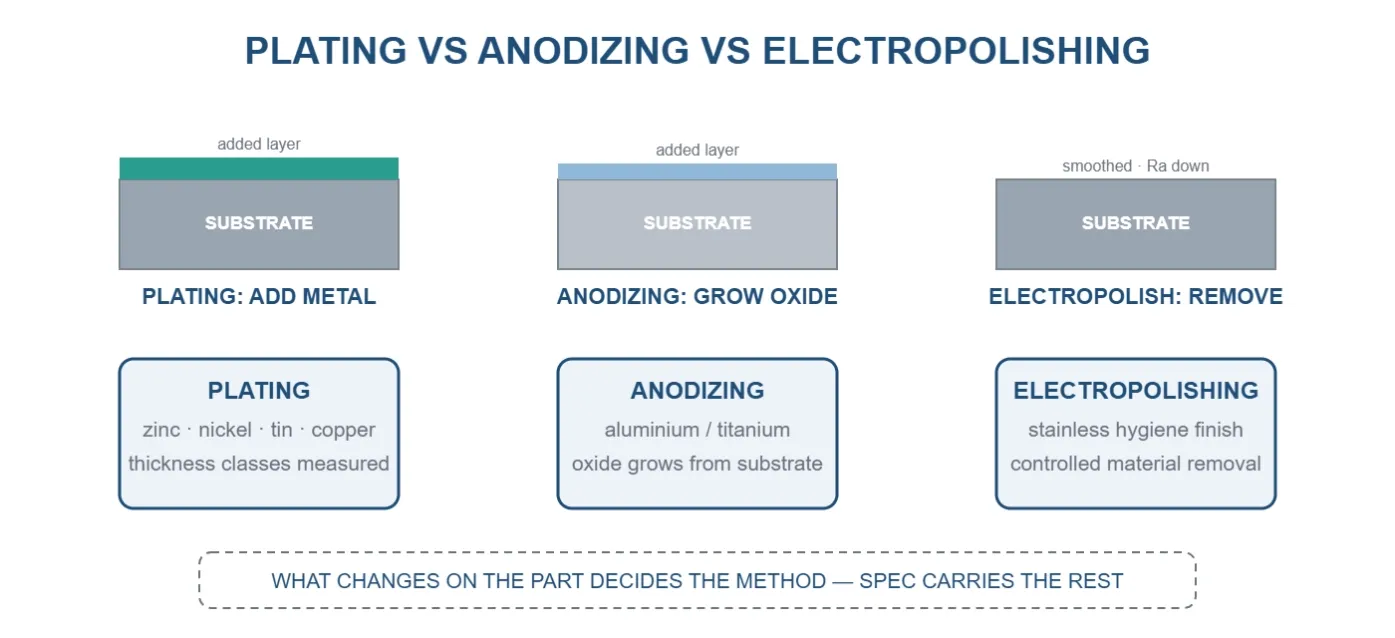
Comparison: Reference Table
Aspect | Plating | Anodizing | Electropolishing |
|---|---|---|---|
What changes | New metal layer added | Oxide grown from substrate | Surface removed and smoothed |
Typical substrate | Steel, brass, zinc die-cast, plateable plastics | Aluminium, titanium | Stainless steel (also others) |
Best at | Corrosion classes, solderability, build-up | Corrosion + hardness + color on Al | Cleanability, Ra reduction, passive finish |
Dimension effect | Grows by coating thickness | Grows by oxide (part dims half consumed) | Shrinks by removal (controlled) |
Masking needs | Standard rack/mask practice | Rack contact points | Fixture contacts |
Verification | Thickness (XRF/gauge), adhesion, salt spray | Oxide weight/thickness, seal quality | Ra before/after, passivation tests |
How to Choose
- Corrosion or solderability on steel/brass → plating (the coating spec carries the function)
- Aluminium corrosion, hardness, color → anodizing
- Stainless hygiene, cleanability, micro-roughness, passive finish → electropolishing (pharma/food/semiconductor classic; specified per standards such as ASTM B912 for electropolished stainless passivation)
- Stacked needs → they combine: electropolish then passivate; plate then passivate; anodize and seal. The surface treatment families overview shows where each sits.
Field Workflow: Route a Part in Five Questions
- ☐ Substrate — does it form oxide (Al/Ti) or need a deposited layer (steel/brass)?
- ☐ Function — corrosion class, wear, solder, hygiene, appearance?
- ☐ Tolerance budget — how much dimensional change can the part accept?
- ☐ Verification — which test does the buyer run?
- ☐ Line scope — which chemistry and water-treatment boundary follows?
Standards and Evidence Boundary
- ISO 2080 — electroplating and related processes: vocabulary.
- ASTM B912 — passivation of stainless steels using electropolishing — ASTM International.
- Coating specifications (e.g., ASTM B633 for zinc on steel) — the classes plating must hold.
Evidence boundary: this article compares treatments at industry-general level. Anodizing and electropolishing process parameters, and any acceptance criteria, come from the applicable standards and your customer specification — not from this page. Anodizing and electropolishing line scope is discussed for orientation; our build focus is plating and cleaning lines.
FAQ
Can you anodize steel?
No — anodizing is oxide growth on oxide-forming metals (aluminium, titanium). Steel gets conversion coatings or plating instead.
Does electropolishing replace passivation?
It usually includes a passive result — the chromium-enriched surface — and is often specified together with a passivation practice. The spec chain on the drawing decides.
Which adds the least dimension?
Electropolishing removes material (controlled thinning); anodizing grows about half its thickness above the original surface; plating adds its full thickness. For tight tolerances this table row is the decision.
Can one factory run all three?
They use different chemistries and ventilation; sharing pre-treatment and rinsing infrastructure is where integration pays. Layout comes from the part mix.
Related Reading
- Pillar guide: What Is Electroplating? — the deposited-layer family in depth.
- Overview: Surface Treatment Methods: An Overview — the whole map including paint and mechanical.
- Next step: browse plating lines for the electroplating side.
Diagnostic CTA: What to Send Us — and What You Get Back
Send three inputs through our RFQ form:
- Parts, substrates and the function the treatment must deliver
- The drawing's spec chain (coating class, Ra, passivation)
- Volume and current process status
ES-PRO returns: a treatment-route recommendation with the line configuration for the plating/cleaning scope, an equipment list, a quotation, and an explicit list of open questions — we state what is missing rather than assuming it.
References & Authorities
- ISO 2080 — Electroplating and related processes: vocabulary — International Organization for Standardization (ISO).
- ASTM B912 — Standard specification for passivation of stainless steels using electropolishing — ASTM International.
- ASTM B633 — Standard specification for electrodeposited coatings of zinc on iron and steel — ASTM International.
- Chemistry supplier datasheets — bath systems and operating windows for the specific chemistry (issued by the chemistry supplier).
- Industry associations — e.g., NASF (National Association for Surface Finishing, US) and IMF (Institute of Materials Finishing, UK) publish supplementary guidance and training for the surface-finishing industry.
- Standards are cited for identification; always use the current edition from the issuing body. Process parameters are governed by the datasheets for the specific chemistry.