
Oct 4, 2026Plating Process
Steel Plating: Types and When Each Is Used
Steel is the most plated substrate. See the main coating types — zinc, nickel, tin, copper and chrome — and when each one earns its place on a line.
Steel is the most-plated substrate in industry: zinc for corrosion, nickel for barrier and wear, tin for solderability, copper for underlayers, chromium for hard surfaces. About a 6-minute read.
Written by Jason Han · Engineering reviewed by Eayon · Published 4 October 2026 · Updated 4 October 2026
"Steel plating" means electroplating a coating onto steel parts — the steel is the substrate, the plated metal is the working surface. This article maps the main coating choices to the threats they solve, so a coating decision starts from the part's job rather than from a catalogue.
Choose by the Threat
Steel fails four ways in service: it corrodes, it wears, it solder poorly, and it looks unfinished. Each mainstream coating answers a different threat:
- Corrosion → zinc (sacrificial: corrodes instead of the steel), with passivate for multiplied life
- Barrier + wear → nickel (dense, corrosion-resistant deposit; engineering nickel for build-up and wear)
- Solderability/conductivity → tin (electronics, bus bars, wire termination)
- Leveling/adhesion bridge → copper (the ductile underlayer beneath nickel and chrome; also a strike on difficult substrates)
- Hard/hard-wearing surfaces → chromium (hard chrome for wear, decorative chrome over nickel for finish)
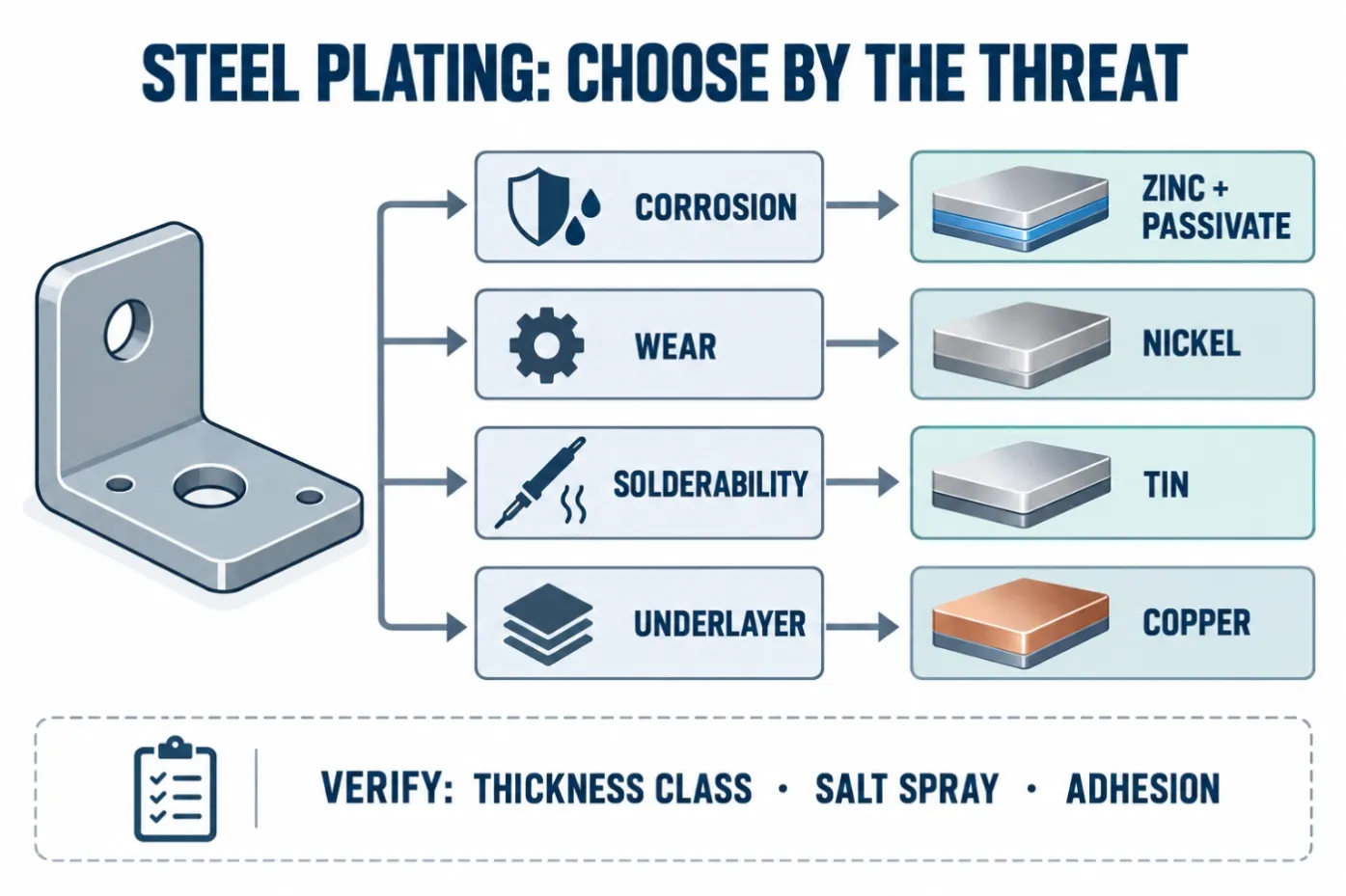
Coating Types: Reference Table
Coating | Primary job on steel | Typical thickness class logic | Watch-outs |
|---|---|---|---|
Zinc (+ passivate) | Sacrificial corrosion protection | Classes by service condition — mild to severe | Hydrogen embrittlement on high-strength steel; bake after plating |
Nickel (electrolytic) | Barrier corrosion, wear, build-up | Engineering grades by use | Deposit brightness ≠ corrosion life; ductility matters |
Tin | Solderability, conductivity, food-safe surface | Classes by service environment | Whisker management on electronics; matte vs bright deposit |
Copper | Underlayer, leveling, heat-transfer surfaces | Underlayer thickness per stack spec | Locks in surface defects if pre-treatment is poor |
Chromium (hard) | Wear, low friction, dimensional repair | By wear requirement | Process is demanding: etched steel needs clean activation |
The Line Perspective
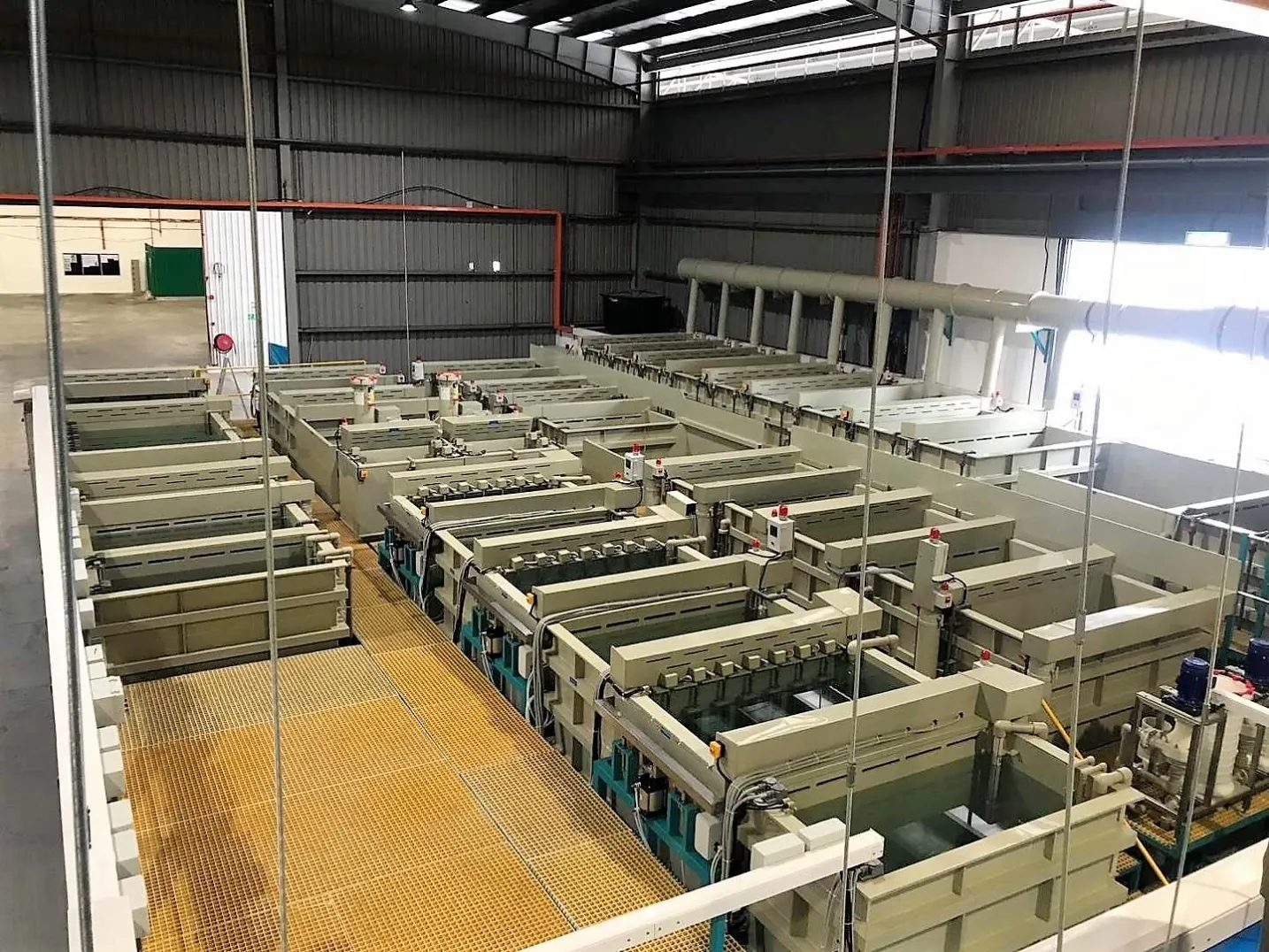
Whatever the coating, a steel plating line runs the same discipline: pre-treatment that actually removes oil and oxide, an activation step immediately before plating, the plating cell with controlled current, counterflow rinsing, and post-treatment (passivate for zinc, bake for high-strength steel, anti-tarnish where needed). What changes between coatings is the chemistry system, the temperature window and the current-density range — the plating line tank sequence adapts around them. The fundamentals live in what is electroplating; the corrosion workhorse gets its own treatment in zinc plating.
Field Workflow: Pick the Coating in Five Questions
- ☐ What attacks the part — road salt, chemicals, moisture, heat?
- ☐ What contact happens — fasteners against dissimilar metals? sliding wear? soldering?
- ☐ What does the drawing call out — a coating class or a performance test?
- ☐ What is the substrate condition — high-strength steel (embrittlement risk) or free-machining?
- ☐ What volume and format — barrel for bulk hardware, rack for engineered parts?
Five honest answers usually point to one coating system — and to the thickness class the line must hold.
Standards and Evidence Boundary
- ASTM B633 — electrodeposited zinc coatings on iron and steel; thickness classes by service condition.
- ISO 19598 — the ISO counterpart for zinc and zinc-alloy coatings with supplementary treatment.
- ASTM B689 — electrodeposited engineering nickel coatings.
- ASTM B545 — electrodeposited tin coatings.
Evidence boundary: this article compares coatings at industry-general level. The coating class, embrittlement relief and acceptance tests come from your drawing and the applicable standard — not from this page.
FAQ
Is zinc always the answer for rust?
For atmospheric corrosion on standard steel parts, usually yes — it is sacrificial and economical. Chemical exposure, high heat or food/water contact change the answer: nickel systems or stainless substrates enter the conversation.
Why bake high-strength steel parts after zinc plating?
Plating can drive hydrogen into high-hardness steel; a post-plate bake diffuses it out before it cracks the part. The drawing's strength class decides whether baking is mandatory.
Can one line plate several of these coatings?
Yes within chemistry families — many shops run zinc and zinc-alloy systems on one line design, or nickel systems for different uses. Chromium and tin need their own chemistry windows. Line design starts from the coating list you actually run.
What is the thinnest coating that still protects?
The service-condition class in the coating spec decides — that is exactly what the classes encode. Thinner than class is a specification miss even if the part "looks fine".
Related Reading
- Pillar guide: What Is Electroplating? — the process behind every coating above.
- Adjacent decision: Barrel vs Rack Plating: How to Choose — the format decision for steel part mixes.
- Next step: browse plating lines to match a line to your coating list.
Diagnostic CTA: What to Send Us — and What You Get Back
If you are choosing or spec-ing a coating for steel parts, send three inputs through our RFQ form:
- The part families and the service environment they face
- The drawing's coating classes — or the performance target if the spec is open
- Volume, part size and format (barrel/rack)
ES-PRO returns: a recommended coating system with the line configuration to hold it, an equipment list, a quotation, and an explicit list of open questions — we state what is missing rather than assuming it.
References & Authorities
- ASTM B633 — Standard specification for electrodeposited coatings of zinc on iron and steel — ASTM International.
- ISO 19598 — Electroplated coatings of zinc and zinc alloys on iron or steel — International Organization for Standardization (ISO).
- ASTM B689 — Standard specification for electrodeposited engineering nickel coatings — ASTM International.
- ASTM B545 — Standard specification for electrodeposited coatings of tin — ASTM International.
- Chemistry supplier datasheets — bath systems, concentrations and operating windows for specific plating chemistries (issued by the chemistry supplier).
- Industry associations — e.g., NASF (National Association for Surface Finishing, US) and IMF (Institute of Materials Finishing, UK) publish supplementary guidance and training for the surface-finishing industry.
- Standards are cited for identification; always use the current edition from the issuing body. Process parameters are governed by the datasheets for the specific chemistry.