
Oct 4, 2026Plating Process
Metal Finishing: The Complete Guide
Metal finishing covers cleaning, plating, conversion and verification. See how the pieces fit, what each does, and how a line turns them into output.
Metal finishing is every process that cleans, coats, converts or verifies a metal surface — and a line is simply those processes in the right order. About a 7-minute read.
Written by Nick Wong · Engineering reviewed by Li Wang · Published 4 October 2026 · Updated 4 October 2026
Buyers meet "metal finishing" as a catalogue of process names. Engineers meet it as a sequence: clean the surface, change it or cover it, rinse, dry, verify. This guide is the map between those two views — what each family does, where it belongs in a line, and which deeper guides to read next.
The Map
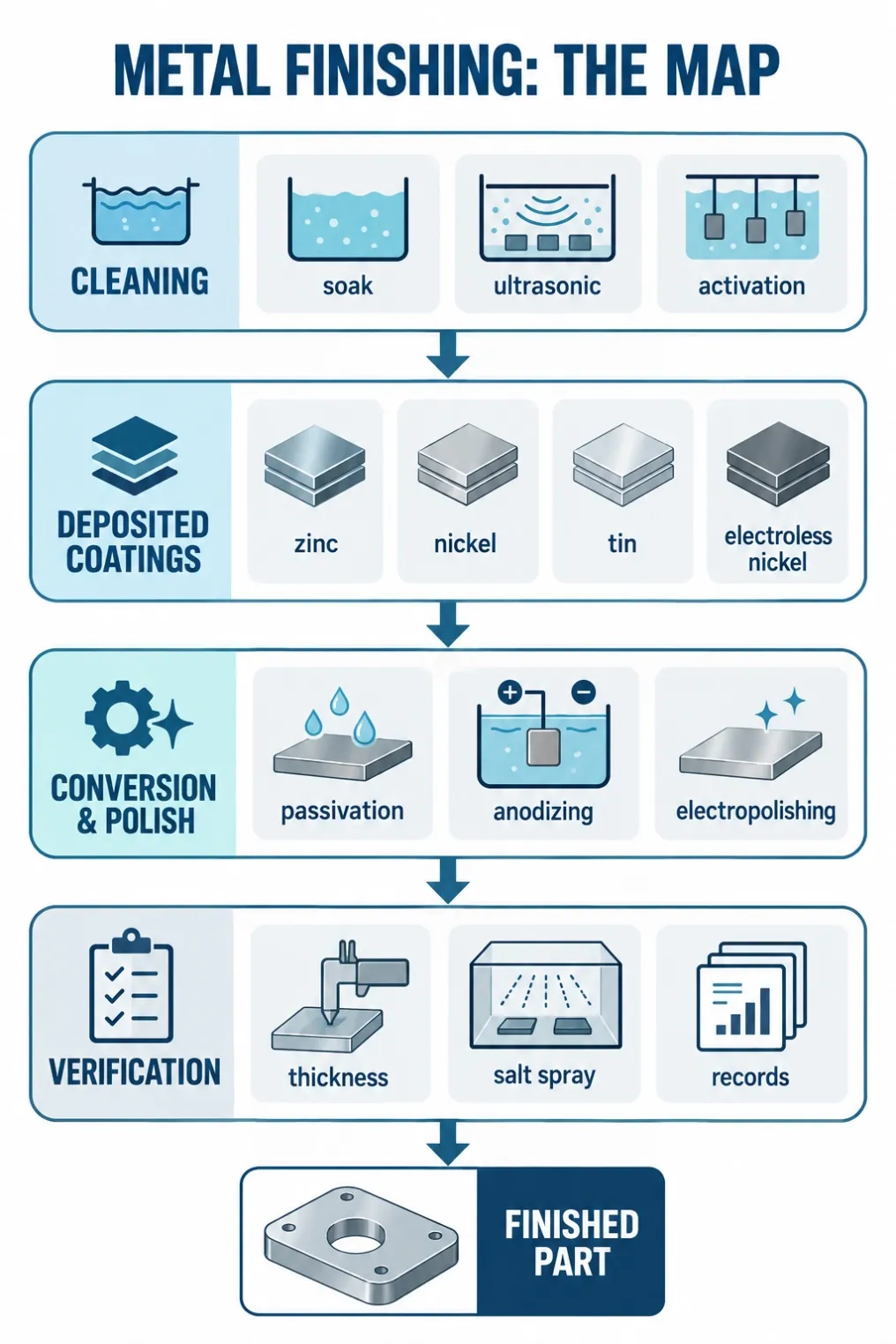
Four families cover almost everything a metal part meets before assembly:
- Cleaning and pre-treatment — soak, ultrasonic and electrolytic degreasing, acid pickling, activation. Nothing downstream survives bad pre-treatment.
- Deposited coatings — electroplating (zinc, nickel, tin, copper, chromium, precious metals) and autocatalytic/electroless deposition (electroless nickel), where chemistry, not current, drives the deposit.
- Conversion and related treatments — passivation of stainless, trivalent passivates on zinc, anodizing on aluminium, electropolishing for smooth passive surfaces.
- Verification — thickness (XRF, eddy/magnetic), adhesion, salt-spray and the records that prove it.
What Each Family Decides
- Cleaning decides adhesion. The majority of coating failures trace back to residue the eye cannot see — which is why ultrasonic cleaning, with cavitation reaching blind holes and joints, is the industrial default for demanding parts. The physics are in how ultrasonic cleaning works.
- Deposition decides function. Corrosion (zinc), barrier and wear (nickel), solderability (tin), conductivity (copper, precious metals). The core process is in what is electroplating.
- Conversion decides stability. Passivates and anodizing build protective layers from the substrate itself — thin, but decisive for stain and corrosion start.
- Verification decides trust. Classes and tests exist so the buyer does not have to trust appearances.
What a Line Actually Includes
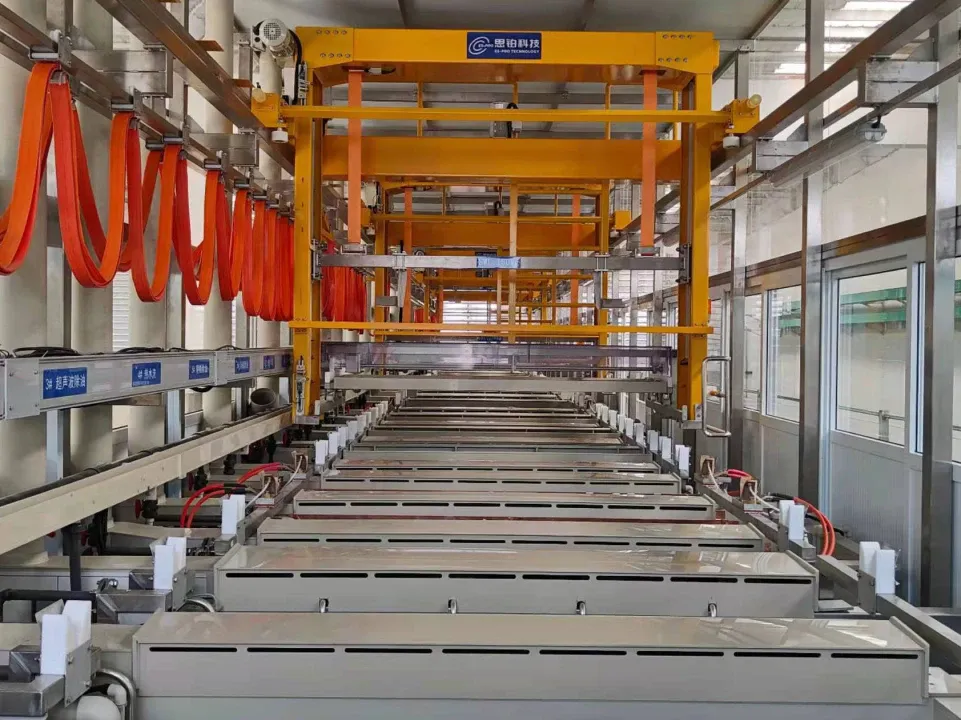
A production finishing line chains the families into one flow: pre-treatment tanks (soak/ultrasonic/electrolytic), plating cells with rectifiers and filtration, post-treatment dips, multi-stage counterflow rinsing, dryers — plus the water and air side (DI water systems, wastewater treatment, fume scrubbers) and the handling and control side (racks/barrels, hoists, PLC recipes). Automation level follows volume and mix: manual for labs and high-mix, automatic hoist lines for stable volume. The equipment view is in plating lines.
Field Workflow: Map Any Part to a Finishing Route
- ☐ Substrate — steel, aluminium, brass, plastic (plateable), zinc die-cast?
- ☐ Threat — corrosion, wear, solderability, appearance, cleanliness spec?
- ☐ Coating candidate — which family from the map answers the threat?
- ☐ Spec — which coating standard and thickness class applies?
- ☐ Volume/mix — which automation level keeps takt and consistency?
- ☐ Boundary — what wastewater and fume scope does the chemistry imply?
Six answers produce a route — and a line concept.
Standards and Evidence Boundary
- ISO 2080 — electroplating and related processes: vocabulary; the shared language across suppliers and audits.
- ASTM B633 — electrodeposited zinc on iron and steel; the model for thickness-class specifications.
- US EPA Metal Finishing Effluent Guidelines (40 CFR Part 433) — the regulatory reference for finishing discharge; the template local permits build on.
Evidence boundary: this guide states industry-general facts and maps. Process parameters, acceptance criteria and chemistry windows come from the applicable standards and chemistry supplier datasheets — not from this page.
FAQ
Is anodizing a type of electroplating?
No — anodizing grows an oxide layer from the aluminium itself; plating deposits a different metal on top. Both are electrochemically driven surface treatments, which is why they sit on the same map but in different families.
What is the difference between electroplating and electroless nickel?
Electroplating needs external current; electroless nickel deposits chemically, giving uniform thickness on complex geometry. The trade-offs (cost, phosphorus grade, deposit properties) decide which fits.
Why so many rinse tanks?
Counterflow rinsing multiplies dilution while reusing water: it protects downstream baths, delivers spot-free surfaces and cuts water and wastewater volumes at once.
Where does wastewater fit?
Inside the line, permanently — rinse water and spent baths are treated before discharge. Permits usually require the treatment plan before the line is approved.
Related Reading
- Pillar guide: What Is Electroplating? — the deposition family in depth.
- Cleaning family: How Does an Ultrasonic Cleaner Work? — cavitation cleaning explained.
- Next step: browse plating lines and peripheral equipment to see the families as machines.
Diagnostic CTA: What to Send Us — and What You Get Back
Send three inputs through our RFQ form:
- The parts and substrate families you need to finish
- The threats or specs that drive the finishing requirement
- Throughput and current line status (if any)
ES-PRO returns: a finishing route proposal mapped to the families above, a line configuration with equipment list, a quotation, and an explicit list of open questions — we state what is missing rather than assuming it.
References & Authorities
- ISO 2080 — Electroplating and related processes: vocabulary — International Organization for Standardization (ISO).
- ASTM B633 — Standard specification for electrodeposited coatings of zinc on iron and steel — ASTM International.
- US EPA Metal Finishing Effluent Guidelines (40 CFR Part 433) — United States Environmental Protection Agency (EPA).
- Chemistry supplier datasheets — bath systems, concentrations and operating windows for specific chemistries (issued by the chemistry supplier).
- Industry associations — e.g., NASF (National Association for Surface Finishing, US) and IMF (Institute of Materials Finishing, UK) publish supplementary guidance and training for the surface-finishing industry.
- Standards are cited for identification; always use the current edition from the issuing body. Process parameters are governed by the datasheets for the specific chemistry.