
Oct 4, 2026Plating Process
Surface Treatment Methods: An Overview
Paint, plating, anodizing, passivation, PVD and more — see the main surface treatment families, what each costs to run, and how to choose between them.
Every surface treatment delivers protection or function by one of four routes — solution, vapor, paint or mechanical. Pick the route first, the process second. About a 6-minute read.
Written by Mia Shang · Engineering reviewed by Li Wang · Published 4 October 2026 · Updated 4 October 2026
"Surface treatment" spans dozens of process names, but they organize into a few families by how the treatment reaches the part. That structure is the fastest way for a buyer to compare options honestly — including the option of doing less.
The Families
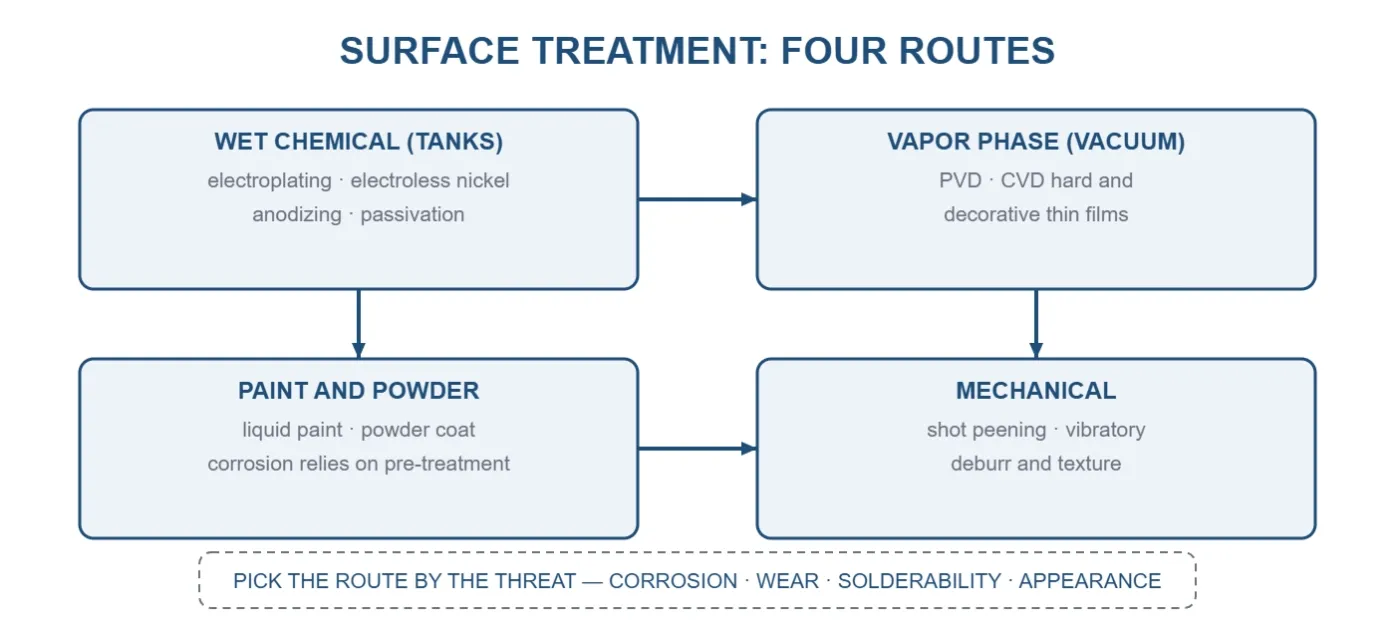
- Wet chemical (solution-based) — electroplating (zinc, nickel, tin, copper, chromium, precious metals), electroless nickel, conversion coatings (passivation, phosphating), anodizing. The coating forms in a tank; thickness and alloy are tunable; the line needs rinsing and water treatment.
- Vapor phase — PVD/CVD hard and decorative coatings. Excellent hardness and thin, precise layers; batch-vacuum economics suit high-value parts more than bulk hardware.
- Paint and powder — organic barriers with color freedom; corrosion performance depends on pretreatment (often plating or conversion beneath).
- Mechanical — shot peening (compressive stress), tumbling/vibratory finishing (deburr, polish). They change the surface without adding a coating layer — and often precede the coating steps.
What Each Family Is Good At
Family | Best at | Limits to plan around |
|---|---|---|
Wet chemical / plating | Corrosion classes, solderability, build-up, conductive layers | Line + water treatment footprint; chemistry windows |
Vapor phase (PVD/CVD) | Hardness, wear, thin decorative layers | Vacuum batch economics; part size inside chamber |
Paint / powder | Color, UV stability, large parts | Corrosion relies on the pre-treatment beneath |
Mechanical | Fatigue life, deburr, surface texture | No corrosion barrier by itself |
How to Choose
Choose by the threat and the verification the buyer will apply:
- Corrosion class on steel hardware → zinc system (plating) with passivate, verified by thickness and salt spray
- Wear + hardness on a precision part → hard chrome (plating) or PVD depending on geometry and volume economics
- Solderability/conductivity → tin or silver/gold plating (plating family)
- Aluminium corrosion + appearance → anodizing (conversion family)
- Cleanliness as the spec (medical, precision assembly) → ultrasonic cleaning lines — treatment without a layer
Where the choice lands in the plating family, the equipment conversation starts in what is electroplating and becomes concrete in how to set up a metal plating line. The full equipment range is under plating and cleaning equipment.
Field Workflow: Specify a Treatment in Five Lines
- ☐ Threat: corrosion / wear / solder / appearance / cleanliness
- ☐ Substrate: steel / aluminium / brass / zinc die-cast / plastic
- ☐ Verification: which class or test will the buyer run?
- ☐ Volume & geometry: bulk barrel parts or rack-sensitive precision?
- ☐ Environment boundary: wastewater and fume scope implied by the chemistry
Standards and Evidence Boundary
- ISO 2080 — electroplating and related processes: vocabulary — the shared naming that keeps quotations comparable.
- Coating specifications (ASTM B633 for zinc, ASTM B545 for tin and so on) — the classes each treatment must hold.
Evidence boundary: this overview compares families at industry-general level. Process selection for a specific part comes from the drawing, the applicable standard and the chemistry supplier — not from this page; PVD/CVD and paint systems are discussed for orientation only.
FAQ
Is plating better than painting?
They answer different threats: plating gives metallic corrosion classes, conductivity and solderability; paint gives color and UV stability at low per-part cost on large surfaces. Many demanding parts use plating beneath paint for the best of both.
Which treatment adds the least thickness?
Conversion treatments (passivation) add fractions of a micrometre; PVD layers run in micrometres; plating classes typically start around 5 µm and rise. "Least" should follow the spec, not the fashion.
Do I still need cleaning if I plate?
Cleaning is not optional — it is the first tank of every plating line. No coating survives poor pre-treatment.
What about combined lines?
Common: ultrasonic washing → plating → passivation → rinse → dry is one integrated flow. Design the line around the whole route, not tank by tank.
Related Reading
- Pillar guide: What Is Electroplating? — the deepest family on the map.
- Planning: How to Set Up a Metal Plating Line — from treatment choice to equipment list.
- Next step: browse plating and cleaning equipment by category.
Diagnostic CTA: What to Send Us — and What You Get Back
Send three inputs through our RFQ form:
- The parts, substrate and the threat that started your search
- Any coating spec or class the customer applies
- Throughput, part sizes and site constraints
ES-PRO returns: a recommended treatment route with the line configuration to run it, an equipment list, a quotation, and an explicit list of open questions — we state what is missing rather than assuming it.
References & Authorities
- ISO 2080 — Electroplating and related processes: vocabulary — International Organization for Standardization (ISO).
- ASTM B633 — Standard specification for electrodeposited coatings of zinc on iron and steel — ASTM International.
- ASTM B545 — Standard specification for electrodeposited coatings of tin — ASTM International.
- Chemistry supplier datasheets — bath systems and operating windows for the specific chemistry (issued by the chemistry supplier).
- Industry associations — e.g., NASF (National Association for Surface Finishing, US) and IMF (Institute of Materials Finishing, UK) publish supplementary guidance and training for the surface-finishing industry.
- Standards are cited for identification; always use the current edition from the issuing body. Process parameters are governed by the datasheets for the specific chemistry.