
Plating Process
Tin Plating: Bright and Matte Routes and Line Inputs
Tin plating as a deposit family: what the deposit provides, the bright and matte route difference, substrate and handling choices, and the line inputs to brief.
# Tin Plating: Bright and Matte Routes and Line Inputs
ES-PRO editorial team �� Updated 27 October 2026
Tin plating deposits a soft, solderable, corrosion-resistant metal that bonds well to copper, brass, steel and nickel alloys �� which is why it appears everywhere from terminals to food-processing hardware to threaded fittings. The deposit family has one decision that shapes everything downstream: bright or matte. The routes differ in appearance and deposit structure, and the choice belongs in the callout, not in the operator's preference.
What does tin plating provide?
Four functions drive most callouts:
- Solderability. Tin accepts solder readily, which makes it a standard finish on connection points across industries.
- Corrosion protection in mild environments. Tin protects the substrate sacrificially in many indoor and sheltered conditions; thickness follows the invoked specification.
- Low-friction behavior. The soft deposit galls less than steel-on-steel, which is why threaded and sliding parts carry tin callouts.
- Appearance. Bright tin serves decorative and cosmetic-facing roles; matte tin serves where appearance is secondary to function.
ASTM B545 is the electrodeposited-tin specification many callouts reference; its coating classes and verification requirements live in the controlled edition. On power hardware, our tin for bus bars guide covers the application angle.
Bright or matte �� what is the difference?
Aspect | Bright tin | Matte tin |
|---|---|---|
Appearance | Reflective, cosmetically preferred | Dull gray, functional |
Deposit structure | Fine-grained with brightener organics co-deposited | Coarser, low-organic structure |
Typical callout bias | Decorative and light-functional parts | Solderability-first and electronics-adjacent work |
Verification focus | Appearance plus thickness | Solderability, deposit structure and thickness |
The honest boundary: which route a part should carry is a design-authority decision written into the requirement. The line's job is to hold whichever route is invoked and verify the deposit against it. Where the part is a PCB finish rather than a component coating, our ENEPIG vs ENIG comparison owns that landscape.
What does the tin line look like?
Substrates decide the pre-plate route. Copper and brass need consideration of the copper-tin surface chemistry that develops with heat; steel needs its own activation; zinc die castings bring their own substrate constraints. Name the substrate families �� the brief's first line.
Handling follows the part. Small parts in volume run in barrels �� our barrel vs rack guide frames that choice �� while terminals, bus bars and housings run racked. Strip products belong to continuous reel-to-reel lines, a handling family of their own.
Verification follows the function. Solderable parts verify solderability; threaded parts verify fit; decorative parts verify appearance �� alongside thickness per the specification, measured as our thickness testing guide explains.
Where this does not fit
- Reading this as a brightener or bath recipe: chemistry families and cycles belong to the chemistry supplier's documentation and the validated route.
- Choosing bright versus matte by preference: the callout decides; the routes verify differently.
- Assuming tin suits every environment: hard service and specific chemical exposures need the requirement's judgment, not this page's.
- Treating PCB final finishes as tin plating scope: those are separate specification families covered by their own pages.
Questions You May Have:
Which is better for soldering, bright or matte tin?
The requirement decides, and electronics-adjacent callouts often name the matte route because of its deposit structure �� but the criterion to verify is the solderability requirement itself, tested per the contract, not the route's reputation.
Does tin plating rust?
Tin itself does not rust, but corrosion can reach the substrate through pores or damage and show at edges and thin zones. Thickness and deposit quality per the invoked specification are the defense; our thickness testing guide covers measurement.
Can tin be plated over zinc die castings?
Yes with the right route �� but the substrate's own constraints (temperature, activation, porosity) shape the pre-plate stages. Brief the substrate honestly and the route can be designed.
What does "reflow" mean on a tin callout?
A thermal step after plating that reflows the deposit �� it changes surface structure and solderability behavior and adds a thermal stage the line must carry, subject to the substrate's temperature limits. Whether it applies is a callout question.
Technical references
- ASTM B545 �� Standard Specification for Electrodeposited Coatings of Tin (ASTM catalogue). Classes and verification requirements are in the controlled edition.
- Deposit and equipment practice description. Bath families and cycles follow the chemistry supplier's documentation and the process owner's validated route.
Get Proposal and Demo
Introduce your project with company, name, email and project country. Technical fields are optional. Describe the substrate families, the bright/matte callout and the verification requirements when available, and ask which handling format and line scope the assessment recommends.
Details can follow by sales email, or chat on WhatsApp. The equipment buyer's guide compares line formats in depth.
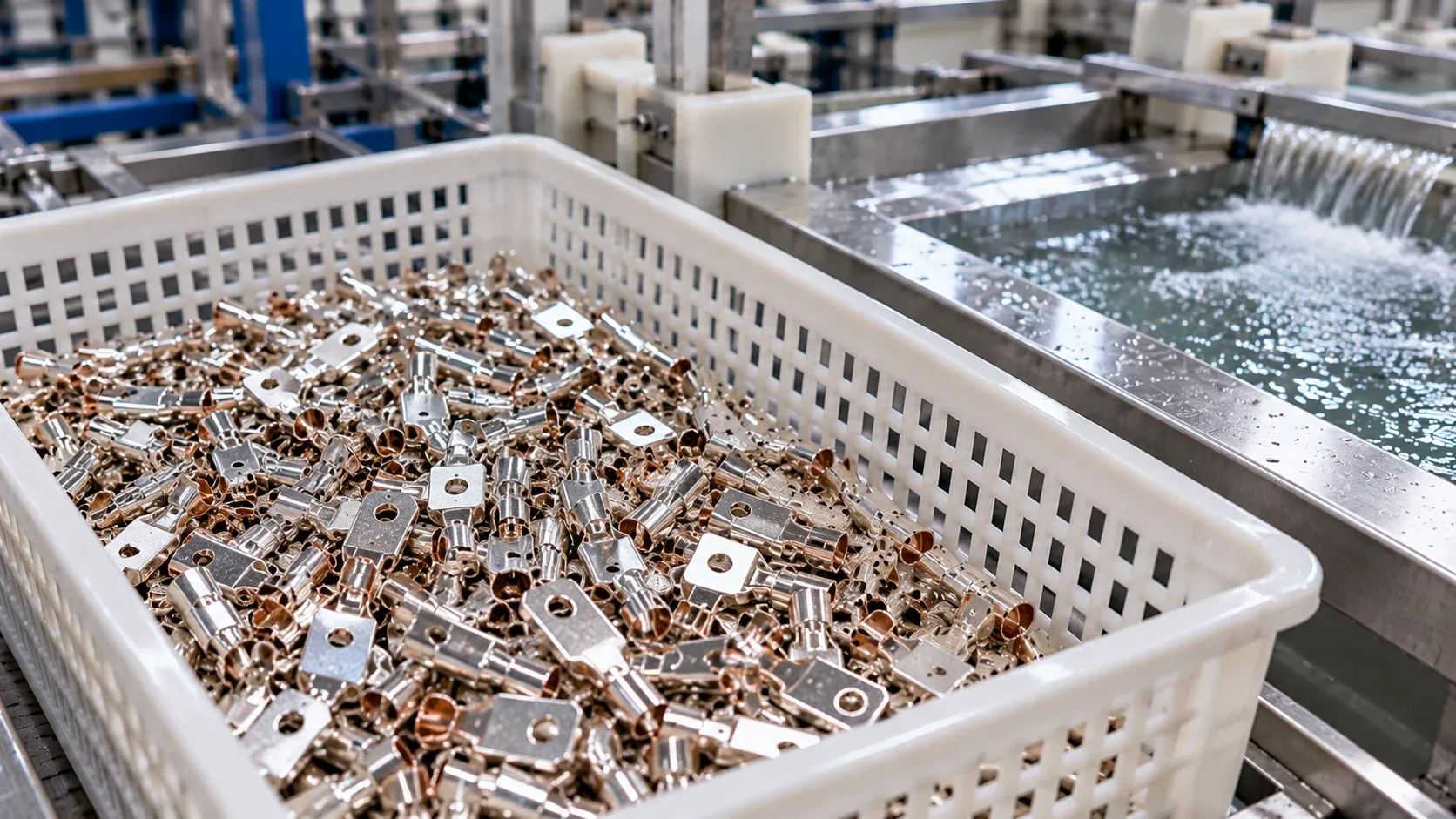
Image note: AI-assisted conceptual diagrams illustrate equipment or workpiece contexts; they are not an ES-PRO installation, customer reference or evidence of coating performance.


