Electroplating Equipment for Russia and the EAEU: Standards Stack
Map EAEU product regulations, GOST rinse-water classes and national treatment permitting to equipment scope for plating lines in Russia and the union.
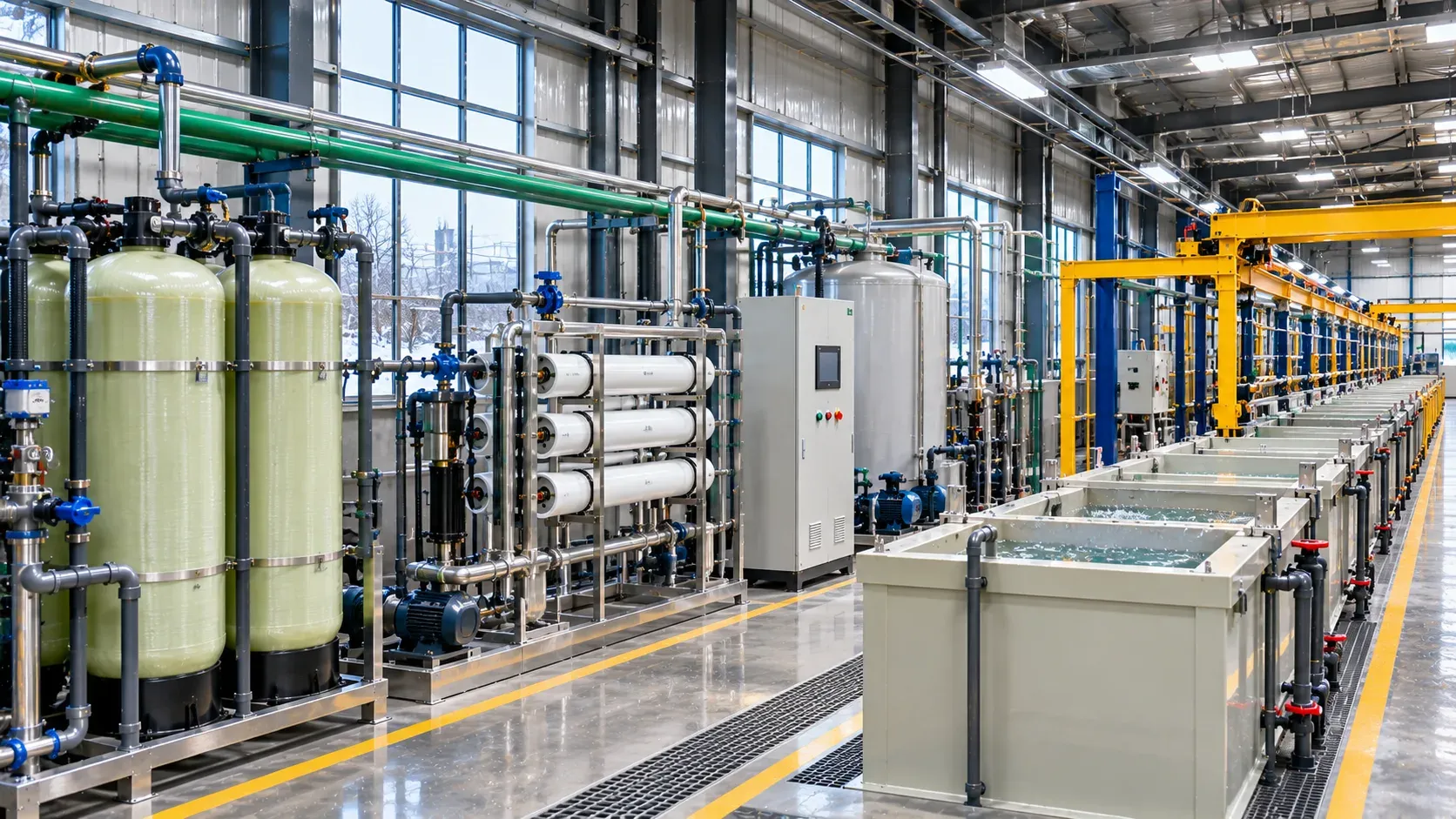
Plating equipment for Russia and the wider EAEU answers to a standards stack with three layers: union product regulations, long-standing process-water standards, and national treatment permitting. Buyers who map all three layers avoid the classic mistake — designing a line that satisfies the customer but not the paperwork. This guide assembles the stack into a specification.
Planning overview only; confirm current requirements with the relevant Russian and EAEU authorities.
What the rules actually require
- TR CU 037/2016 — the EAEU's RoHS-type regulation — restricts lead, cadmium, hexavalent chromium, mercury and others in electrical and electronic equipment (mandatory since 2020). Finishes on EEE products must comply.
- TR EAEU 041/2017 governs chemical product safety and touches bath chemistries and documentation.
- GOST 9.314-90 remains the long-standing reference for water quality in electroplating production and rinse systems.
- National permitting treats plating shops as hazardous pollution sources: treatment facilities (typically chemical precipitation, ion exchange and membrane stages) are expected, not optional.
The treatment train that solves it
Stage | What it does | Equipment to specify |
|---|---|---|
1 · Segregated collection | Keeps cyanide, hex-chrome and acid streams apart so they cannot react in the drain | Separate sumps and drainage channels per stream, labelled and bunded |
2 · Cyanide oxidation | Destroys free cyanide before it reaches the metal-removal stage | Alkaline chlorination with sodium hypochlorite, ORP-controlled dosing, retention tank |
3 · Hexavalent chrome reduction | Converts Cr(VI) to Cr(III) so it can precipitate | Acidified reduction tank with bisulfite/metabisulfite dosing on ORP control |
4 · Metals precipitation | Drops dissolved metals out as hydroxide solids | pH-controlled lime or caustic dosing, polymer flocculation, flash-mix then flocculation chambers |
5 · Clarification | Separates the solids from the water | Lamella clarifier or DAF unit with sludge bleed |
6 · Polishing | Catches fines and residual metals to hold tight limits | Sand or multimedia filter, ion-exchange polishing where limits are tight |
7 · Final pH trim and monitoring | Returns the water to the permitted band and proves it | pH trim dosing, flow meter, composite sampler or online probe at the outlet |
8 · Sludge handling | Turns wet solids into a disposal-ready cake | Filter press or sludge drying bed, containment and manifest-ready storage |
The treatment train shrinks or grows with one upstream decision: rinse design. Three-stage counterflow rinsing cuts rinse water dramatically compared with a single overflowing tank, and conductivity-controlled fresh-water feed keeps the load inside the treatment plant's envelope. On high-quality routes, a final DI rinse protects deposit quality — see the DI water RFQ guide. Instrumenting the rinse with conductivity control is the cheapest load reduction available; the method is in the rinse conductivity guide.
Region-specific notes
- Recirculation intent is common in EAEU specifications: ion exchange and reverse osmosis polishing support closed-loop rinsing, which matters for both compliance and water-heating cost in cold climates.
- EAC conformity paperwork for finished products draws on finish records — traceability in the control system earns its cost.
- Cadmium finishes on EEE products face the TR CU restriction: plan alternatives at specification time.
For the water-side scope see the DI water RFQ guide; the treatment anchor is the wastewater treatment brief; the records scope is in the traceability guide.
Five ways compliance projects actually fail
These failure modes recur everywhere — and each one is a specification decision, not bad luck:
- The pH doser that nobody maintains. Metal removal stands or falls on precipitation pH. A single dosing pump with no redundancy, no alarm and no calibration schedule is the most common cause of effluent excursions. Specify dual pumps with auto-changeover and alarm escalation.
- Streams mixed too early. Cyanide and acid streams meeting in one sump generate HCN gas; chrome and cyanide in one tank poison each other's treatment. Segregation is civil-works scope — pour the channels when you pour the floor.
- No equalization. Rack dumps create peak flows that overwhelm a clarifier sized for averages. An equalization tank at the front of the train flattens the load and shrinks the equipment downstream.
- Treatment sized for commissioning, not production. Full racks load the effluent three times harder than the commissioning run. Size for the production case, with sample data from a comparable line if possible.
- Records that live in a notebook. Inspectors, auditors and customers all ask for history. Instrumented treatment data with retention in the control system turns a stressful inspection into a file hand-over — the scope is in the controls and traceability guide.
What drives cost and timeline
Two questions dominate every treatment budget: how many stages, and how automated. A train with cyanide destruction and chrome reduction costs more than a zinc-only precipitation plant — the route decides, not the brochure. Automation (ORP/pH controls, data logging, remote alarms) adds cost at purchase and removes it at every inspection afterwards.
Timeline is dominated by the permit, not the equipment. Treatment plant fabrication is measured in weeks; permits are measured in months and depend on application completeness. The sequence that works: write the equipment scope first, open the authority conversation with it, then order. More on the equipment side in the wastewater treatment brief.
Key takeaways
- Three layers apply: union product regulations (TR CU 037/2016), process-water standards (GOST 9.314-90), national treatment permitting.
- RoHS-type restrictions push cadmium and Cr(VI) alternatives for EEE-product finishes.
- Closed-loop rinsing with ion exchange and RO is a regional default worth costing early.
- EAC evidence depends on finish traceability — put it in the control scope.
- Treatment stages (precipitation, ion exchange, membrane) are expected by permitting, not optional.
Your next five steps
- Confirm whether TR CU 037/2016 applies to your product category.
- Classify your rinse water against the GOST class your route needs.
- Define the treatment train including recirculation intent.
- Put finish traceability into the control system for EAC evidence.
- Open the permitting conversation with the written treatment scope.
FAQ
Does TR CU 037/2016 apply to all plating?
No — it applies to electrical and electronic equipment within its scope. Other finishes follow customer and national rules, but the RoHS-type trend influences specifications anyway.
Is GOST 9.314-90 still the reference?
It remains the long-standing reference for plating production water quality in the region. Confirm the current status with your authority.
What treatment stages are typical?
Chemical precipitation for heavy metals, ion exchange and membrane polishing where closed-loop or strict limits apply, and segregated cyanide pre-treatment.
Send your routes, site classification and current permits by sales email, or discuss the project on WhatsApp. We size treatment and line equipment against the standard you must hold — not the one the brochure mentions.
Image note: AI-generated editorial photography illustrates equipment or workpiece contexts; it is not an ES-PRO installation, customer reference or evidence of coating performance.