Plating Lines & Equipment
DI Water Systems for Plating: An Equipment RFQ
Plan a DI water system for plating using feed analysis, point-of-use quality, peak demand, storage and acceptance checks. Define the complete supply boundary.
@media (max-width:600px) { .espro-guide { font-size: 17px; } .espro-guide .comparison-scroll { overflow: visible; } .espro-guide table, .espro-guide tbody, .espro-guide tr, .espro-guide td { display: block; width: auto; } .espro-guide thead { display: none; } .espro-guide tr { border-bottom: 2px solid #d7e3f4; } .espro-guide td { padding: 12px 15px; } .espro-guide td:before { content: attr(data-label); display: block; color: #2454a6; font-size: 12px; font-weight: 700; margin-bottom: 5px; } .espro-guide .brief-flow { display: block; } .espro-guide .brief-flow span { display: block; margin-bottom: 10px; } }
A DI water system for plating should be specified against the water quality required at each point of use, the factory's feed water, and the demand profile. Define how quality will be measured and how off-specification water is handled. A nominal production rate or a single purity figure is insufficient for comparing complete systems.
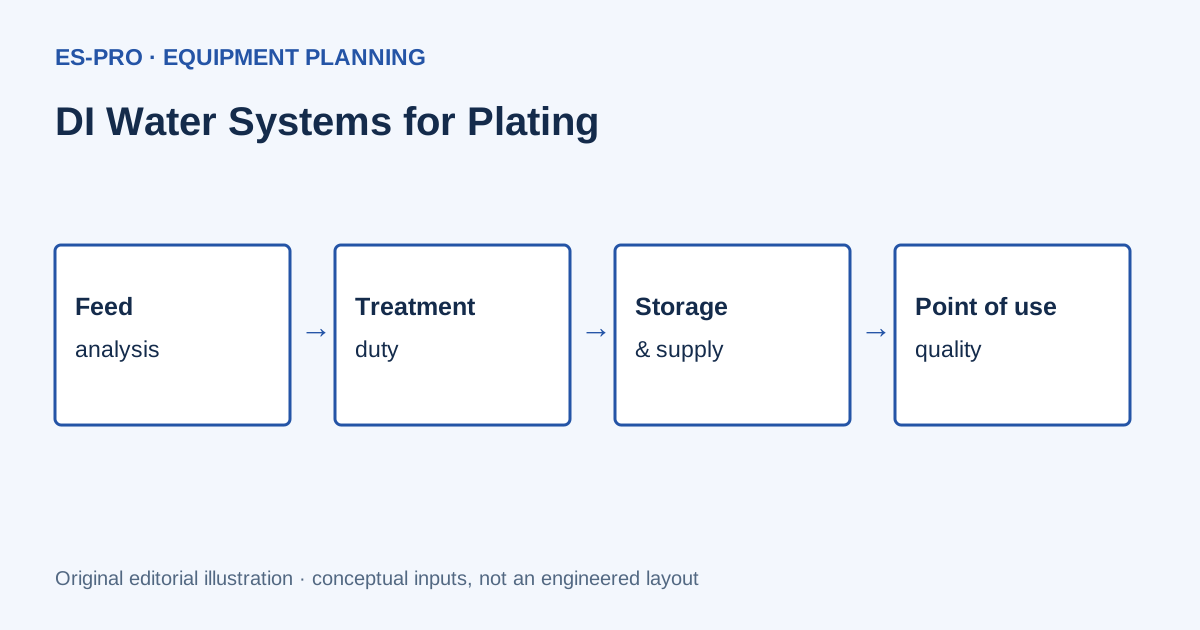
Feed analysisDemand & storageVerify at point of use
Original editorial enquiry framework. Conceptual inputs, not an engineered layout or measured result.
This guide is for a buyer planning water supply to process make-up, rinsing or cleaning equipment. Begin by listing the actual users. A treatment plant serving one final rinse has a different distribution duty from a plant serving several production lines. For the broader equipment boundary, see our metal plating line checklist.
Which plating-water quality requirements belong in a DI system brief?
Create a point-of-use schedule. For each outlet, record the process owner's required water specification, operating demand, connection conditions and measurement location. Identify whether a requirement applies to freshly produced water, stored water, water delivered at the equipment, or a working rinse after parts have entered it. Those are different acceptance points.
Use the agreed measurement method and units. Conductivity and resistivity concern electrical properties of the sample; a good reading should not be treated as a complete assessment of every contaminant. The official ASTM water-testing catalogue lists D1125 and a separate flowing high-purity-water method, D5391. Select the applicable method and edition with the process owner rather than transferring a laboratory-water specification to the whole factory.
Include feed-water analysis and its collection date. Where the supply varies, provide more than a convenient single sample. Identify known interruptions, seasonal changes and any existing treatment upstream. State which information is unavailable so the proposal can list the additional tests needed before final selection.
How should DI water production and storage capacity be compared?
Separate daily consumption from instantaneous demand. Several tanks may be filled together even when their average consumption is modest. State the largest planned filling event, the time allowed for it, and whether normal production continues during filling. Record working shifts and shutdown periods alongside these events.
The supplier should show its proposed balance between treatment production, storage and distribution. Ask which assumptions support the quoted output and which feed-water conditions can change it. A tank can buffer a demand event, but the offer still needs to explain replenishment, usable storage and the response to poor water quality.
Brief item | Buyer information | Evidence to request in the offer |
|---|---|---|
Feed supply | Analysis, variability and available pressure | Stated feed conditions and treatment assumptions |
Water users | Quality target and connection for each outlet | Point-of-use schedule and acceptance locations |
Demand events | Routine use, simultaneous fills and recovery time | Production/storage balance for those events |
Distribution | Route, delivery pressure and retained pipework | Connection boundary and proposed monitoring points |
Off-specification water | Process-owner release and recovery rules | Alarm, hold or diversion functions included |
Service streams | Reject, flushing or regeneration duties as applicable | Quantities and connections to be confirmed |
This is an original procurement worksheet, not a designed water circuit or an ES-PRO performance guarantee. Ask the supplier to mark each assumption as confirmed, provisional or outside its scope.
Which DI water system interfaces are easy to omit?
Define the boundary between the treatment package and the factory distribution system. Identify who provides storage, pumps, pipework, isolation, sampling access and instruments. An offer headed “DI system” may cover only one part of that boundary. Request a connection list and an explanation of how each equipment outlet receives its specified water.
Ask about maintenance and service ownership. Different treatment arrangements have different consumables and servicing needs. The proposal should identify routine monitoring, replacement responsibilities, access space and any specialist service it assumes. Evaluate those duties against the factory's staff and planned production schedule.
Water supply and wastewater treatment are separate project duties. Reject or service streams need an agreed discharge route; they should not be assumed to fit the existing effluent plant without assessment. The EPA metal-finishing effluent guidance provides U.S. category context, rather than a universal permit or water-supply specification. Give the actual project country and permitted discharge arrangements.
What should a plating DI water system acceptance test show?
Specify the agreed feed conditions, operating demand and sampling locations before the demonstration. Ask for a record of delivered water quality during the chosen operating sequence, including the demand event used to size storage. Identify who takes samples, which instruments are used and how their condition is checked.
Include an agreed safe demonstration of an alarm or off-specification response. The useful question is what the production line receives while the system recovers. Confirm the release decision and any retained factory controls involved. A screenshot of a normal conductivity reading does not establish the response to a quality interruption.
For an upgrade, compare existing and proposed boundaries explicitly. Record which tanks, pumps, sensors and pipework remain. Request a commissioning and transition plan that identifies when the retained system is available, how it is checked and which temporary arrangements require factory approval.
Questions You May Have:
Is the highest quoted purity always the right purchase?
Use the quality required by the actual process at the agreed sampling point. Additional treatment should have a stated purpose and operating consequence in the proposal.
Can a daily consumption figure size the complete system?
It does not describe simultaneous fills or other peak events. Provide both routine consumption and the demand events that the production schedule requires.
Is DI water the same project as wastewater treatment?
No. Water preparation supplies users; effluent treatment receives process and service streams. Specify their connections and responsibilities separately.
Can an enquiry begin without a current water report?
Yes. Describe the supply, users and known demand. Mark the analysis as unavailable and ask which sampling information is needed before a fixed proposal.
Get Proposal and Demo
Send a water-system project brief with your known feed supply, water users and demand events. Company, name, email and project country are the required introduction fields; technical details are optional. Ask which configuration and operating demonstration are relevant to your water-supply boundary.
Drawings, water reports and distribution layouts can follow by sales email. You can also chat on WhatsApp. Explore the water treatment equipment family and use the quotation scope guide to compare included interfaces.
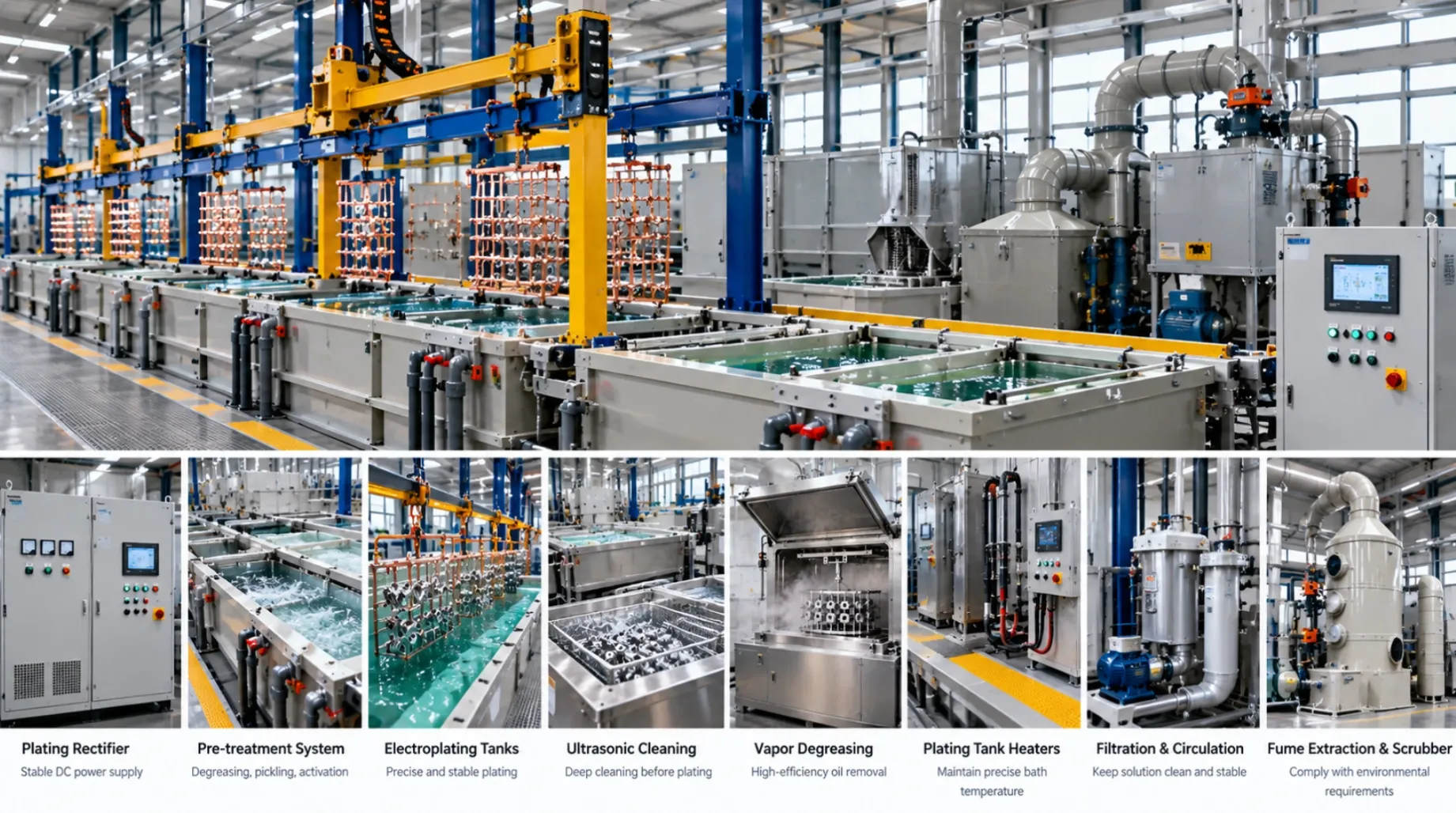
Image note: AI-generated cover illustration; not an ES-PRO installation, customer project or test result.