Plating Lines & Equipment
Plating Line Layout: Tank Sequence, Flow and Access
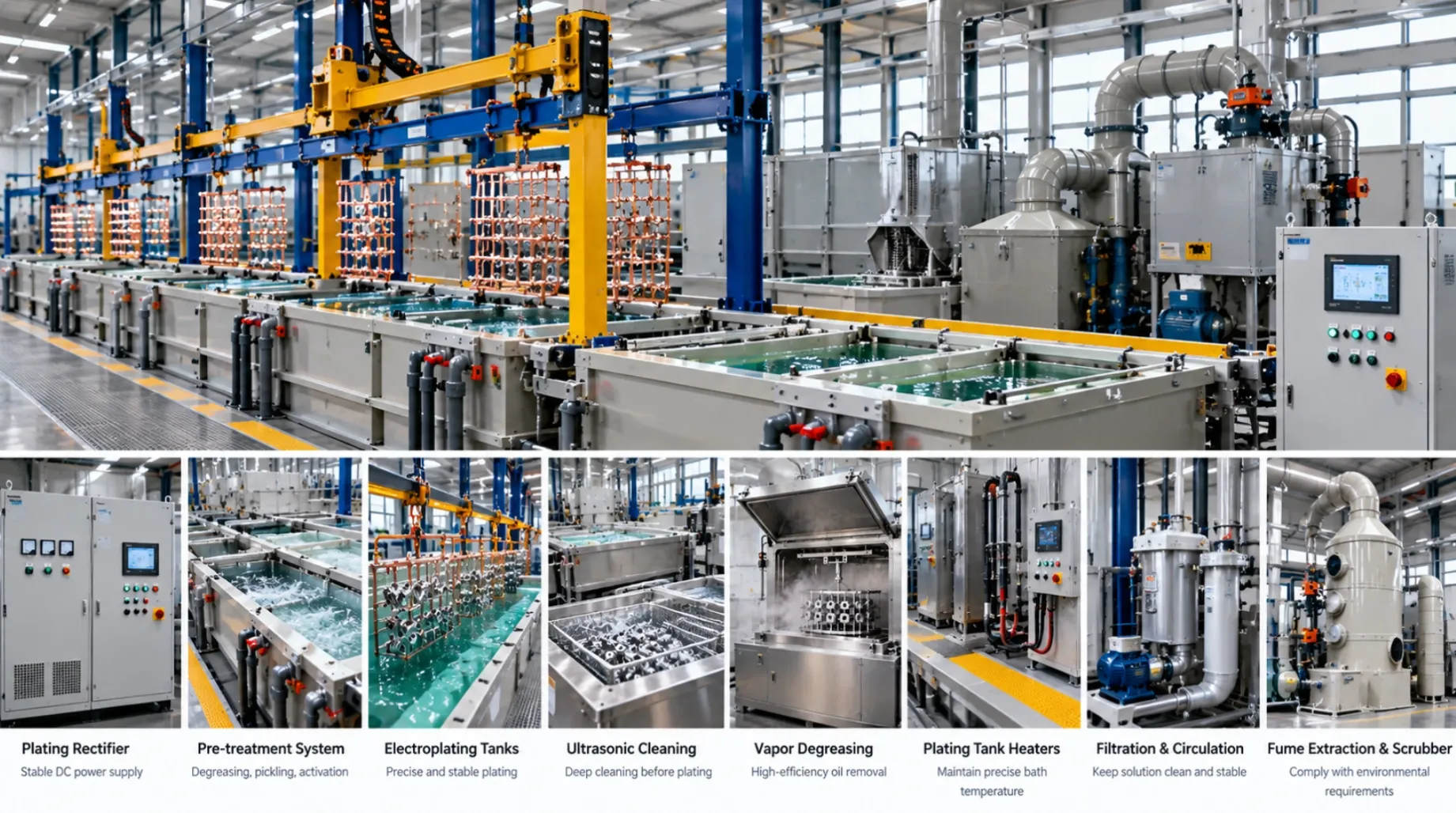
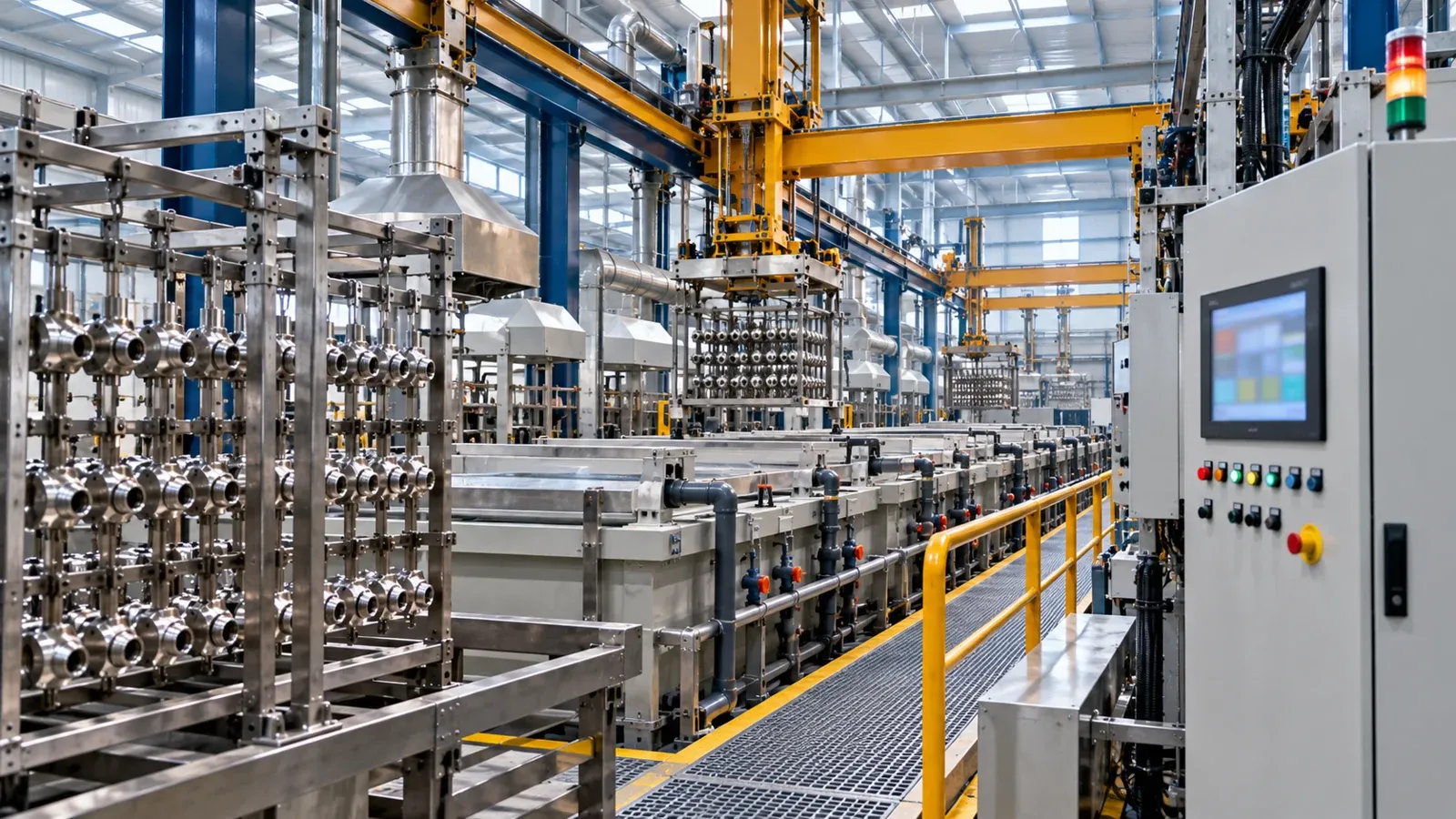
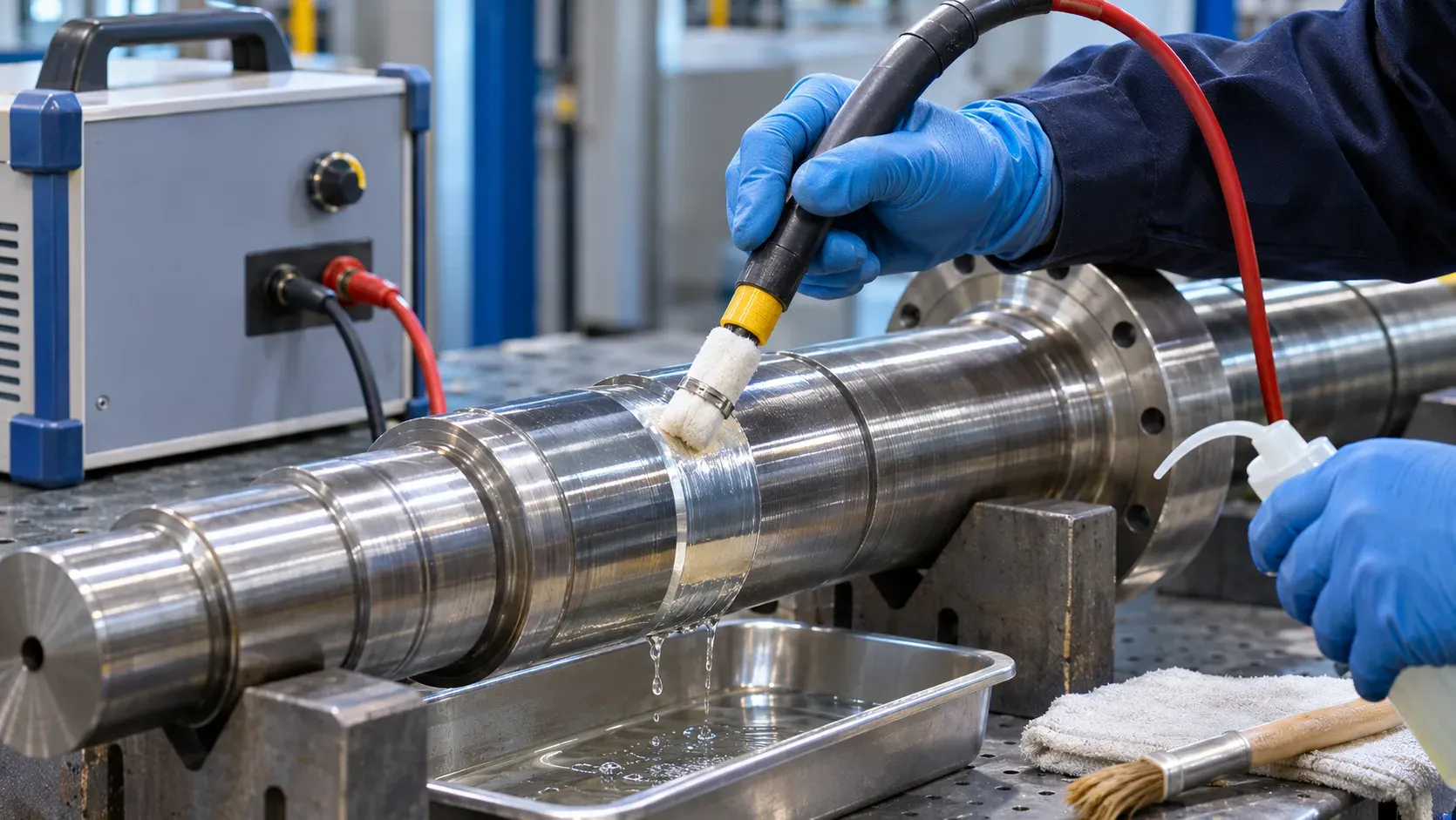
Plating line layout inputs: tank sequence from the process route, material flow and handling formats, and the building access and expansion space the line needs.
# Plating Line Layout: Tank Sequence, Flow and Access
ES-PRO editorial team �� Updated 27 October 2026
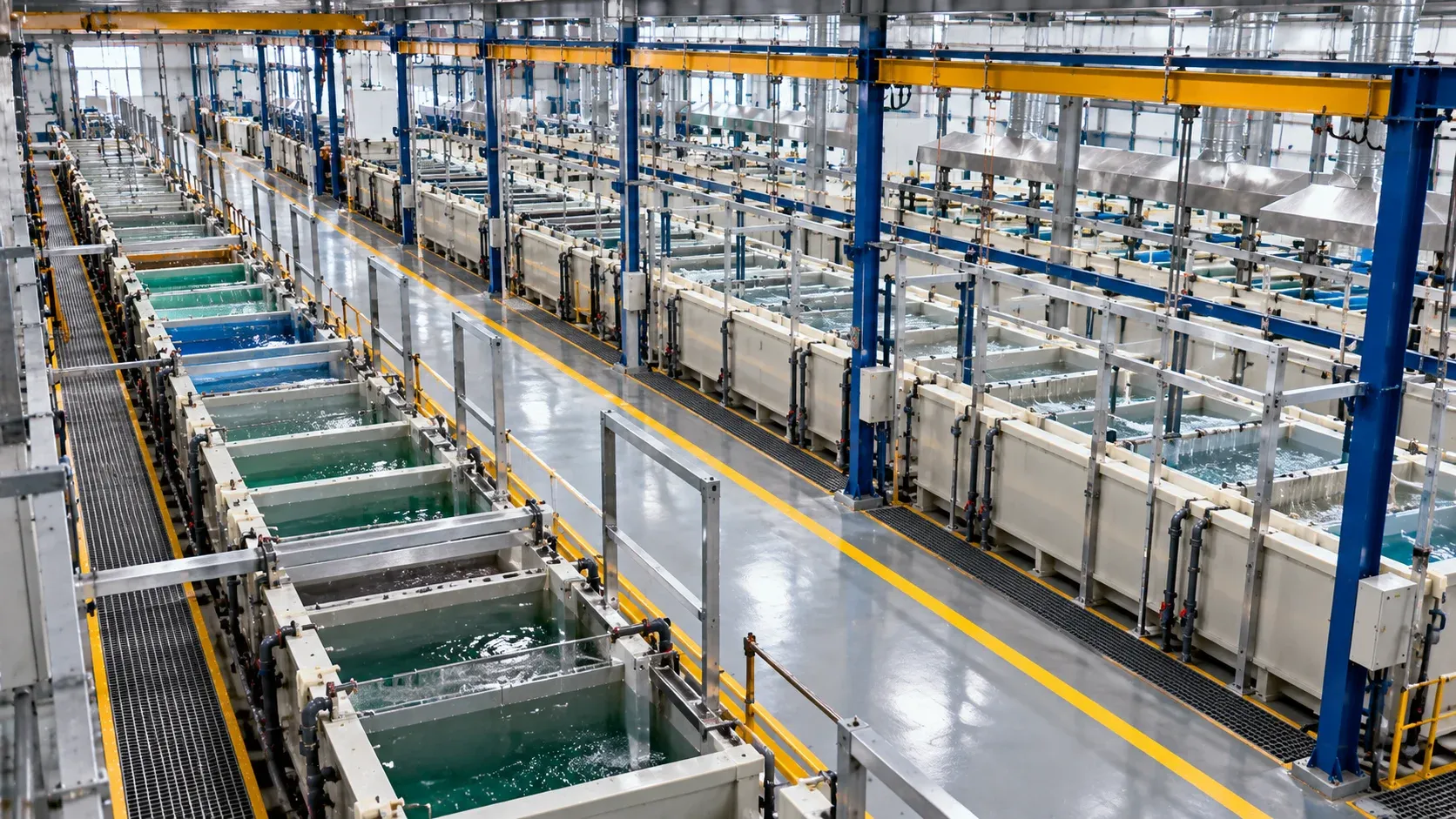
A plating line's layout is decided before any tank is bought: the process route fixes the tank sequence, the material flow decides what throughput the line can actually deliver, and access decides what maintenance will cost for the line's whole life. Layout mistakes are the expensive kind �� the ones that surface as inherited condition years later �� because the building locks them in. This page organizes the inputs a buyer owns.
What fixes the tank sequence?
The validated process route fixes the order of operations; layout decisions come next:
- Stage count per step. Cleaning and rinsing often repeat �� multi-stage counterflow rinses trade tank count for water economy �� an explicit design decision.
- Dwell and tank length. Each stage's dwell time and the handling system's speed size the tank; a stage that runs long either stretches the tank or the cycle.
- Special cells. Cooled cells for exothermic processes, agitated cells where the route calls for solution movement, and heated cells each bring utility interfaces to specific positions.
- Isolation boundaries. Incompatible chemistries need separation �� by distance, by drip trays, by drain routing �� before an accident draws the boundary instead.
How does material flow go?
Decision | What it decides |
|---|---|
One-way vs shuttling flow | Whether every part passes every tank, or loads reverse for multi-route capability |
Loading and unloading position | Where work enters and leaves; buffer and racked-work storage nearby |
Handling format | |
Bypass and isolation paths | How one tank is serviced while the line keeps running �� the availability the maintenance plan depends on |
Flow crossings | Where people, parts and chemicals cross �� the layout's safety structure |
Throughput is a flow property before it is an equipment property: a well-equipped line with a crossing-choked floor delivers the buffer's schedule, not the rectifier's.
What does the building owe the line?
- Floor structure: tank pits, trenches and drainage falls; floor loading where tanks and solutions concentrate mass.
- Ventilation routing: hood positions and duct paths constrain ceiling space and penetrations early.
- Utilities at positions: water, drains, power and compressed air at the tanks that need them, not wherever the wall happens to be.
- Corrosion zoning: electrical gear and controls sited away from mist zones, per the environment the controls guide records.
- Access for the line's life: room to pull a tank liner (our liner guide describes the shutdown it needs), reach anodes and filters, and add a tank later �� expansion headroom is the cheapest space a layout can reserve.
Where this does not fit
- Treating this as a substitute for the supplier's general arrangement: the GA drawing integrates route, handling and utilities; this page organizes the inputs you bring to it.
- Reading it as civil engineering: structural and permitting questions belong to the site's responsible functions.
- Choosing the process route by layout convenience: the validated route leads; the layout serves it �� our setup checklist sequences the whole project.
- Buying tanks before the layout holds: equipment ordered against an unsettled layout becomes the retrofit problem.
Questions You May Have:
How much floor space does a plating line need?
It follows from the route, the throughput and the handling format �� no useful single number. The supplier's general arrangement sizes it; your leverage is in checking that access, expansion and utility positions survived the compression.
Should the line be one row or two?
Single rows simplify handling and drainage; multiple rows fit more stages into a building and can separate incompatible chemistries. The route, building shape and hoist sharing decide �� assess against the actual route, not habit.
Can the layout be phased?
Yes �� phase boundaries work when each phase leaves the line production-capable, as capacity projects generally require. Reserve the utilities and floor positions of later phases from day one.
What do layouts most often get wrong?
Maintenance access, rinse-water routing and expansion space �� the quiet inputs that cost nothing at drawing stage and everything after installation. Walk the line's service tasks on the drawing before it becomes steel.
Technical references
- Practice description. General arrangement, civil interfaces and permitting follow the supplier's design and the site's responsible functions.
Get Proposal and Demo
Introduce your project with company, name, email and project country. Technical fields are optional. Describe the route, the throughput target and your building constraints when available, and ask which layout concept �� and which handling format �� the assessment recommends.
Details can follow by sales email, or chat on WhatsApp. The quotation scope guide helps compare what each offer's layout includes.
Image note: AI-assisted conceptual diagrams illustrate equipment or workpiece contexts; they are not an ES-PRO installation, customer reference or evidence of coating performance.