
Plating Process
Electroforming: Mandrels, Metal Build and Line Inputs
Electroforming explained: how the deposit becomes the part, what mandrels and current distribution demand from the line, and the brief inputs that matter.
# Electroforming: Mandrels, Metal Build and Line Inputs
ES-PRO editorial team �� Updated 27 October 2026
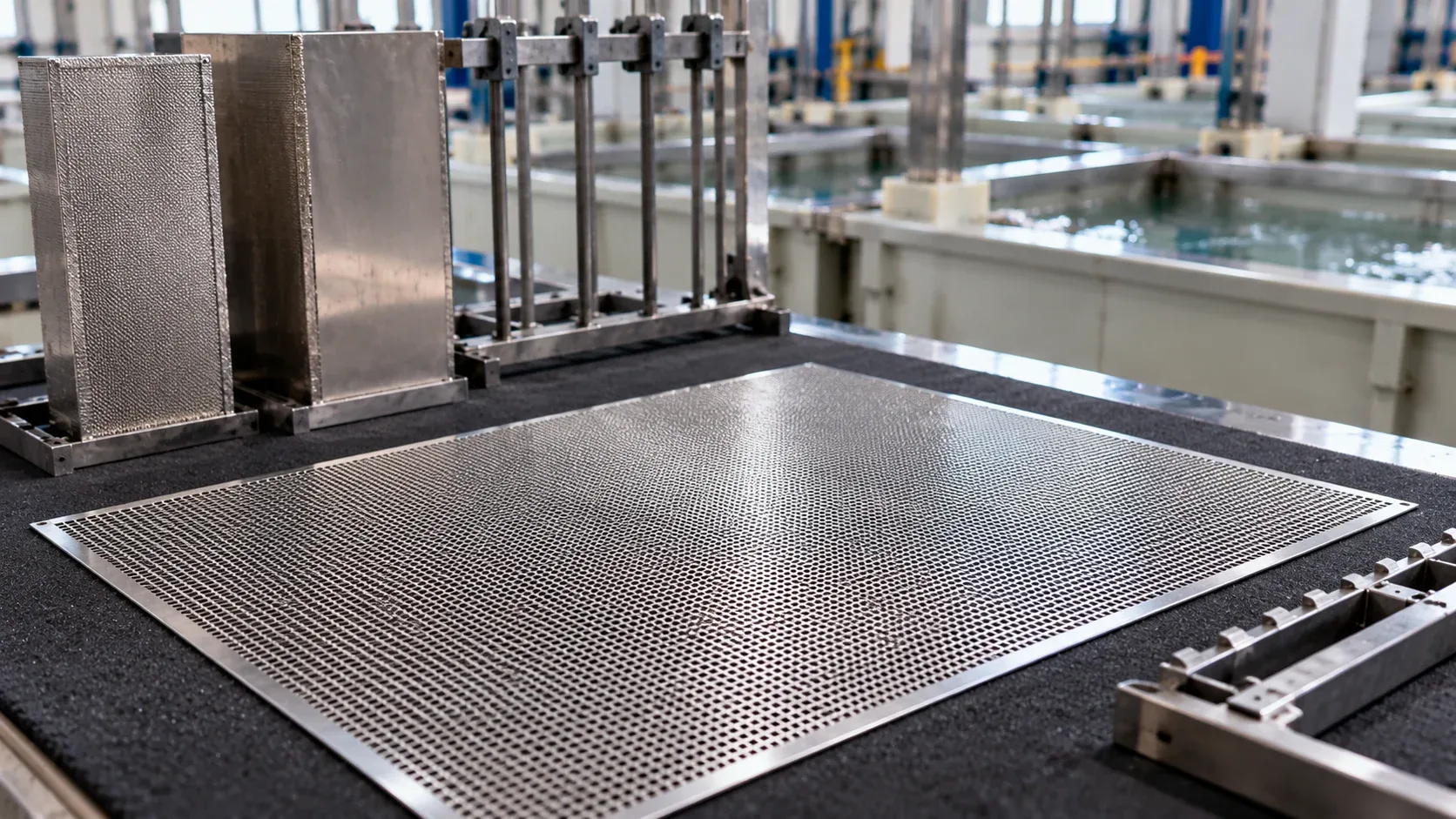
Electroforming is electrodeposition taken to structural scale: metal is plated onto a mandrel until the deposit itself becomes the part. Meshes, molds, reflectors, bellows and waveguide components are made this way, typically in nickel and copper. Compared with ordinary plating, the deposit is a hundred times the thickness concern, the mandrel is the tooling, and current distribution literally draws the part's geometry �� so the line logic changes accordingly.
How is electroforming different from plating?
In plating, a thin deposit adds a property to a finished part. In electroforming, the growth of the deposit is the manufacturing method:
- Thickness changes meaning. Coating work verifies minimum thickness; electroforming verifies a dimensional tolerance on grown surfaces, where the deposit is the wall of the part.
- The mandrel defines the shape. The part's working surface replicates the mandrel's surface; permanent mandrels (separated and reused) and expendable mandrels (dissolved, melted or otherwise removed) are two tooling families with different line implications.
- Deposit stress becomes a design variable. A stressed deposit distorts the part as it grows and after separation. Managing stress is why low-stressed sulfamate-type nickel systems are central to electroforming nickel.
The electrochemical principle is the one our process walkthrough describes; electroforming pushes it far beyond coating duty.
What does the line need?
Element | Why it matters in electroforming |
|---|---|
Mandrel preparation and separation | Surface quality replicates into the part; separation method shapes the process chain |
Current distribution | Conforming anodes, tooling and part geometry decide growth uniformity �� the deposit's dimensional accuracy |
Low-stress deposition systems | Nickel and copper families chosen with stress management in view; chemistry follows the validated route |
Long-dwell bath control | Growth takes far longer than coating; evaporation, dosing and level control run for the whole cycle |
Handling | |
Verification |
What belongs in an electroforming brief?
Input | What to provide | What the proposal should clarify |
|---|---|---|
Part family | Meshes, molds, reflectors, others �� with target geometry | Cell design and anode tooling concept |
Mandrel concept | Permanent or expendable; material | Preparation, separation and reuse stages in scope |
Material system | Nickel, copper, or a sequence | Bath families and stress-management approach |
Tolerances | Dimensional allowance on grown surfaces | Growth uniformity strategy and verification |
Post-operations | Backing, trimming, bonding | Included stages and interfaces |
Throughput | Parts per period; growth duration expectations | Line format and tank fleet |
Where this does not fit
- Confusing electroforming with electroless deposition: electroforming is electrolytic �� current and anodes are integral; autocatalytic processes are a different family.
- Treating it as a coating upgrade: the deposit-as-part logic changes tooling, verification and economics, not just thickness.
- Quoting meshes or molds without mandrel data: the mandrel concept drives the line; a brief without it is an assumption.
- Expecting standard coating thickness specs to govern: dimensional tolerances on grown surfaces are the verification framework.
Questions You May Have:
What is the difference between electroforming and electroplating?
Electroplating adds a thin functional layer to a finished part; electroforming grows metal until the deposit is the part itself. The distinction shows up in thickness meaning, tooling (the mandrel), verification (dimensions, not minimum coating) and cycle time.
Which metals can be electroformed?
Nickel and copper are the common engineering families, each with low-stress system options; other systems exist for specific needs. The material choice follows the part's requirements and the process owner's validated chemistry.
How accurately does the deposit replicate the mandrel?
The working surface replicates the mandrel's surface quality �� which is why mandrel preparation is a process step, not a procurement detail. Dimensional accuracy across the part depends on growth uniformity, which current distribution and cell design own.
Can an existing plating line be adapted for electroforming?
Sometimes for small work �� but long dwells, current-distribution tooling, bath control and handling usually exceed what a coating line was sized for. An engineering assessment against the actual parts decides; our quotation scope guide frames the boundary.
Technical references
- Practice description. Deposition systems, mandrel processes and verification follow the process owner's validated documentation and the part's requirements.
Get Proposal and Demo
Introduce your electroforming project with company, name, email and project country. Technical fields are optional. Describe the part family, the mandrel concept and the tolerance expectations when available, and ask which line scope the assessment recommends.
Details can follow by sales email, or chat on WhatsApp. The equipment buyer's guide places this family among the line formats.
Image note: AI-assisted conceptual diagrams illustrate equipment or workpiece contexts; they are not an ES-PRO installation, customer reference or evidence of coating performance.


