Cadmium Plating: Where It Fits and the Alternatives
Cadmium plating today: where the callout still appears, the line and effluent boundary it carries, and the alternative routes and their requalification cost.
# Cadmium Plating: Where It Fits and the Alternatives
ES-PRO editorial team �� Updated 27 October 2026
Cadmium plating survives where other coatings struggle to match it: sacrificial corrosion protection with consistent torque-tension behavior on fasteners, good galvanic compatibility with aluminum, and decades of qualification history behind aerospace and defense callouts. It is restricted in most consumer applications �� and that split is the whole story of this page: where the requirement still names cadmium, what running it demands from a line, and what the alternative routes cost to adopt.
Why is cadmium still called up?
Three properties keep the callout alive in legacy and high-reliability work:
- Sacrificial protection with lubricity. Cadmium corrodes preferentially to steel and, with its post-treatments, provides low-friction, anti-galling behavior on threads that many alternative deposits must re-prove.
- Galvanic compatibility. In assemblies that mix steel fasteners with aluminum structures, the galvanic couple behaves in ways designers have relied on for decades.
- Qualification history. Specifications such as ASTM B766 for electrodeposited cadmium and SAE AMS 2400 for aerospace plating carry qualification records and supplier familiarity that a replacement route must rebuild.
Against that stands the regulatory reality: cadmium is restricted in consumer and electronic applications, with narrow exemptions for continuing aerospace and defense use. The applicable requirement, not preference, decides whether cadmium may be used at all.
What does a cadmium line involve?
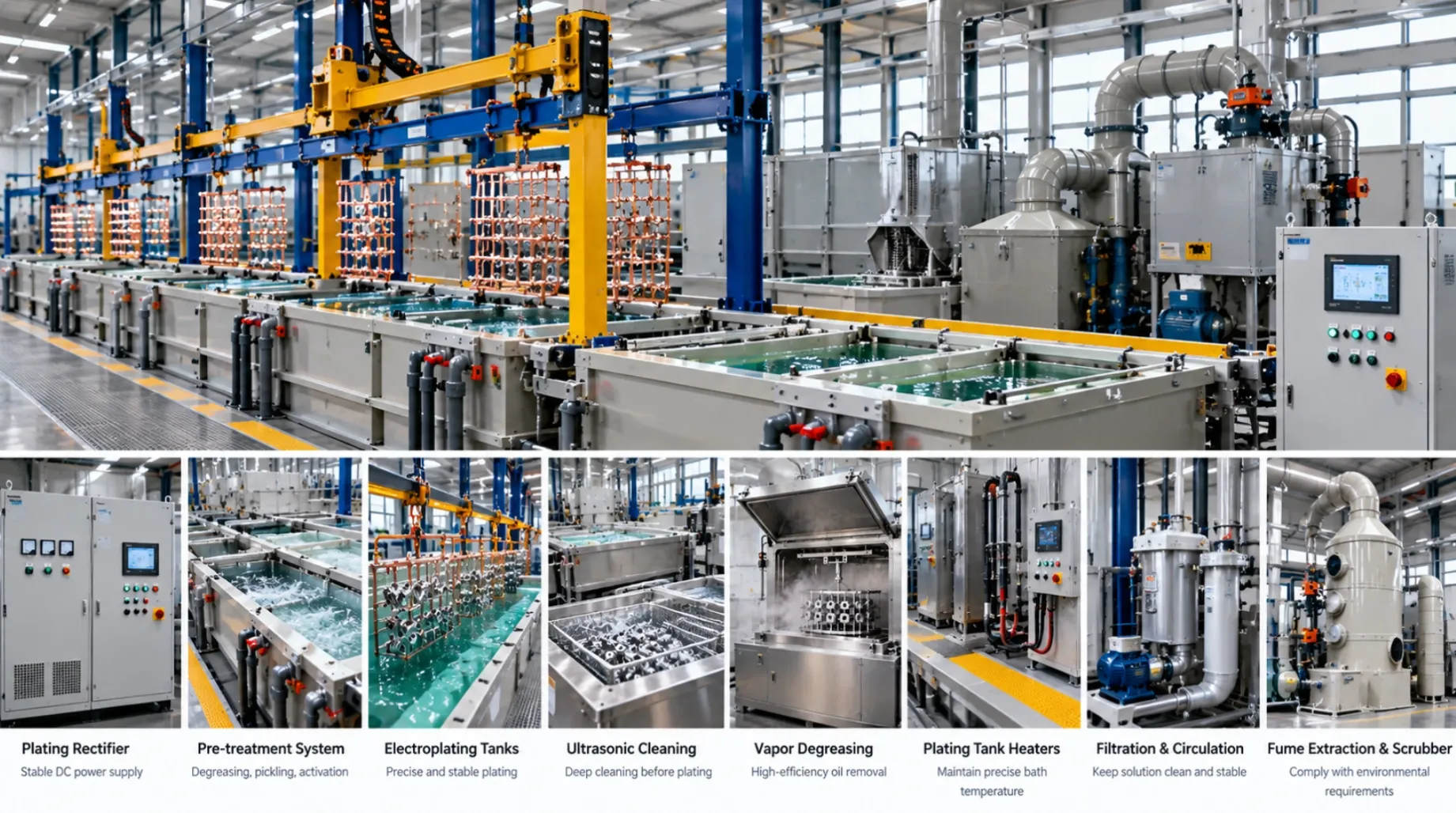
The deposition step sits inside a larger obligation chain, on substrates whose route logic our steel plating guide maps. Bath families for cadmium exist in several chemistries; which one the route uses follows the process owner's validated documentation, not this page. What the equipment side must own is broader:
- Pre- and post-treatment in line with the invoked specification, including the post-treatment systems the callout names.
- Hydrogen embrittlement management where high-strength steels are plated; the invoked specification defines the baking and verification that manage it.
- Effluent treatment sized for cadmium. Cadmium is a regulated metal in discharge limits; the effluent plant is part of the line decision, not an afterthought.
Callout element | What it fixes |
|---|---|
Specification and edition | The coating's verification structure (B766, AMS 2400, or the contract's document) |
Type/class and thickness | Deposit family and minimum thickness per the invoked edition |
Substrate and strength class | Whether hydrogen embrittlement management applies |
Post-treatment | The chromate or alternative post-treatment the callout names |
What are the alternatives?
Route | Matches cadmium on | Where it falls short to verify |
|---|---|---|
Zinc-nickel alloy | Corrosion protection on steel; lower plating toxicity | Torque-tension behavior and galvanic couples need requalification; the line differs in bath and post-treatment control |
Tin-zinc | Sacrificial protection; solderability in some cases | Deposit softness and post-treatment behavior; requalification burden |
Zinc flake (non-electrolytic) | Fastener corrosion without hydrogen-charging risk | Application is a different, non-electrolytic equipment family |
Vapor-deposited aluminum | Galvanic compatibility with aluminum; cadmium-free | An entirely different line family; not a plating-line substitution |
None of these is a drop-in swap. Each moves the properties the original callout relied on, and the design authority �� not the plating shop �� decides which deviations the part can carry and what requalification proves it. For the wider zinc-side decision these alternatives sit in, our zinc plating guide and the galvanized-versus-plated comparison frame the specification logic.
Where this does not fit
- Treating cadmium as simply banned: consumer restrictions and narrow aerospace/defense exemptions coexist; the applicable requirement governs.
- Promising an alternative as a replacement without requalification: the properties that justified cadmium must be re-proven for the part, not asserted from a datasheet.
- Reading this as bath chemistry instruction: compositions and cycles belong to the process owner's validated documentation.
- Assuming effluent obligations end at the plating tank: the regulated metal drives the treatment plant boundary.
Questions You May Have:
Is cadmium plating banned?
No �� it is restricted. Consumer and electronic applications face prohibition or narrow exemptions under RoHS and related regulation; aerospace and defense callouts persist under specific provisions. Whether a given part may carry cadmium is a contract and regulation question, answered requirement by requirement.
What replaces cadmium on fasteners?
Zinc-nickel, tin-zinc and zinc-flake systems are the common engineering answers, each with a requalification burden on torque-tension and galvanic behavior. The design authority approves the substitute; the line supplier equips whichever route is approved.
Does cadmium plating risk hydrogen embrittlement?
Plating high-strength steels carries hydrogen embrittlement management obligations regardless of deposit chemistry, and cadmium routes historically include baking requirements in their callouts. The invoked specification defines them, and the line's oven capacity follows from them.
Can one line run cadmium and the alternatives?
Pre- and post-treatment stages and records can be shared by design; the deposition baths and their effluent streams must be assessed separately. Name the product mix in the brief so the effluent plant is sized once, not twice.
Technical references
- ASTM B766 �� Standard Specification for Electrodeposited Coatings of Cadmium (ASTM catalogue). Coating structure and verification are in the controlled edition.
- SAE AMS 2400 �� Plating, Cadmium (SAE catalogue). Aerospace deposit specification; the contract-invoked edition governs.
- Regulatory, route and equipment practice description. Bath chemistries and cycles follow the process owner's validated documentation.
Get Proposal and Demo
Introduce your project with company, name, email and project country. Technical fields are optional. Describe the substrate families, the specification invoked and your effluent boundary when available, and ask which route �� cadmium or an alternative �� the line plan should serve.
Details can follow by sales email, or chat on WhatsApp. The quotation scope guide helps compare what each offer includes.
Image note: AI-assisted conceptual diagrams illustrate equipment or workpiece contexts; they are not an ES-PRO installation, customer reference or evidence of coating performance.