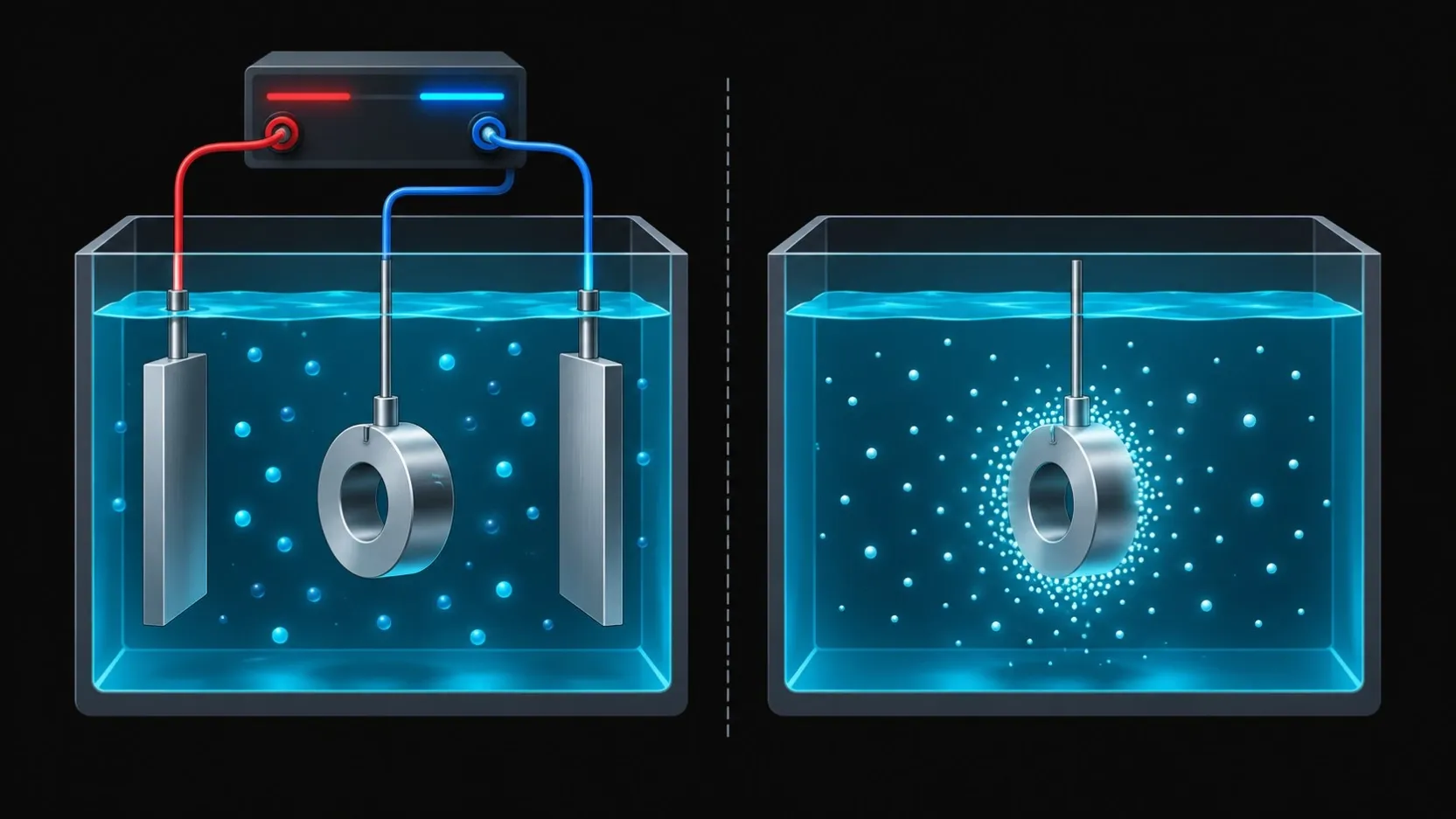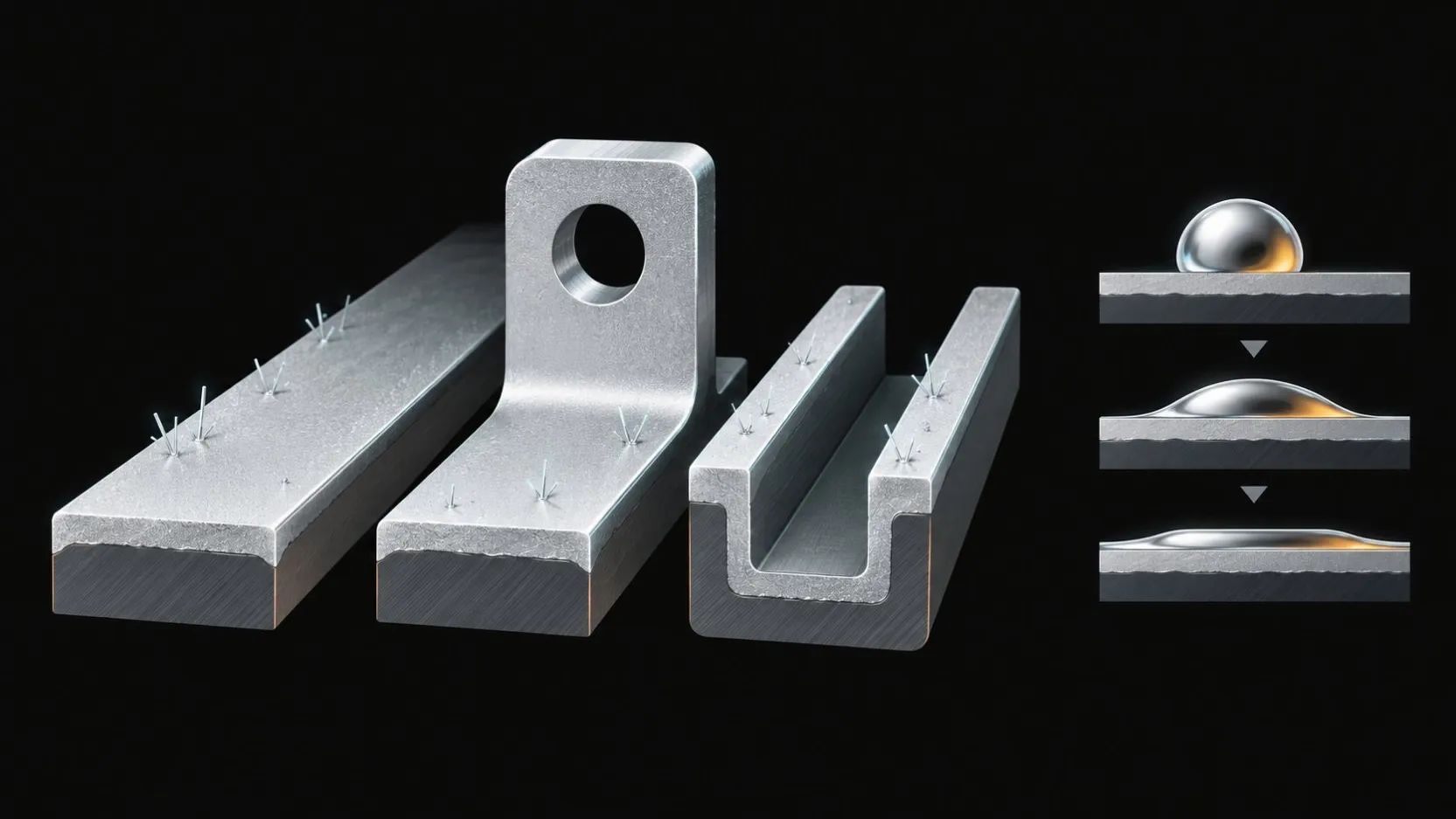
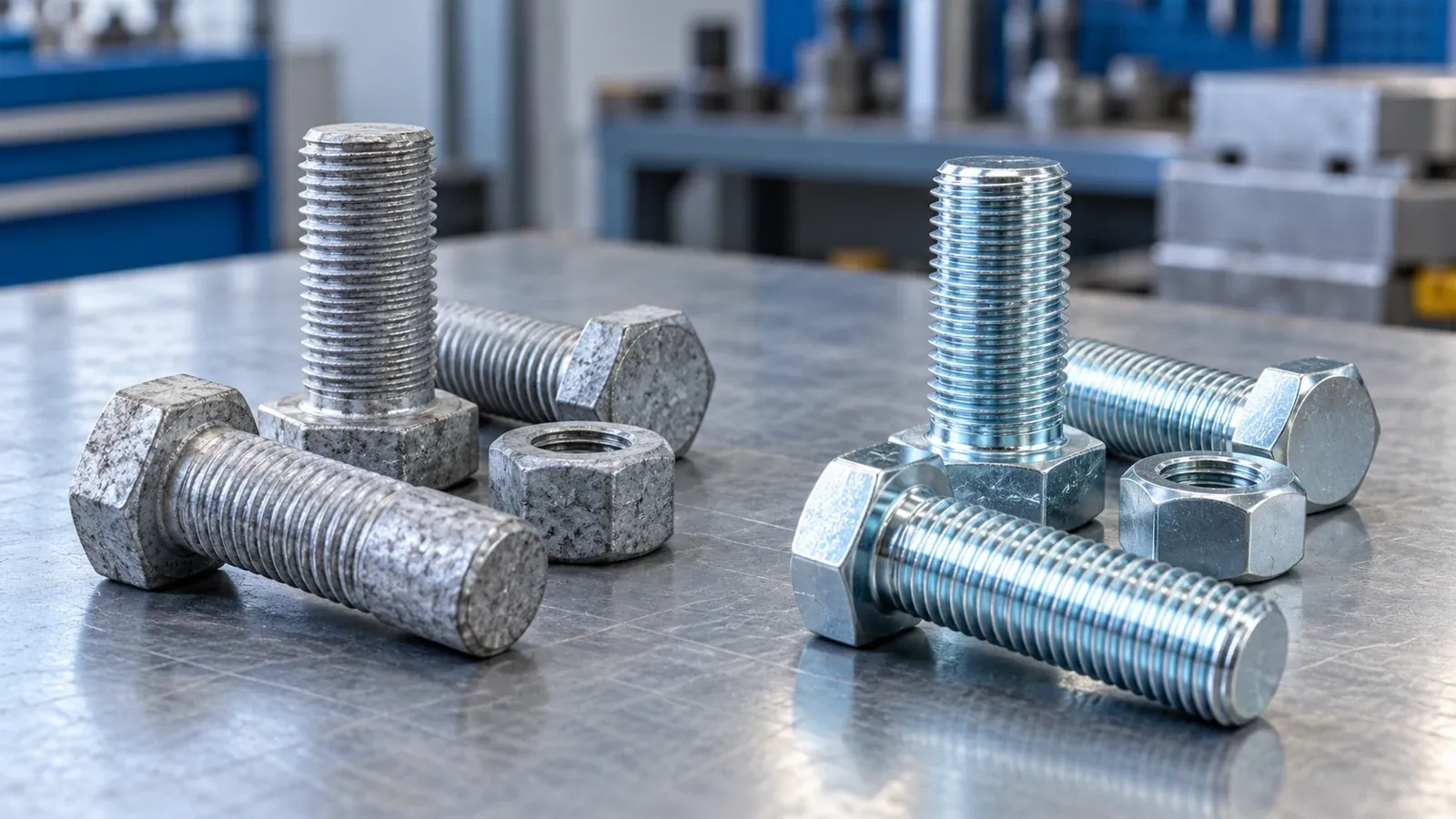
Here, galvanized means hot-dip galvanized. Both routes use zinc to protect steel: hot-dip immersion forms a zinc-iron coating, while electroplating deposits zinc using external current. Select provisionally from exposure, geometry and finished fit, then confirm the product specification. A commercial label alone cannot identify the route.
In this guide
How do hot-dip galvanizing and zinc electroplating differ?
Hot-dip galvanizing immerses an article in molten zinc and produces a coating that reacts with the steel. Zinc electroplating deposits zinc from a solution using external current. Both can provide sacrificial protection, but coating structure, processing conditions and dimensional effects differ.
ISO 1461:2022 covers fabricated hot-dip galvanized articles within its scope, excluding products covered by certain product-specific standards. ASTM B633-23 covers electrodeposited zinc on iron and steel and points to fastener-specific specifications where appropriate.
Neither route guarantees uniform thickness on every feature. Define significant surfaces, minimum thickness and maximum dimensional build-up for the actual geometry and process.
Which example projects favour hot-dip galvanizing or zinc plating?
These examples illustrate a first screening decision, not an approved coating instruction or an ES-PRO customer case.
- Fabricated outdoor bracket without a close-fitting bore. Start a hot-dip discussion because exposure and the fabrication geometry drive this brief. Confirm whether ISO 1461 applies, the specified coating requirements, fabrication details and inspection. Outdoor exposure alone does not approve the route or predict its life.
- Indoor threaded fixture fastener with tight assembly fit. If the product specification permits zinc electroplating, request that option with its full finish designation and compatible mating parts. For a US mechanical fastener, check the F1941/F1941M branch below. Finished fit, strength condition and the complete protective system still need approval.
- High-strength fastener with an incomplete drawing. Confirm neither route yet. Obtain the grade, strength, coating permission and assembly requirements before comparing quotations. A low build-up requirement does not override a strength-related restriction.
Which galvanizing or zinc-plating specification should the drawing cite?
Choose the applicable product and coating specification before selecting equipment. Identify its edition, drawing requirements and any customer amendments. A public catalogue page identifies the standard; the controlled contract version provides the detailed requirements.
| Decision | Hot-dip route | Electroplated route |
|---|---|---|
| Scope | ISO 1461 or the applicable product-specific standard | B633 or the applicable fastener/coating specification |
| Thickness | Article category and applicable local/mean requirements | Coating designation, significant surfaces and measurement locations |
| Fit | Allowances and inspection of mating features | Minimum coating and maximum build-up compatible with fit |
| Final system | Any approved subsequent treatment | Specified passivate, topcoat or other treatment |
| Acceptance | Which local/mean thickness, sampling, reading locations and appearance criteria apply; who approves the records? | Which thickness locations, adhesion or embrittlement checks and corrosion endpoint are required; who supplies the records? |
Do not substitute a generic thickness table for the product specification. A callout such as "zinc coat, corrosion resistant" leaves the route and acceptance unresolved.
US mechanical fasteners need a specific branch
For bolts, screws, nuts and related hardware, check the product specification before borrowing a general fabricated-article callout. ASTM F2329/F2329M-15(2023) addresses hot-dip zinc coatings on specified carbon/alloy-steel fasteners; ASTM F1941/F1941M-16(2025) addresses electrodeposited coatings on inch/metric mechanical fasteners. These references identify coating-specification families; they do not grant coating permission for every fastener grade.
Record which edition the product or purchase specification invokes. Ask whether the mating nuts require specified oversize tapping, which bolt/nut allowance system applies, and which gauges verify the finished assembly. Agree the permitted allowances before coating instead of assuming that plated and hot-dip coated mating parts are interchangeable.
How do coating buildup and thread limits affect zinc-coating choice?
Both routes change finished dimensions. Do not use one coating allowance for every thread: thread size, tolerance, coating distribution and the product standard affect the finished fit.
Send pre-coating and finished thread requirements, critical bores and mating surfaces. Confirm the inspection stage and gauging. A hot-dip fastener designed with suitable allowances should not be rejected because another precision component cannot accept the same build-up.
Our zinc plating overview introduces the electrolytic route. Non-electrolytic zinc flake is another candidate only where the product specification permits it.
What must be checked before zinc coating high-strength steel?
Provide steel grade, strength and heat-treatment condition before selecting the coating. The public scope of ASTM B633-23 sets a restriction for high-strength steels above 1700 MPa (247 ksi): they should not receive zinc electroplating under that specification. Baking is not a universal permission to plate any high-strength part.
Where an approved route requires stress relief, embrittlement relief or verification, the process authority must define the procedure and records. The equipment brief then identifies oven scope, timing, load identification and acceptance responsibilities.
Non-electrolytic zinc flake avoids electrolytic deposition; this does not establish that all preparation steps are free of hydrogen risk. Assess the complete route before comparing line quotations.
What belongs in a zinc electroplating line brief?
Coating class does not establish production capacity. If the approved decision is electroplating, define loading, process duties and accepted output separately in the line brief. Give the assessor:
| Input | What to provide | What the proposal should clarify |
|---|---|---|
| Part and coating | Material, geometry, applicable coating designation and final treatment | Coating distribution across significant surfaces |
| Loading | Volumes, part families, barrel or rack arrangement | Load size, contacts and part protection |
| Thread limits | Thread size and tolerance class | How build-up is controlled and inspected |
| Strength class | Tensile strength; stress relief and baking requirement | Oven boundary, records and part traceability |
| Acceptance | Required thickness test and corrosion test hours | Who tests, on what specimen, with what records |
| Factory interfaces | Utilities, space, wastewater destination | Included equipment and retained responsibilities |
Our line setup checklist covers the wider factory inputs, and the quotation scope guide explains how to compare proposals that include different equipment boundaries.
Questions You May Have:
Is galvanizing simply better protection than plating?
No universal ranking applies. Compare the complete system against exposure, geometry, fit and the product specification; thickness alone does not settle the choice.
Can one drawing specify both?
A drawing can allow alternatives if the design authority defines each acceptable route, finish designation, finished fit and acceptance criteria. Avoid an unqualified "galvanized or zinc plated" note that leaves those decisions to the assembler.
How long will zinc plating last?
The B633 class, the environment and any supplementary treatment set the expectation, and the acceptance test is defined in the contract — for example, the salt-spray hours associated with the specified treatment type. Treat test hours as acceptance evidence, not as a service-life guarantee. Our coating thickness testing guide covers thickness inspection as a separate quality-control input; thickness measurements do not establish service life.
Which route is right for standard fasteners?
Start with the fastener specification, strength class and finished thread limits. It may permit different systems under different requirements; do not assume B633 covers every fastener.
Can the same factory run both?
A hot-dip galvanizing plant and an electroplating line are different equipment families. If your product range needs both, treat them as two projects with separate boundaries rather than one "zinc coating" enquiry.
Official references
- ASTM B633-23 — Electrodeposited Coatings of Zinc on Iron and Steel — service conditions, thickness classes, supplementary treatment types, high-strength requirements.
- ISO 1461:2022 — official scope and product exclusions; use the controlled standard for detailed contract requirements.
- ASTM F2329/F2329M-15(2023) — hot-dip fastener coating scope.
- ASTM F1941/F1941M-16(2025) — electrodeposited mechanical-fastener coating scope.
Get Proposal and Demo
Introduce your zinc coating project with company, name, email and project country. Technical fields are optional. Provide the part drawing, applicable coating designation, thread limits and production volumes when available, and ask which line scope and demonstration apply.
Drawings and specifications can follow by sales email, or you can chat on WhatsApp.