
Plating Process
Passivation vs Electropolishing for Stainless Steel: Which Line Do You Need?
Passivation changes surface chemistry; electropolishing changes chemistry and geometry. Compare mechanisms, equipment scope and the decision path for stainless parts.
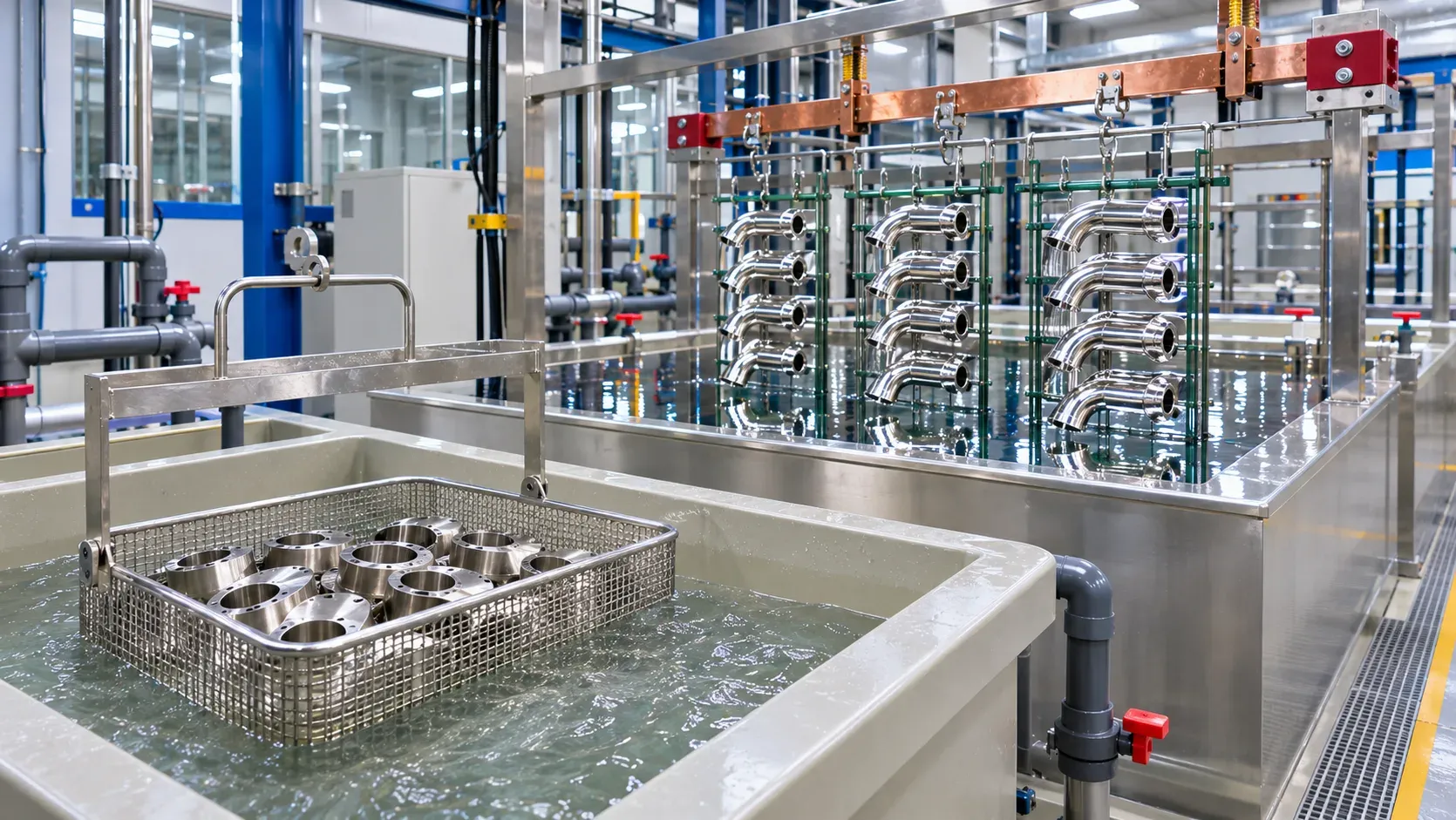
Two stainless steel treatments get confused in buying conversations because both promise corrosion resistance: passivation and electropolishing. They are not competitors — they solve different problems, and many specifications call for both in sequence. This guide separates them, shows what equipment each requires, and gives you a decision path for your parts.
Planning document, not a process datasheet — confirm chemistry parameters with your supplier.
The core difference in one sentence
Passivation is a chemical bath that removes free iron from the surface and restores the chromium-rich passive layer — it changes the surface's chemistry without touching its geometry. Electropolishing is an electrochemical process that removes a thin layer of metal — it changes both chemistry and geometry, smoothing micro-peaks while it enriches the passive layer.
A machined part with fine surface texture and free iron contamination: passivation cleans the chemistry, but the texture stays. The same part needing a smooth, featureless, easy-to-clean surface: electropolishing does both jobs in one step.
Side by side
Aspect | Passivation | Electropolishing |
|---|---|---|
Mechanism | Acid immersion (nitric or citric based) | Electrolytic dissolution — the part is the anode |
Surface geometry | Unchanged — machining marks stay | Micro-smoothed; peaks level out |
Corrosion resistance | Restored to the alloy's natural level | Enhanced beyond the natural level (chromium-enriched layer) |
Material removal | Negligible — contamination only | Thin, controlled layer (as little as 0.0025 mm on deburring passes) |
Cleanability | Standard for the finish | Exceptional — the micro-smooth surface sheds bacteria and residue |
Equipment scope | Tank, heating, ventilation — no rectifier | Rectifier, racks, temperature control, extraction, effluent treatment |
What equipment each requires
Passivation is the simpler line: treatment tanks with heating and ventilation, rinse stages, and the effluent handling the acid requires. No power supply, no racking contacts, no current-density engineering — which is why passivation lines are common even in small shops.
Electropolishing borrows the infrastructure of an electroplating line: a DC rectifier sized to the loaded area, anode racks with engineered contact points, temperature-controlled electrolyte (phosphoric-sulfuric systems per supplier specification), extraction over the evolving gas, and the rinse plus effluent treatment the electrolyte demands. If you already run plating lines, an electropolishing tank slots into the same hall; if you do not, the investment is a line, not a tank.
For the rectifier sizing logic see the surface area and rectifier load guide; the effluent scope is in the wastewater treatment brief.
The decision path
- The part is corrosion-stained or has free iron, geometry is fine. Passivation alone. The cheapest solution that solves the problem.
- The surface must be smooth, bright and easy to clean (medical, pharma, food, semiconductor). Electropolishing — usually after mechanical polishing where machining marks exist. Passivation follows as a final step.
- Tight tolerances. Electropolishing removes as little as 0.0025 mm on deburring passes — mechanical polishing removes far more. Plan the tolerance stack accordingly.
- Magnetic or free-machining stainless grades. Electropolishing does not respond on magnetic grades — passivation or mechanical routes instead. Confirm the grade first.
- Both specified together. Common sequence: mechanical polish → electropolish → passivate. Each stage has its own tank and scope.
Key takeaways
- Passivation fixes chemistry without geometry; electropolishing fixes both — they are complements, not alternatives.
- Electropolishing's equipment scope is a plating line; passivation's is a tank. Budget accordingly.
- Electropolishing removes as little as 0.0025 mm — the tight-tolerance route.
- Deep machining marks survive both — mechanical pre-polishing is the honest answer when scratch removal is required.
- Magnetic stainless grades do not electropolish — confirm the grade before quoting either process.
Your next five steps
- Define what the surface must do: corrosion resistance only, or cleanability and brightness too.
- Confirm the stainless grade (magnetic check on samples).
- Decide the sequence: passivation alone, or mechanical polish + electropolish + passivate.
- Size the equipment: tank-only for passivation, rectifier and racks for electropolishing.
- Add the effluent treatment scope for whichever chemistry you run.
FAQ
Do we need passivation after electropolishing?
Electropolishing leaves a chromium-enriched passive surface; many specifications still call for a final passivation step. Follow your industry standard and customer requirement.
Can passivation make a rough surface smooth?
No — passivation removes free iron only. Geometry changes require mechanical polishing or electropolishing.
Which process costs more to install?
Electropolishing — it needs a rectifier, racks, temperature control, extraction and effluent treatment. Passivation is a tank line without power infrastructure.
Image note: AI-generated editorial photography illustrates equipment or workpiece contexts; it is not an ES-PRO installation, customer reference or evidence of coating performance.


