
Plating Process
Hexavalent vs Trivalent Chrome Conversion
Hexavalent chromium plating has been the industrial standard for decades — hard chrome for wear resistance, decorative chrome for brightness. But REACH authorisation requirements, customer pressure an
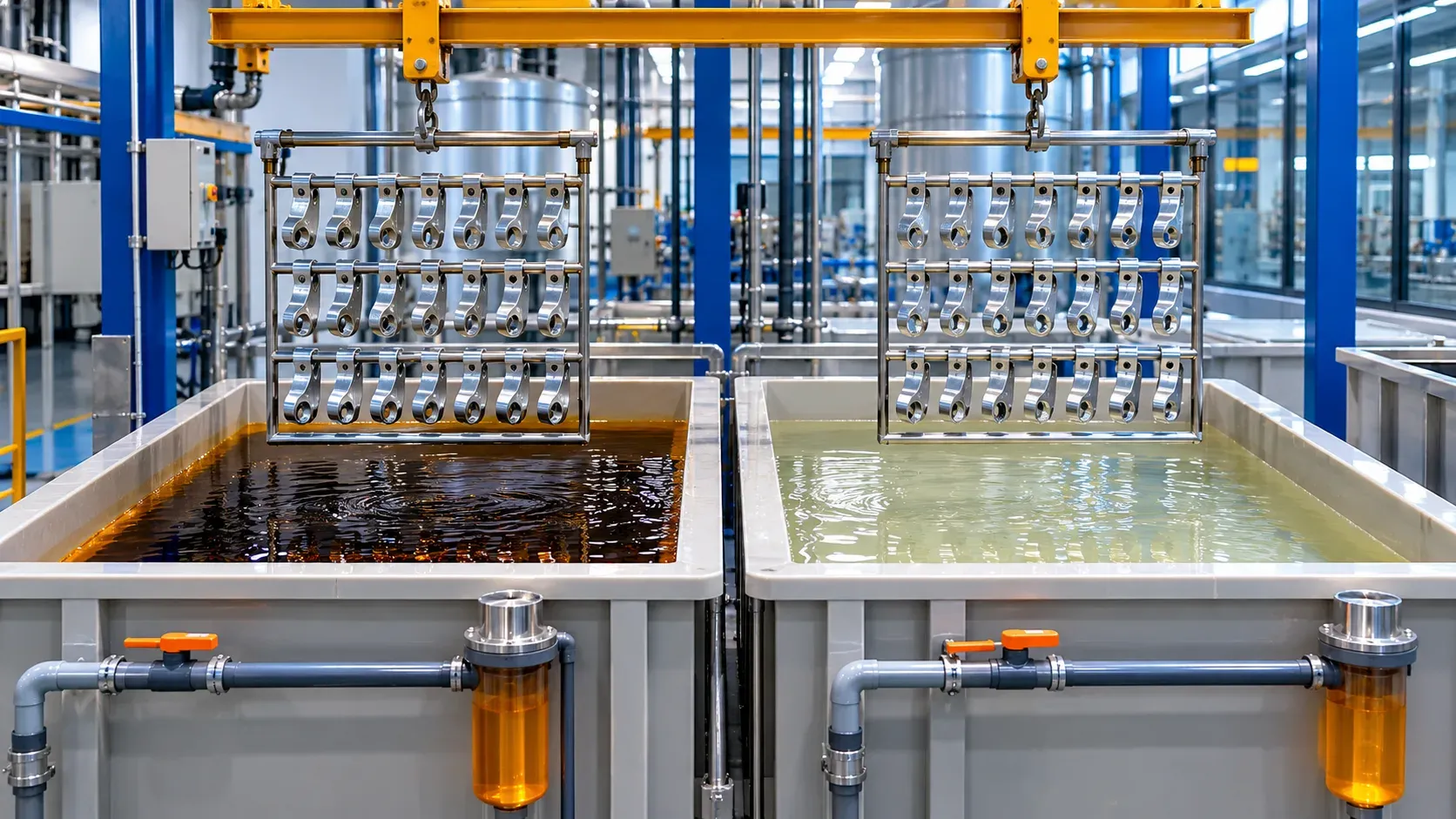
Hexavalent chromium plating has been the industrial standard for decades — hard chrome for wear resistance, decorative chrome for brightness. But REACH authorisation requirements, customer pressure and KKDİK-style national registrations are pushing buyers toward trivalent alternatives. The equipment conversation is not a simple swap: the two chemistries demand different tank materials, current densities, effluent treatment and quality verification. This guide gives you the conversion facts and the equipment scope for both routes.
Planning document, not a process datasheet — confirm chemistry parameters with your supplier.
The chemistry comparison that drives equipment
Parameter | Hexavalent chrome | Trivalent chrome |
|---|---|---|
Deposition rate | Slow — 0.1–0.5 µm per 10 min typically | Faster at equivalent current density |
Throwing power | Poor — needs auxiliary anodes for complex parts | Better — more uniform on complex geometry |
Current efficiency | 10–20% — most energy goes to hydrogen gas | 20–35% — better energy efficiency per µm deposited |
Hardness | 850–1050 HV (hard chrome) | 600–800 HV — softer deposit |
Bath temperature | 50–60°C — needs heating and cooling | 45–55°C — similar thermal management |
Tank material | Lead-lined or PVC with lead; GACT removed after REACH rules | PVDF, PP or high-density PVC |
Effluent treatment | Cr(VI) reduction to Cr(III) before precipitation — extra reduction stage required | Direct precipitation — no reduction stage needed |
Fume control | Mist suppressants + scrubbers — Cr(VI) mist is carcinogenic | Standard acid fume extraction — far less hazardous |
Authorisation status | REACH authorisation required in EU; KKDİK in Turkey; TR CU restricted | No authorisation needed |
The effluent treatment advantage
The single biggest equipment difference is the effluent treatment stage. Hexavalent chrome must be reduced to trivalent before precipitation — this requires an acidified tank with metabisulfite or SO₂ dosing on ORP control, plus a retention tank sized for the batch. Trivalent effluent can go directly to the mixed-metal precipitation stage without the reduction step.
For a hard chrome shop converting to trivalent, the reduction stage equipment becomes redundant. For a new build choosing trivalent, the treatment train is one stage shorter from day one. Either way, the wastewater treatment brief and the agitation brief define the process scope.
Hard chrome: a different conversation
Hard chrome plating (for wear resistance on hydraulic rods, moulds and printing rolls) still relies on hexavalent chemistry because trivalent cannot match the hardness or thickness capability. If your application genuinely needs hard chrome above 50 µm thickness or above 900 HV hardness, the conversion conversation is not about the plating chemistry — it is about the containment: sealed tanks, mist suppression, air monitoring and the REACH authorisation documentation.
For decorative chrome (typically 0.25–0.5 µm over nickel), trivalent is now the industry default for new installations. The color difference (slightly darker, less blue-white) is accepted by most OEM specifications.
Key takeaways
- Trivalent effluent skips the Cr(VI) reduction stage — one fewer treatment tank to build and operate.
- Decorative chrome: trivalent is the default for new lines. Hard chrome: hexavalent still holds for thickness and hardness.
- Tank materials differ — trivalent needs PVDF or PP, not lead-lined.
- Throwing power is better with trivalent: fewer auxiliary anodes needed on complex parts.
- KKDİK and REACH both create registration pressure on hexavalent chemistry supply chains.
Your next five steps
- Classify your chrome need: decorative (thin) vs hard (thick, high hardness).
- For decorative: specify trivalent chemistry and PVDF/PP tank material.
- For hard chrome: evaluate the authorisation pathway and containment investment.
- Recalculate effluent treatment with or without the reduction stage.
- Confirm chemistry KKDİK/REACH status with your supplier in writing.
FAQ
Can we convert our existing hexavalent tank to trivalent?
The tank material must be checked — lead linings are not compatible with trivalent chemistry. The rectifier, hoists and rinse system typically transfer. The chemistry, anodes and effluent treatment all change.
Is trivalent chrome more expensive to operate?
Chemistry costs per liter are higher, but better current efficiency and the absence of the Cr(VI) reduction stage in effluent treatment partially offset the chemistry premium. A total-cost-of-ownership calculation over 3–5 years is the honest comparison.
What about hard chrome replacement technologies?
HVOF thermal spray, electroless nickel (high-phosphorus) and electrodeposited nickel-tungsten alloys are the main alternatives. Each has its own equipment scope and substrate considerations.
Image note: AI-generated editorial photography illustrates equipment or workpiece contexts; it is not an ES-PRO installation, customer reference or evidence of coating performance.


