Plating Lines & Equipment
Electropolishing Equipment: Specify the Part and Process
Electropolishing equipment should be specified using the actual material, approved process, significant surfaces and finished-part limits. Define the permitted dimensional change, loading conditions a
Electropolishing equipment should be specified using the actual material, approved process, significant surfaces and finished-part limits. Define the permitted dimensional change, loading contacts, electrical and thermal duties, rinsing and verification. Choosing a tank and power supply before resolving those inputs can leave the most important part-acceptance questions unanswered.
Material & surfacesFixture & process dutyMeasure the result
Original editorial enquiry framework. Conceptual inputs, not an engineered layout or measured result.
This guide supports a production buyer preparing an electropolishing equipment enquiry. It concerns the conditions the equipment must accommodate, rather than prescribing an electrolyte or operating recipe. Start with representative parts and a drawing that distinguishes appearance, surface condition and dimensional requirements.
What result is required on each electropolished surface?
Identify the alloy, manufacturing condition and relevant fabrication history. Mark the areas that matter to the customer, including those that are difficult to access or measure. State the incoming condition and the required finished condition using the product authority's chosen inspection method.
Where a surface-roughness requirement applies, record the parameter, measurement locations and acceptance method. An appearance description such as “bright” or “smooth” should not silently substitute for a measured requirement. Conversely, a local roughness reading should not be assumed to define appearance over the whole component.
The official ASTM B912-26 record concerns passivation of stainless steels using electropolishing. Use its applicable material scope and the agreed edition where the project specification calls for it. The reference does not validate an equipment package or establish a universal finish for every alloy and geometry.
Which dimensional and contact limits should electropolishing preserve?
Provide the finished-part tolerances and identify features where material removal must be assessed. Include threads, sealing faces, sharp features, thin sections or other critical geometry selected by the product authority. Ask the process owner to define the acceptable change and the verification required for those locations.
Mark permitted fixture contacts and any areas that require masking or a restricted treatment boundary. Specify how contact marks are judged after processing. A component supported successfully in a tank can still be unacceptable if the fixture touches a significant finished surface.
Input | Buyer/process-owner requirement | Equipment assessment question |
|---|---|---|
Material and condition | Alloy, fabrication state and incoming surface | Which approved process applies to representative parts? |
Significant surfaces | Marked drawing and finish requirements | Where must the proposed treatment be assessed? |
Dimensions | Finished limits and permitted changes | Which features need before/after measurement? |
Contacts/masking | Allowed locations and restricted areas | What fixture or masking trial is required? |
Operating duty | Approved electrical, temperature and timing requirements | Which control and service functions must be quoted? |
Verification | Agreed methods and acceptance authority | What part evidence and equipment records are required? |
This original enquiry worksheet is a planning aid. It is not a designed fixture, a treatment recipe or a customer test result.
How does part geometry affect electropolishing equipment selection?
Review the largest part and the full product mix. Give the proposed load arrangement, loaded weight and handling restrictions. Identify trapped-liquid areas and the orientation constraints that the process owner needs to evaluate. Include the clearance needed for fixtures and handling as well as the part's external dimensions.
Ask for a proposal explaining the electrode and fixture arrangement at the level appropriate for the assessment. The question is how the approved process can be implemented for the significant surfaces. Do not accept a generic photograph as proof that the particular recesses, contacts and tolerances have been evaluated.
For a production line, identify loading and unloading tasks, transfers, rinsing and subsequent handling. Use the plating-line setup checklist to coordinate the surrounding services. Equipment capacity should be related to the agreed load and route, with manual work and changeovers stated.
Which electropolishing factory services need a defined supply scope?
List the approved electrical operating requirement and the factory supply conditions. Define heating or cooling duties, process monitoring and any circulation functions selected for the route. Ask which instruments, connections and control interfaces accompany the equipment.
Rinsing and downstream cleanliness need their own requirements. Identify water quality at the selected points of use, drainage and the intended acceptance checks after rinsing or drying. An electropolishing result judged before the final handling steps does not establish the condition delivered to the customer.
The European Commission JRC surface-treatment reference provides EU technical context for electrolytic and chemical installations. Its role here is background for the site assessment; project-specific permissions and equipment duties must still be established.
What should an electropolishing equipment trial establish?
Agree the representative incoming parts, approved process and loading arrangement. Preserve the part identity and incoming condition. Measure the significant features selected by the product authority before and after processing, using the agreed methods and locations.
Record process conditions alongside the finished-part evidence. Ask which outcomes the trial demonstrates and which remain subject to further work. A demonstration judged only on brightness may leave dimensional, roughness, passivation or subsequent cleanliness requirements unresolved.
For a replacement, identify the existing limitation and the equipment retained. Separate a process-development question from a confirmed equipment deficiency. Ask which new assessments or approvals are needed if the fixture, electrical operation or production route changes.
Questions You May Have:
Is electropolishing interchangeable with chemical passivation?
Use the treatment required by the product specification. The relevant preparation, operating and acceptance requirements must be identified rather than treating the method names as interchangeable.
Does a bright sample prove that every tolerance is satisfied?
No. Verify the agreed significant surfaces and dimensional features using the selected methods. Appearance and dimensional acceptance answer different questions.
Can tank dimensions alone establish the usable load?
The fixture, electrode arrangement, clearances, handling and approved process also need assessment for the actual part mix.
Can an equipment discussion start before the surface specification is final?
Yes. Describe the part and intended result, and mark unresolved requirements. Final selection and acceptance need the relevant requirements approved.
Get Proposal and Demo
Introduce your electropolishing requirements with the known material, significant surfaces and production objective. Company, name, email and project country are required; technical details are optional. Ask ES-PRO to assess the requested equipment scope and confirm which configuration and part demonstration are applicable.
Drawings and inspection requirements can follow by sales email, or chat on WhatsApp. Use the quotation scope guide and the coating measurement overview to separate equipment duties from the actual inspection requirement.
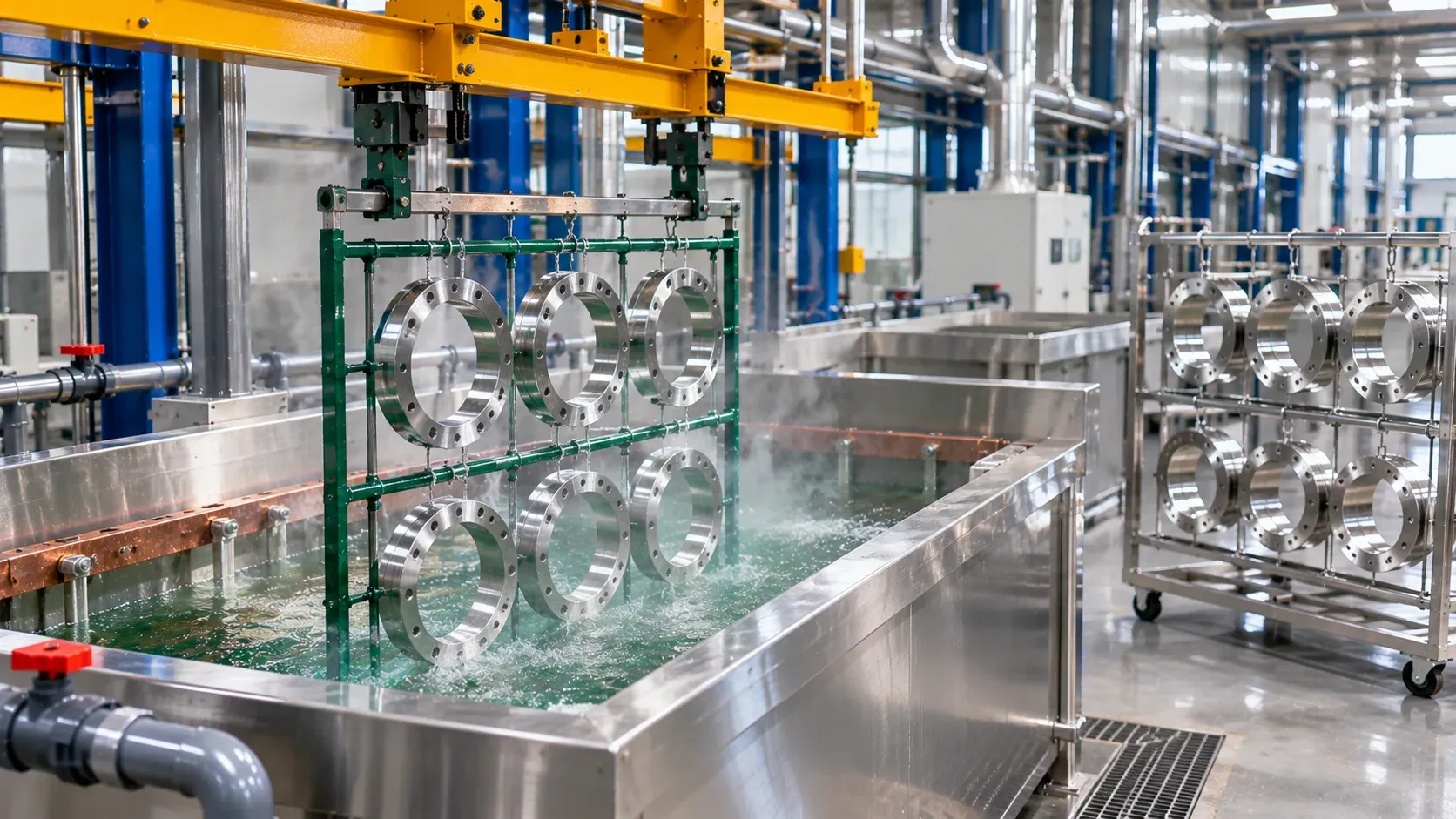
Image note: AI-generated cover illustration; not an ES-PRO installation, customer project or test result.