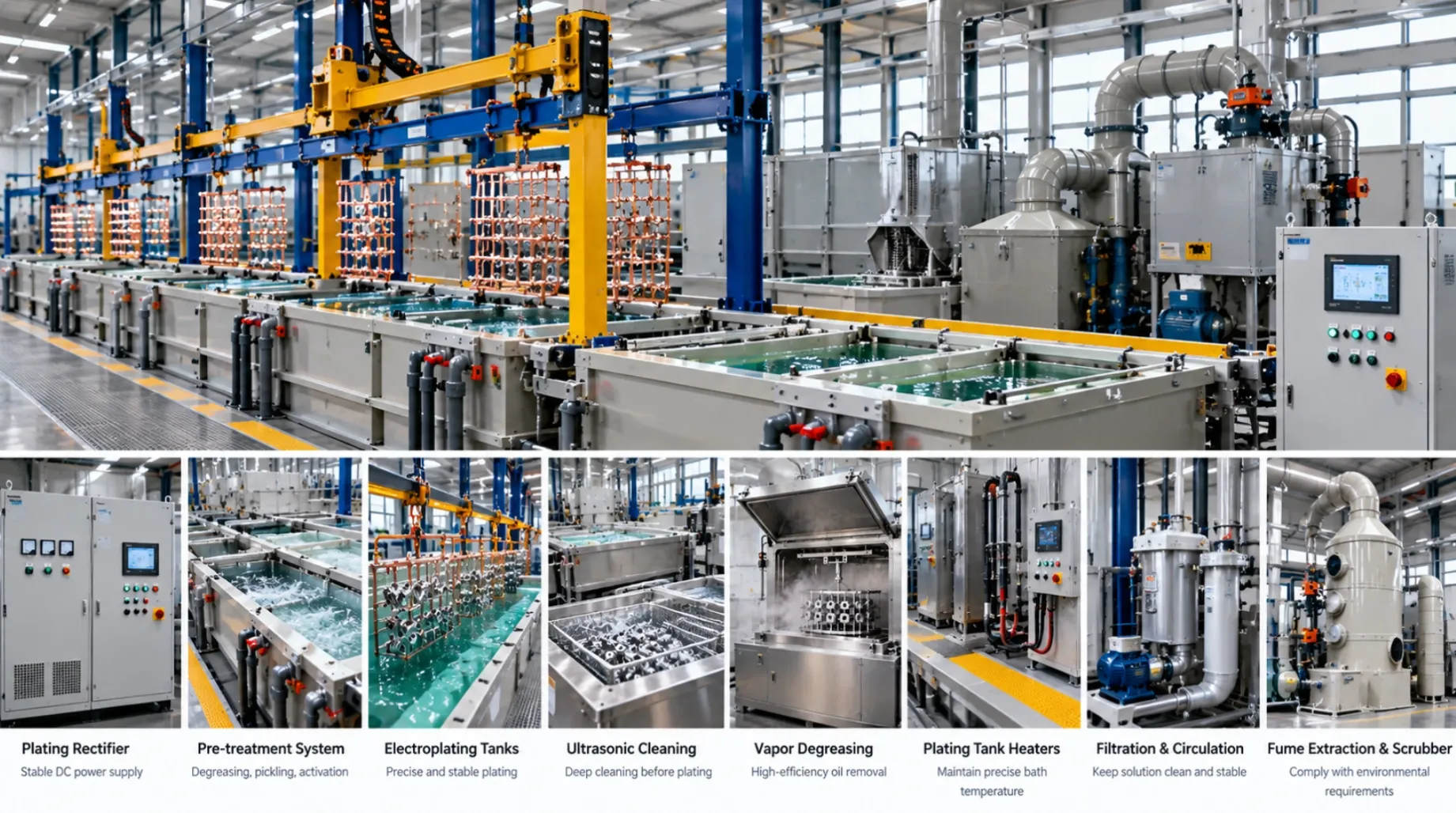
Electroplating stainless steel requires a coating specification and a preparation route assessed for the actual stainless grade and surface condition. Before defining a line, identify the coating's purpose, acceptable contact locations and verification requirements. A part labeled only “stainless steel” leaves important process and equipment decisions unresolved.
This is a project-planning guide for manufacturers buying equipment or assessing an upgrade. It does not provide a chemical preparation recipe. The process specialist should approve the preparation and coating sequence, while the equipment offer identifies the duties needed to run that sequence.
In this guide
What should the coating achieve on the stainless steel part?
Explain why the coating is required: appearance, an electrical contact surface, wear behavior or another specified function. Supply the actual drawing and acceptance criteria. Avoid asking the supplier to infer the coating merely from the part's application name.
If only some surfaces are plated, mark those areas. Identify threads, sealing faces, holes and tolerance-critical dimensions, together with areas that must remain uncoated. Include any acceptable contact marks or masking restrictions. A marked drawing is more useful than a general statement that the finish should look good.
Passivation and a deposited metal coating are different treatment objectives. If the drawing calls for passivation, use our stainless steel passivation equipment brief to frame that project.
Which stainless steel and surface details does a plating inquiry need?
State the stainless steel grade, manufacturing route and previous finishing operations. Include welds, machined areas, heat treatment, polishing, protective films and known residues. If the material identity is uncertain, provide the available certificates and explain the uncertainty.
Ask the process owner to review representative parts before selecting the preparation route. Parts with the same nominal grade can arrive with different surface conditions. That difference belongs in the project record rather than being discovered after the equipment has been ordered.
If several material grades or part families will use one line, provide a family schedule. Show what changes between them: preparation, coating sequence, loading, masking or verification. The supplier can then identify which equipment duties or changeovers need separate assessment.
How does stainless steel preparation affect plating equipment scope?
An equipment quotation needs the approved stage duties, operating windows and required control functions. Request a tank schedule identifying each stage's purpose, wetted-material assessment, temperature-control duty and transfer requirements. The brief should not substitute a generic sequence for the approved process.
If the process is not yet approved, start the inquiry with the known part information and coating objective, and list the unresolved route items explicitly. Agree who owns process development and which representative samples need assessment before the technical equipment scope is frozen. First contact does not require a completed process sheet.
Assign rinsing, drying, extraction and effluent responsibilities alongside the coating equipment. List any services retained from an existing line and their verified condition. Ask who checks the interfaces before those existing services are treated as suitable for the proposed process.
Which stainless steel plating transitions need controlled transfer?
The public ASTM B254-26 record describes preparation and activation before metal deposition on stainless steel. Re-formation of the surface film makes transfer conditions relevant to adhesion. Translate the approved route into equipment duties; the abstract is not a universal recipe, prescribed waiting time or company qualification.
A nickel strike, including a Wood's strike where appropriate, is one preparation/deposition option for the process specialist to assess. The archived 1981 UCRL-86673 research report documents nickel-strike approaches tested on stainless alloys; it is historical research, not a universal production route or current acceptance standard. Confirm the actual grade, starting condition, subsequent coating and required stage duties with the process owner rather than selecting a bath from its name.
Ask the process owner to mark transitions where drying, waiting or carryover can invalidate the approved preparation. Supply the permitted conditions from process documents rather than inventing a transfer time. These requirements affect scheduling, occupied-stage handling, rinse interfaces and interruption recovery.
| Part or route feature | Equipment question | Trial evidence to agree |
|---|---|---|
| Prepared surface awaiting deposition | Which transitions need controlled handling, and what happens when a stage is unavailable? | Load-linked preparation/transfer record and finished-coating checks |
| Recessed, welded or tolerance-critical feature | Can orientation, contact and drainage serve the actual geometry? | Inspection/measurement locations mapped to the drawing |
| Mixed grade or prior surface condition | Which preparation, recipe or tooling assessment changes by family? | Representative samples and recorded approval boundary |
| Masked or uncoated feature | How are exclusion zones, contacts and masking removal handled? | Boundary and dimensional checks against the marked drawing |
A passing adhesion check on a convenient coupon does not establish every feature on a production load. Agree whether coupons are representative, which actual parts must be examined, the governing method and release authority. This is an equipment/trial schedule, not a new acceptance standard.
A drawing checklist for plating stainless steel parts
| Item to mark or describe | Why the equipment assessment needs it |
|---|---|
| Stainless grade and surface condition | Establishes the substrate and preparation questions |
| Coating metal / stack and coated surfaces | Identifies the specified layer sequence and areas; unresolved items remain marked for confirmation |
| Specified thickness, tolerance and measurement locations | Aligns the coating requirement with actual features and agreed inspection; do not insert a generic value |
| Finished dimensional limits | Identifies features needing masking or special inspection |
| Acceptable contact locations | Helps assess rack contact and part orientation |
| Maximum dimensions and loaded weight | Supports handling and usable tank-space assessment |
| Appearance and adhesion acceptance | Defines the result the trial or commissioning must demonstrate |
| Product mix and output unit | Gives a basis for load and cycle assumptions |
For a flange like the illustrative cover workpiece, mark the sealing face, bore, threads and any permitted rack-contact points on the actual drawing. Confirm which must be coated, excluded or protected; the image does not identify those requirements.
This table is an ES-PRO editorial inquiry framework. It does not establish that a proposed coating is suitable, or that a particular handling arrangement has already been validated.
What should a stainless steel plating sample trial demonstrate?
Agree which sample parts represent the difficult features, not just the easiest flat surface. Include recessed areas, welds, masking boundaries or other specified features where relevant. Define the preparation route and inspection method to be recorded during the assessment.
The acceptance plan should identify who assesses adhesion, thickness, appearance and any required functional result. A photograph of an attractive part cannot establish all those characteristics. Ask for the agreed records and retain the material identity with them.
If an initial sample result changes the route, update the equipment brief before comparing quotations. Keep assumptions visible: part loading, stage conditions, timing and verification responsibilities should refer to the same approved requirement.
How should stainless steel plating output be specified?
State accepted output in pieces, mass or plated area per month, using a unit suited to the part family. Include working shifts and anticipated product changes. Ask the supplier to distinguish the time within a process stage from the interval between completed loads.
For handling options, review gantry-type electroplating equipment. For scope planning, use the line setup checklist. These pages help organize the equipment discussion; they do not approve a stainless steel preparation route.
Questions You May Have:
Can I use a generic steel-plating brief for stainless steel?
Use it as a document structure, but identify the stainless grade and preparation requirements explicitly. Do not assume the same sequence applies to every substrate.
Is a finished-part photo enough to begin?
It can start the conversation. Add the material grade, dimensions, coating purpose and critical surfaces so the missing information can be identified.
Should the sample trial use the final loading arrangement?
Where practical, agree a representative arrangement and record differences from production. A successful isolated sample does not by itself prove the planned production load.
Does a line quotation include coating approval?
Only if that responsibility is explicitly included and defined. Identify the process owner, acceptance tests and sign-off responsibilities in the supply boundary.
Get Proposal and Demo
Share your stainless steel coating requirement with a marked drawing, material grade and accepted-output target. Ask which trial and equipment configuration should be assessed. Technical files can follow at sales@electroplating-equipment.com.
For first contact, only company name, your name, email and project country are required. Phone, city and all technical fields are optional; supporting files can follow by email.