Plating Process
Plating Line Automation ROI Guide
Automating a plating line is the single biggest investment decision after the chemistry. The ROI calculation is not just about replacing an operator — it is about consistency, traceability, customer a
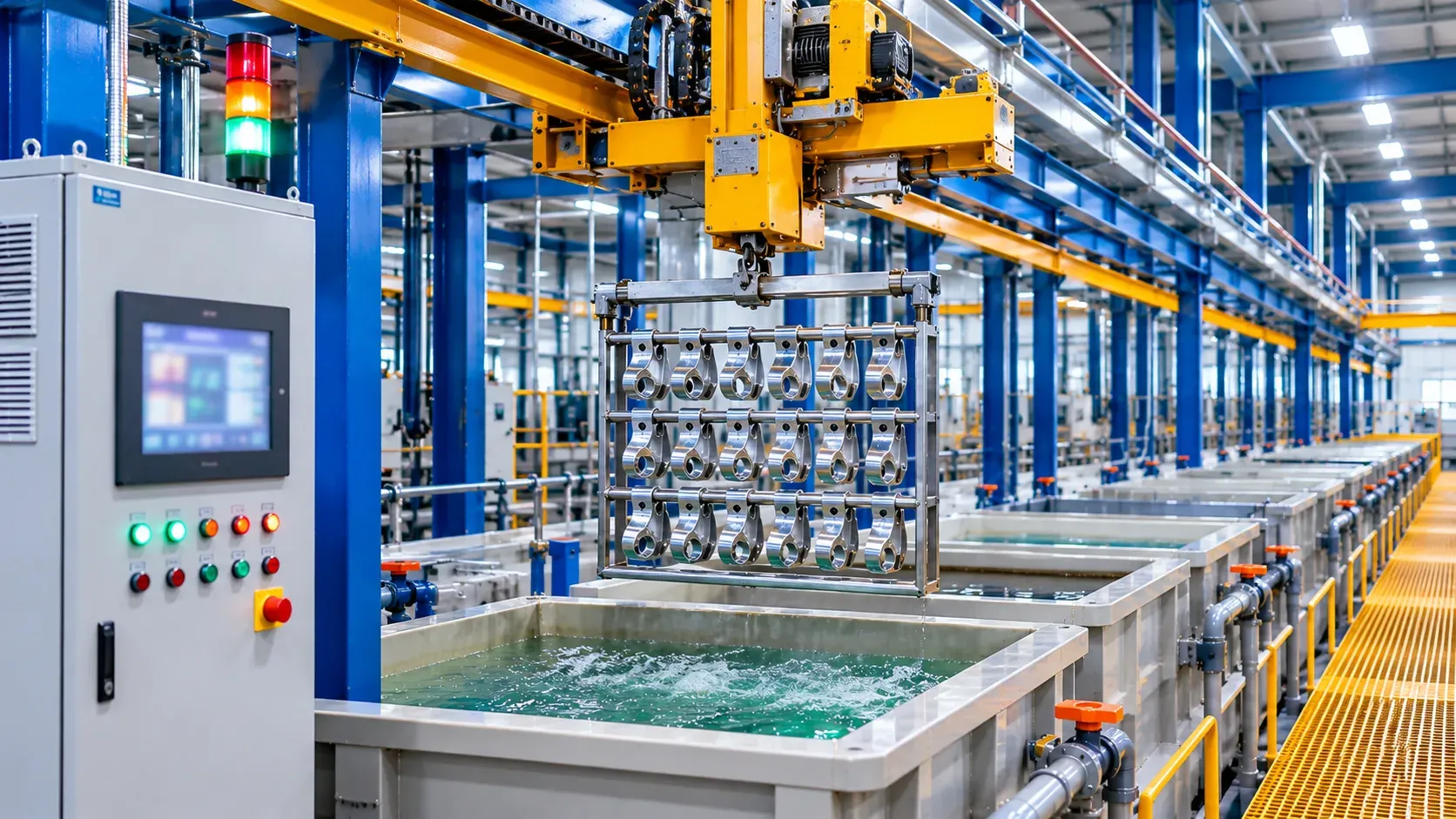
Automating a plating line is the single biggest investment decision after the chemistry. The ROI calculation is not just about replacing an operator — it is about consistency, traceability, customer audit readiness and the ability to scale without scaling labour. This guide covers the automation levels, what each adds, and how to calculate the return.
Technical planning document — confirm costs against your regional labour rates and production volumes.
The three automation levels
Level | Description | Equipment added | Cost range |
|---|---|---|---|
Manual | Operator moves racks or barrels between tanks by crane or manually; timing by experience | Overhead crane, tanks, rectifiers | Base line cost |
Semi-automatic | Single-hoist system with programmed tank sequence; operator loads and unloads | Single automated hoist, programmable controller, position sensors | Base + €30,000–60,000 |
Full automation | Multiple hoists with recipe control, automatic loading/unloading, data logging, remote monitoring | Multi-hoist system, PLC/SCADA, traceability, recipe management, remote access | Base + €80,000–250,000 |
What automation delivers beyond labour saving
The labour saving is the easiest ROI to calculate, but it is rarely the largest benefit. The bigger returns come from:
- Consistency. Every rack follows the same cycle time, the same dwell time, the same current density — every time. Manual timing varies by operator, shift and workload.
- Traceability. Each part is linked to its rack, cycle, bath data and test results. This is what OEM audits and ISO certifications require.
- Scalability. Increase production without increasing operator headcount. The hoist system runs the same programme with more racks.
- Quality control. Alarm management prevents skipped steps, wrong tank sequences and over-exposure — the defects that manual operation produces.
- Recipe management. Store multiple process programmes and switch between them for different routes or customers — without operator training for each change.
Calculating the ROI
Benefit | How to calculate | Typical annual value |
|---|---|---|
Labour saving | Operator salary × number of operators replaced | €30,000–50,000 per operator |
Reduced defects | Defect rate reduction × cost per defect × production volume | €10,000–50,000 depending on defect rate |
Increased throughput | Additional capacity × margin per part | Varies — often the largest benefit |
Audit compliance | Audit preparation time saved + audit failure risk avoided | €5,000–20,000 |
Energy saving | Optimised cycle times reduce rectifier and heating energy | €3,000–10,000 |
The payback period for semi-automatic automation is typically 2–4 years. For full automation, 3–5 years — longer payback but larger strategic benefit for OEM audit compliance and scaling.
Key takeaways
- Three automation levels exist: manual, semi-automatic (single hoist) and full automation (multi-hoist with recipe control).
- Labour saving is the easiest ROI to calculate but consistency and traceability deliver the larger strategic value.
- Payback period: 2–4 years for semi-automatic, 3–5 years for full automation.
- Recipe management enables multi-customer, multi-route production without operator retraining.
- Automated data logging satisfies OEM audits and ISO certifications without manual documentation.
Your next five steps
- Measure your current operator cost, defect rate and audit preparation time.
- Define which automation level matches your production volume and audit requirements.
- Calculate the ROI with the benefits table above.
- Specify the automation scope: hoist type, controller, recipe management, data logging.
- Plan the installation with commissioning, operator training and a validation run.
FAQ
Can we automate an existing manual line?
Yes — a hoist system can be retrofitted to existing tanks. The tank positions, rectifier control and treatment plant must be compatible with the automation controller. A site survey confirms feasibility.
What is recipe management?
The ability to store and recall different process programmes (tank sequences, dwell times, current densities) for different part routes or customers. The operator selects the recipe and the hoist system runs it automatically.
Does automation eliminate operators?
No — it changes the operator's role from moving parts to monitoring the process, loading racks and responding to alarms. One operator can supervise a fully automated line that would require 3–4 people manually.
Image note: AI-generated editorial photography illustrates equipment or workpiece contexts; it is not an ES-PRO installation, customer reference or evidence of coating performance.