High-Phosphorus Electroless Nickel: A Line Planning Brief
Plan high-phosphorus electroless nickel equipment using deposit classification, substrate, approved chemistry, final condition and acceptance records.
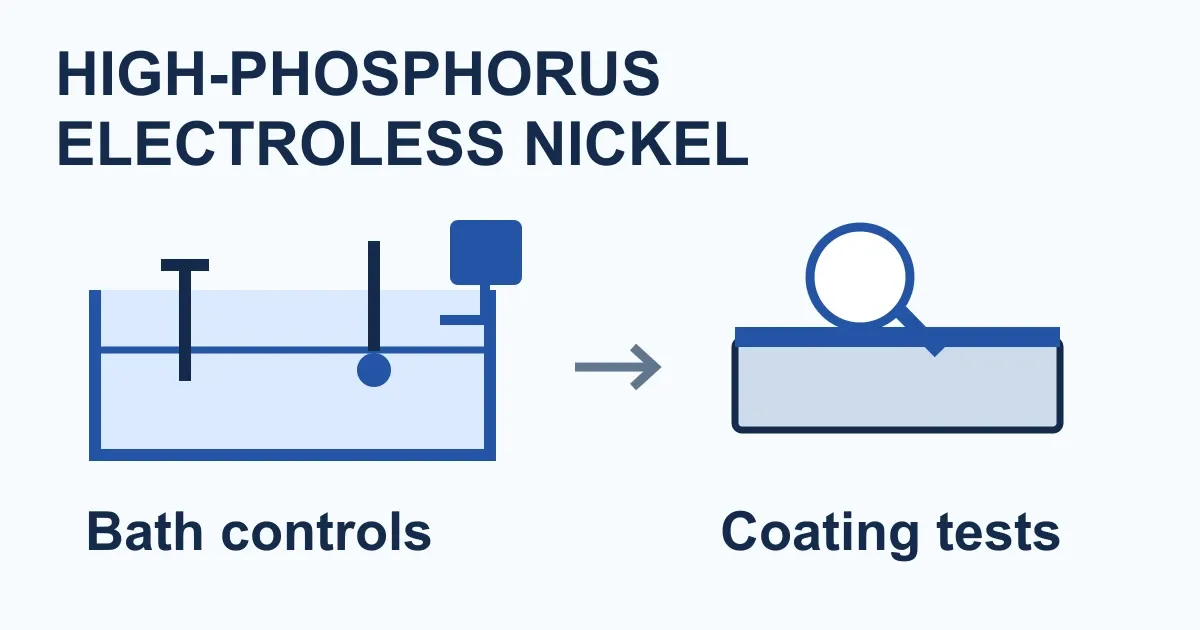
Cover concept: bath controls and coating verification are separate evidence streams. Editorial illustration; not a machine design or test result.
Prepared by the ES-PRO editorial team · Updated 15 October 2026. Source basis: the public ASTM scope and the NBS study linked below; the comparison schedules are editorial purchasing tools.
High-phosphorus electroless nickel is a nickel-phosphorus alloy deposited by chemical reduction. The public scope of ASTM B733-22(2026) describes high phosphorus as more than 10% P. That source-specific description is a starting point: the customer's coating designation, required revision and final condition still govern the order. Equipment selection must connect those requirements to bath control, part handling and coating verification.
Why does the phosphorus designation change the brief?
A buyer considering high phosphorus may be seeking corrosion resistance in a specified environment. The ASTM public scope discusses salt-spray and acid resistance, but that does not establish a service-life promise for a particular part. Identify the exposure, substrate, significant surfaces and the required evidence before choosing the deposit.
Keep three decisions separate: deposit composition, coating thickness/service condition, and any specified post-plating treatment. A phosphorus label supplies none of the missing drawing tolerances or acceptance limits. Commercial chemistry descriptions can use different ranges, so ask the process owner to map the proposed system to the actual contract.
What controls belong in the equipment comparison?
Request a function-by-function offer for the selected chemical system. A heated tank, an automatic analysis/dosing package and a qualified coating process are different deliverables. Mark which functions are included, supplied by the chemistry partner, performed in the plant laboratory or retained from an existing installation.
The historical NBS report on electroless nickel process variables, by Ogburn and Johnson (1973), studied two acid baths. It examined temperature, pH, nickel/reducer replenishment and deposit properties. Its sections on phosphorus and thickness uniformity show why these variables need attention; its experimental conditions are not operating instructions for a current proprietary bath.
| Function to discuss | Process-owner input | Supplier deliverable to identify | Demonstration evidence |
|---|---|---|---|
| Temperature measurement and control | Approved bath window, sensor location and permissible deviation | Sensor, controller, heating interface and any separate protective function | Calibration reference and a time-stamped measured-temperature trend for the agreed test |
| pH and nickel analysis | Approved analytical methods, sampling interval and action rules | Manual sampling provision or an identified automatic analyser, with calibration procedure | Sample identity, result, calibration record and comparison with the agreed reference method |
| Replenishment | Approved chemicals, addition rules and mixing delay | Dosing equipment, manual/automatic mode and loss-of-signal response | Addition quantities, related analysis results and a safely simulated fault response |
| Circulation and filtration | Chemistry-approved materials, filtration and loading arrangement | Pump/filter duties, access and maintenance method | Representative-load coverage/rinsing observations plus agreed coating measurements |
| Bath history and alarms | Required events, retention period and authorised interventions | Batch identification, alarm history and export functions actually included | Retrieve one load's analysis, additions, measured values and acknowledged exceptions |
These are conditional comparison examples, not a standard ES-PRO package. Define the approved control plan first. A pH trace or dosing record alone does not measure phosphorus in the deposit; coating composition requires its own agreed method and sampling plan.
How do part geometry and monthly output affect the line?
Provide maximum dimensions, normal load, exposed surface area and product mix. For internal passages, describe openings, orientation, trapped-air risks and permitted drainage methods. Electroless deposition does not remove the need for solution access: a well-controlled bulk bath does not prove that every recessed surface receives equivalent conditions.
State monthly output as accepted pieces or square metres, with the number of working shifts. For mixed parts, give both part counts and coated area where available. The same number of pieces can represent very different chemical demand, rack occupancy and inspection work. Compare capacity through preparation, deposition, transfer, rinsing and release rather than using tank time alone.
Use the line planning checklist to identify shared stages and loading work. Ask for the stated load assumptions and the limiting stage behind any capacity estimate; do not treat the chemistry's deposition rate as the complete line output.
What should an acceptance record actually show?
Start with a common record header: part/lot identity, drawing revision, substrate condition, coating designation, chemistry identification, load pattern and relevant process dates. Assign a responsible party and an acceptance limit from the approved plan to each characteristic.
The following is an illustrative procurement matrix for a part family, not a completed customer test or a prescribed inspection frequency.
| Requirement | Evidence to define | Inspection stage and responsibility | Record to retain |
|---|---|---|---|
| Deposit composition | Contract phosphorus classification and an agreed composition method/sampling plan | Agreed deposit condition; named laboratory or qualified inspection party | Sample-to-lot link, method, measured result and approval decision |
| Thickness on significant surfaces | Drawing-marked locations and a suitable measurement method | Defined stage before release; identified inspector | Location map, calibration reference and actual readings |
| Any specified post-treatment | Approved purpose and schedule, including the applicable material restrictions | Named treatment provider and inspection stage | Load identity, treatment record and any required subsequent test |
| Equipment functions | Agreed control, alarm, dosing and record-export tests | Supplier/customer commissioning team under an approved safe procedure | Test script, observed response, exceptions and sign-off |
Equipment-function demonstration and coating qualification should have separate sign-offs. For example, exporting a temperature trend can prove that a recording function works; it cannot, by itself, prove composition, adhesion or corrosion acceptance. The coating measurement guide helps plan the related inspection discussion.
What changes in an upgrade project?
List retained tanks, wetted components, heaters, filters, instruments and controls. Supply their materials and condition records. Ask the process owner and equipment assessor to resolve compatibility with the new chemical system before accepting retained items in the offer. An existing nickel tank is not automatically suitable for another approved route.
Include utility capacity, extraction, wastewater interfaces, installation access and shutdown constraints. The quotation scope guide helps allocate these responsibilities. Keep any specified property-changing heat treatment distinct from routine drying when assigning equipment and records.
Questions You May Have:
Can a chemistry controller prove the deposit is high phosphorus?
No. It can demonstrate the bath variables and actions it actually measures or records. Deposit phosphorus needs the agreed composition assessment linked to the relevant sample or lot.
Does electroless deposition require plating current through the workpiece?
The nickel-phosphorus deposit is formed by chemical reduction, rather than by an externally applied plating current through the workpiece. Other preparation stages may have their own electrical duties, which belong in the stage list.
Should I quote output in pieces or square metres per month?
Use the unit relevant to the plant and include the product mix. Coated area is especially useful when comparing chemically different loads; part dimensions and rack occupancy are still needed to assess handling.
Can I request a proposal before the inspection plan is final?
Yes. Share what is known and identify the undecided items. Ask for a provisional equipment boundary and the evidence needed to resolve it; keep unapproved coating acceptance limits out of the final commitment.
Get Proposal and Demo
Discuss your electroless nickel project with company, name, email and project country. Technical fields are optional. Share the part drawing, coating designation, monthly output and required control functions when available.
Send drawings or specifications to sales@electroplating-equipment.com, or chat on WhatsApp. For the wider process choice, see electrolytic versus electroless nickel.