Electroless Nickel Thickness: A Production Planning Brief
Specify electroless nickel thickness with measurement locations, tolerances, part geometry and process controls. Connect coating requirements to line capacity.
Electroless nickel thickness should be specified with measurement locations, acceptance limits and the complete coating requirement. A nominal thickness alone does not define a production or equipment brief. Connect the required result to representative parts, an approved process route and an inspection plan before using coating time to estimate line capacity.
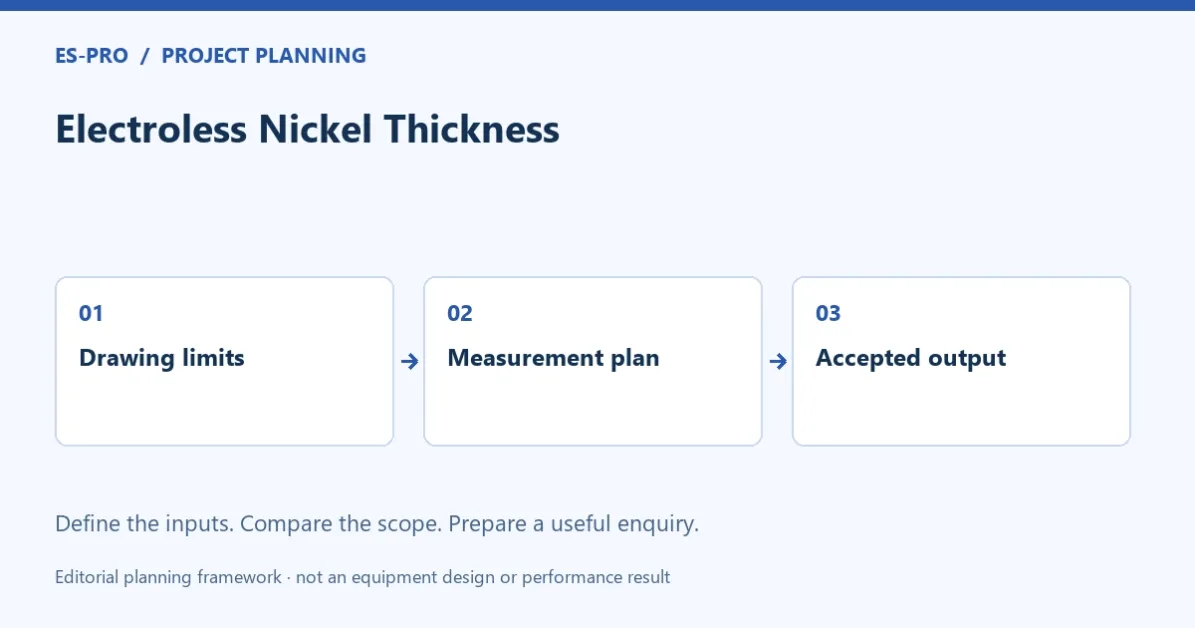
ES-PRO · EQUIPMENT PLANNINGElectroless Nickel Thickness01Drawing limits→02Measurement plan→03Accepted outputEditorial enquiry framework · not an equipment design or performance resultDrawing limits → Measurement plan → Accepted output. Source: ES-PRO editorial planning framework. Conceptual inputs; not a construction drawing or measured result.
This article helps a buyer prepare that connection. It does not recommend a universal thickness for an unidentified component. The customer drawing or responsible design team should establish the functional requirement and finished dimensional limits.
What should an electroless nickel thickness callout specify?
Provide the coating designation, agreed specification edition and the dimensions after finishing. Mark the surfaces where coating is required, where it is excluded and where measurements will decide acceptance. Distinguish an agreed minimum, maximum, range or other acceptance definition.
The ISO 4527 official record identifies a specification and test-method document for autocatalytic nickel-phosphorus alloy coatings. Use the complete agreed specification rather than assigning a thickness from the public title. Any additional customer requirement should remain visible alongside it.
If the drawing is incomplete, identify the decision owner and list the missing requirements. Asking an equipment supplier for a “standard thickness” can move an unresolved design decision into a quotation where it is easily mistaken for approval.
Which part features need separate electroless nickel measurements?
Use a marked drawing or annotated part photograph. Identify critical fits, recessed features, internal surfaces, edges and masking boundaries where applicable. Explain access limitations for the proposed measurement method.
Agree whether the inspection uses the actual part, a representative coupon or another accepted approach. A convenient flat measurement location should not silently replace a required location on the component. Ask the inspection specialist to identify the appropriate method, limitations and records.
Our coating thickness testing guide introduces measurement choices. The present task is deciding what will be measured and how the result connects to the drawing and load record.
An electroless nickel thickness and acceptance schedule
Schedule entry
What to record
Part identity
Drawing revision, material and representative part family
Coating requirement
Deposit designation, specification edition and additional customer conditions
Location
Marked surface or feature, including access or masking restrictions
Acceptance
The agreed minimum, maximum or other defined criterion
Method
Approved measurement approach and any relevant limitation
Sampling
Who selects parts and the agreed sampling responsibility
Record
Result associated with part identity, load and approved process record
The table is an original editorial planning schedule. It does not supply test limits, validate a measurement method or establish a production performance result.
Why does nickel thickness alone not define electroless plating time?
The equipment proposal needs the approved operating requirements and production assumptions. Ask the process owner and supplier to explain the deposition-time basis and the conditions under which it is expected to apply. Record which assumptions need sample verification.
The NASF electroless deposition course identifies operating variables and quality control as distinct subjects. That distinction is useful in a purchase brief: a nominal coating requirement is only one part of the operating and acceptance plan.
Also separate process residence time from the interval between completed loads. Loading, preparation, rinsing, drying, unloading and inspection can affect accepted output. A calculation using only nickel deposition time does not describe the complete line.
How should part geometry and loading enter an electroless nickel brief?
Provide maximum dimensions, weight, intended load arrangement and restrictions on contact or handling. Identify parts with internal passages or other features needing special assessment. Ask how the proposed arrangement supports access to the surfaces defined in the coating requirement.
Include the product mix, working shifts and accepted monthly output. Request the capacity assumptions for the largest, smallest or most demanding relevant load rather than accepting one unexplained headline figure.
If alternative coating routes remain under consideration, the electrolytic versus electroless nickel comparison helps organise those choices. Keep the selected route and acceptance requirements consistent across equipment offers.
What should an electroless nickel production trial establish?
Agree the representative part and loading arrangement, approved process route and inspection schedule. Record the actual conditions used in the trial and any differences from the intended production setup.
The trial should address the required measurement locations and finished features, not just provide a visually attractive sample. Identify who evaluates thickness, adhesion, dimensions and any further specified property. The tests and limits come from the agreed requirement.
If the trial changes the loading or process assumptions, update the equipment brief before finalising capacity. Preserve the connection between the accepted sample result and the conditions that produced it. Otherwise a favourable result may be used to support an offer with different production assumptions.
Questions You May Have:
Is there one standard electroless nickel thickness for every part?
No. Start with the required function, specification and finished dimensions. The appropriate acceptance requirement belongs to the responsible design or customer process.
Can the nominal thickness be the only acceptance value?
Only if the agreed specification makes that sufficient. Clarify limits, locations, methods and sampling before treating a nominal value as the complete requirement.
Does a successful flat coupon prove every feature on the part?
Not automatically. The inspection plan must explain the coupon's role and how the actual component's required surfaces are assessed.
Can capacity be quoted before thickness is approved?
A preliminary discussion can use stated assumptions. Identify the unresolved coating requirement and the conditions needed to confirm output before ordering equipment.
Image note: AI-generated cover illustration; not an ES-PRO installation, customer project or test result.
Electroless nickel thickness should be specified with measurement locations, acceptance limits and the complete coating requirement. A nominal thickness alone does not define a production or equipment brief. Connect the required result to representative parts, an approved process route and an inspection plan before using coating time to estimate line capacity.
Drawing limits → Measurement plan → Accepted output. Source: ES-PRO editorial planning framework. Conceptual inputs; not a construction drawing or measured result.
This article helps a buyer prepare that connection. It does not recommend a universal thickness for an unidentified component. The customer drawing or responsible design team should establish the functional requirement and finished dimensional limits.
What does the thickness requirement need to say?
Provide the coating designation, agreed specification edition and the dimensions after finishing. Mark the surfaces where coating is required, where it is excluded and where measurements will decide acceptance. Distinguish an agreed minimum, maximum, range or other acceptance definition.
The ISO 4527 official record identifies a specification and test-method document for autocatalytic nickel-phosphorus alloy coatings. Use the complete agreed specification rather than assigning a thickness from the public title. Any additional customer requirement should remain visible alongside it.
If the drawing is incomplete, identify the decision owner and list the missing requirements. Asking an equipment supplier for a “standard thickness” can move an unresolved design decision into a quotation where it is easily mistaken for approval.
Which features deserve their own inspection location?
Use a marked drawing or annotated part photograph. Identify critical fits, recessed features, internal surfaces, edges and masking boundaries where applicable. Explain access limitations for the proposed measurement method.
Agree whether the inspection uses the actual part, a representative coupon or another accepted approach. A convenient flat measurement location should not silently replace a required location on the component. Ask the inspection specialist to identify the appropriate method, limitations and records.
Our coating thickness testing guide introduces measurement choices. The present task is deciding what will be measured and how the result connects to the drawing and load record.
A thickness and acceptance schedule
Schedule entry
What to record
Part identity
Drawing revision, material and representative part family
Coating requirement
Deposit designation, specification edition and additional customer conditions
Location
Marked surface or feature, including access or masking restrictions
Acceptance
The agreed minimum, maximum or other defined criterion
Method
Approved measurement approach and any relevant limitation
Sampling
Who selects parts and the agreed sampling responsibility
Record
Result associated with part identity, load and approved process record
The table is an original editorial planning schedule. It does not supply test limits, validate a measurement method or establish a production performance result.
Why does thickness not directly define cycle time?
The equipment proposal needs the approved operating requirements and production assumptions. Ask the process owner and supplier to explain the deposition-time basis and the conditions under which it is expected to apply. Record which assumptions need sample verification.
The NASF electroless deposition course identifies operating variables and quality control as distinct subjects. That distinction is useful in a purchase brief: a nominal coating requirement is only one part of the operating and acceptance plan.
Also separate process residence time from the interval between completed loads. Loading, preparation, rinsing, drying, unloading and inspection can affect accepted output. A calculation using only nickel deposition time does not describe the complete line.
How should part geometry and loading enter the brief?
Provide maximum dimensions, weight, intended load arrangement and restrictions on contact or handling. Identify parts with internal passages or other features needing special assessment. Ask how the proposed arrangement supports access to the surfaces defined in the coating requirement.
Include the product mix, working shifts and accepted monthly output. Request the capacity assumptions for the largest, smallest or most demanding relevant load rather than accepting one unexplained headline figure.
If alternative coating routes remain under consideration, the electrolytic versus electroless nickel comparison helps organise those choices. Keep the selected route and acceptance requirements consistent across equipment offers.
What should the production trial establish?
Agree the representative part and loading arrangement, approved process route and inspection schedule. Record the actual conditions used in the trial and any differences from the intended production setup.
The trial should address the required measurement locations and finished features, not just provide a visually attractive sample. Identify who evaluates thickness, adhesion, dimensions and any further specified property. The tests and limits come from the agreed requirement.
If the trial changes the loading or process assumptions, update the equipment brief before finalising capacity. Preserve the connection between the accepted sample result and the conditions that produced it. Otherwise a favourable result may be used to support an offer with different production assumptions.
Questions You May Have:
Is there one standard electroless nickel thickness for every part?
No. Start with the required function, specification and finished dimensions. The appropriate acceptance requirement belongs to the responsible design or customer process.
Can the nominal thickness be the only acceptance value?
Only if the agreed specification makes that sufficient. Clarify limits, locations, methods and sampling before treating a nominal value as the complete requirement.
Does a successful flat coupon prove every feature on the part?
Not automatically. The inspection plan must explain the coupon's role and how the actual component's required surfaces are assessed.
Can capacity be quoted before thickness is approved?
A preliminary discussion can use stated assumptions. Identify the unresolved coating requirement and the conditions needed to confirm output before ordering equipment.
Titanium's natural oxide layer is one of the most stable in engineering — which makes titanium an excellent structural material and an extremely difficult plating substrate. No conventional pre-treatm
Ultrasonic cleaning before electroplating is not an optional upgrade — for parts with blind holes, threaded features, complex geometry or oil contamination, it is the difference between a coating that
Salt spray testing is the most widely cited corrosion test in plating specifications — and the most misunderstood. Buyers often ask for "1000 hours salt spray" without knowing which standard, which ap
Tell us about your workpiece, coating process and production target. We can review the handling format and equipment scope before discussing a line configuration.
Email
sales@electroplating-equipment.com
Project inquiry
Get Proposal and Demo
Company name, your name, email and project country are required. Phone, city and technical details are optional. Submit without files; send drawings or technical documents to sales@electroplating-equipment.com.