
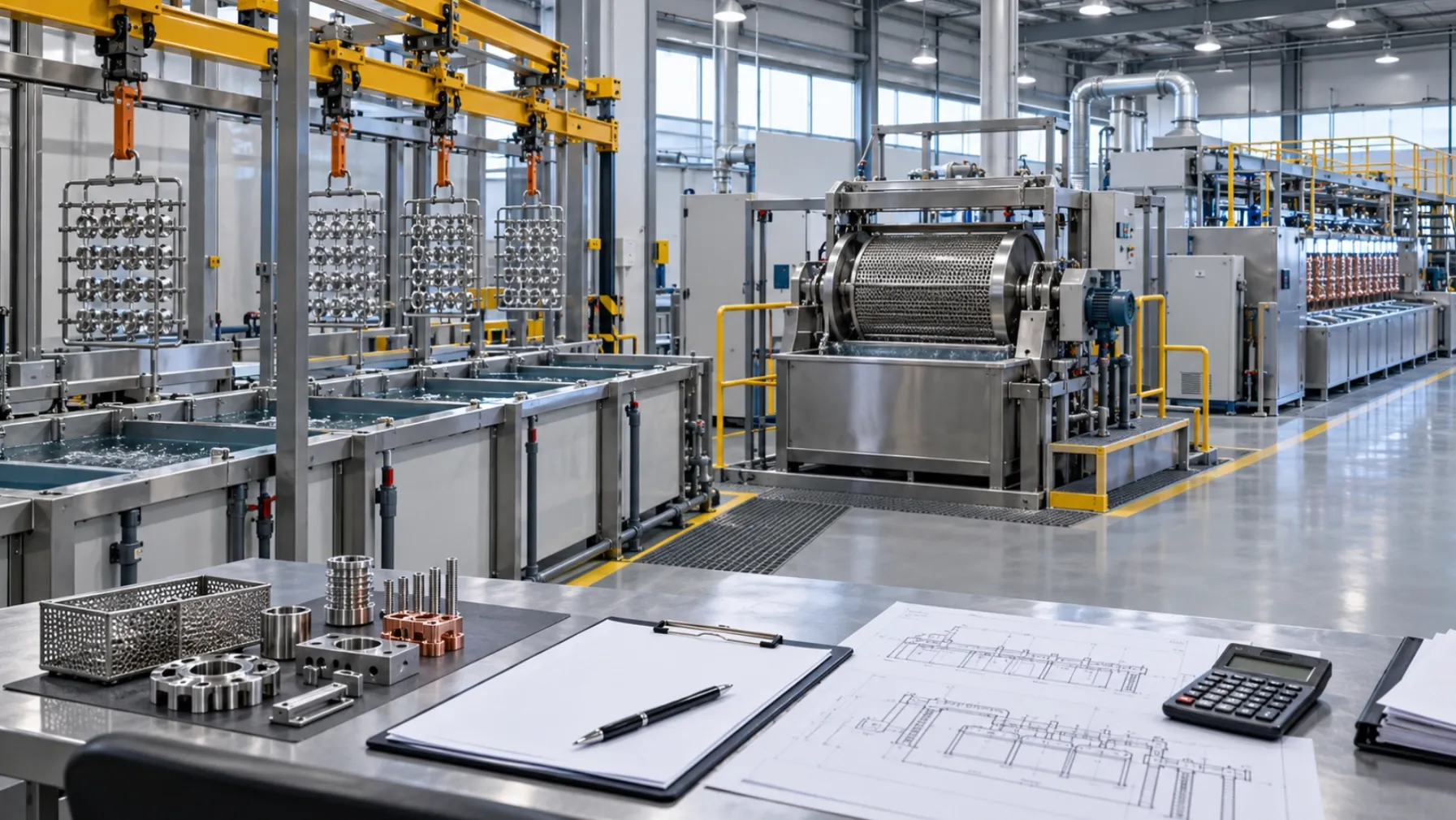
THE SHORT ANSWERElectroplating equipment is a coordinated system of process tanks, power supplies, workpiece handling, controls and support equipment. Choose the handling format from part geometry and production needs; then size the system around the coating process, output target and available utilities. A useful quotation starts with those inputs, rather than a machine name alone.
Which line type fits your workpiece?
“Zinc line” describes a process. “Rack line” describes how parts move through it. Separate these two decisions when comparing electroplating equipment: the same coating may be applied using different handling formats.
Use this table to build a shortlist. Part samples, contact points and coating requirements still need to be assessed before a format is confirmed.
On mobile, swipe sideways to read the Check before choosing column →
| Line format | A starting point for | Check before choosing |
|---|---|---|
| Rack / jigBatch handling | Larger, delicate or appearance-sensitive parts that need individual positioning. | Contact marks, rack capacity, part orientation and loaded weight. |
| BarrelBatch handling | Small loose parts that can tolerate tumbling and contact with other parts. | Damage, nesting, electrical contact, load size and drainage. |
| Reel-to-reelContinuous handling | Strip, wire or linked components supplied on reels. ES-PRO feed configuration requires project review. | Width / thickness, reel size / weight, tension and distortion limits, payout / take-up, selective-area tolerances and speed. Ask how thickness is checked, whether inspection is included, and how dragout is controlled. |
For batch handling options, explore ES-PRO gantry-type electroplating equipment.
Use this table as an engineering shortlist. ES-PRO's gantry catalogue describes rack, barrel, vibration and rotary handling. Its electronics-packaging catalogue discusses retention, deformation and electrical contact for small components. Assess those constraints on your sample parts before choosing a loading arrangement.
Specify a system, not just a tank sequence
A process route may include cleaning, activation, plating, rinsing, post-treatment and drying. The exact stages come from the approved process. Equipment quotations also need to explain the systems around those stages.
Illustrative grouping only. A real process may repeat or omit stages. The European Commission JRC surface-treatment reference provides broader technical context for electrolytic and chemical installations. ES-PRO supply scope must be confirmed separately.
Process tanks & support: Confirm materials, usable dimensions, heating or cooling, filtration and agitation for each duty.
Rectifiers & electrical: State the plated surface area per loaded rack or barrel and the chemistry supplier's current-density requirement, if known. Give site voltage, frequency and available supply. Mark unknown values for engineering review; tank volume alone does not establish a rectifier rating.
Handling & control: Check loaded weight, transfer paths, recipes, loading stations and the output assumptions behind the proposed cycle.
Extraction & water systems: Identify extraction, rinse-water quality, water reuse and effluent treatment requirements, including interfaces supplied by others.
ES-PRO's catalog covers configurable handling equipment and water treatment equipment. Catalog options do not mean every item is included in a quotation. Request a written supply boundary for your project.
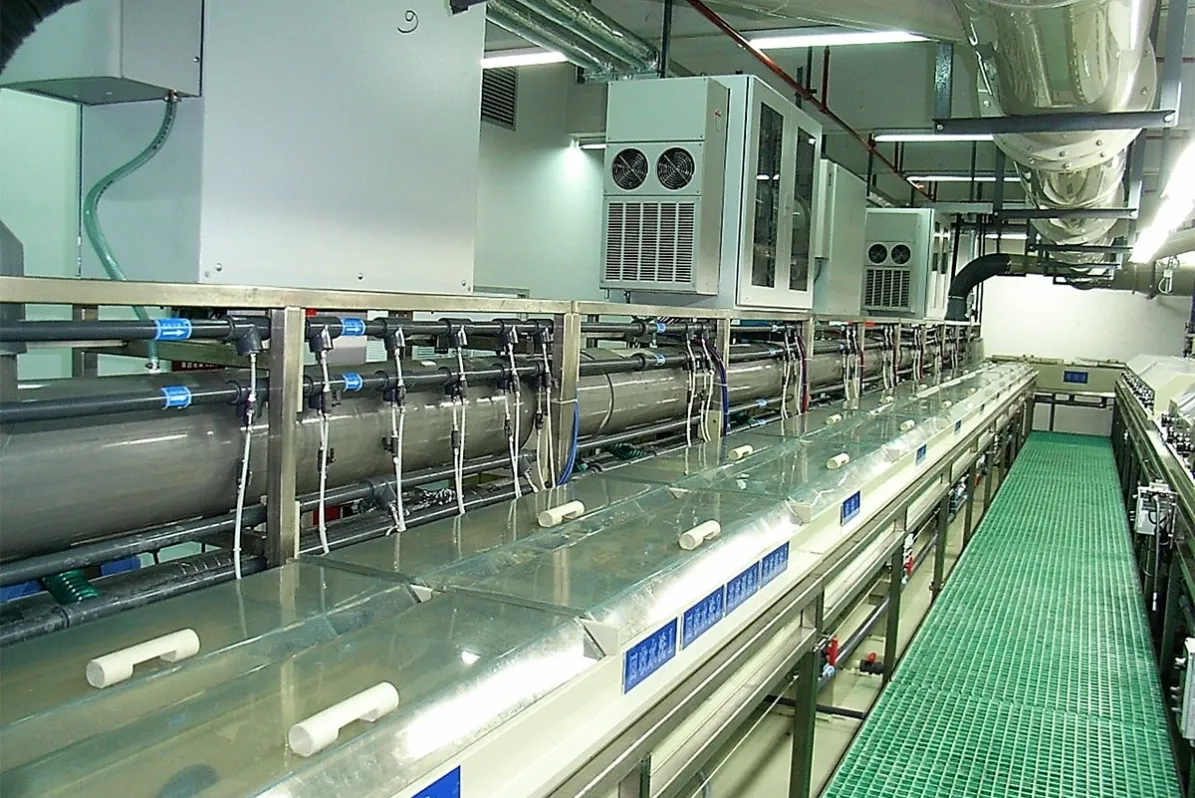
FIG. 02Visible in this supplied catalog photo: processing cells, pipework and an access walkway. Reel payout and take-up units are not shown.
How the coating changes the equipment brief
Once the handling format is shortlisted, share the required coating stack and acceptance criteria. Specify thickness, appearance or performance requirements where known. Do not substitute a generic standard for the customer's actual specification.
Zinc
State the zinc process and required post-treatment. Include drying or any specified additional treatment in the process scope.
Nickel
Clarify whether nickel is a functional deposit or part of a decorative stack. Define thickness, appearance and any additional layers.
Copper / tin
State the substrate, layer sequence and plated areas. For continuous material, identify full-area versus selective coverage.
ES-PRO's inclined-conveyor catalogue describes continuous handling for flat, elongated workpieces. That arrangement differs from reel-fed material. For a reel-to-reel enquiry, provide feed geometry, reel weight, tension limits, plated areas and the thickness-checking method. Request confirmation of the proposed feed configuration; the photograph above does not establish a standard reel-to-reel offering.
control→Process
cells→Rinse / dry→Take-upILLUSTRATIVE FEED PATH · CONFIGURATION REQUIRES PROJECT REVIEW
Feed path drawn for explanation, not a specification for the pictured equipment. Specify feed geometry, tension limits and process residence time.
Compare quotations on the same supply scope
A new line, an upgrade and an expansion need different briefs. For a new line, start with the full site and process requirements. For an upgrade, list retained equipment and known constraints. For an expansion, state the existing bottleneck and the additional output required.
Ask each supplier to mark the following items as included, optional or supplied by others. This makes proposals easier to compare before discussing the headline price.
- Tanks, handling equipment, rectifiers and control system.
- Heating, cooling, pumps, filtration and dosing provisions.
- Extraction, DI water, drainage and wastewater interfaces.
- Installation, commissioning, operator training and documentation.
- Acceptance criteria, spare parts and stated warranty terms.
Check how capacity is calculated: part load, cycle assumptions, process dwell times and loading time should be visible. A claimed output without these assumptions is difficult to compare. For a fuller inquiry checklist, see the plating-line quotation guide.
At acceptance, ask which agreed part load, coating acceptance tests and completed-load interval will be demonstrated.
What to send for a useful first inquiry
You do not need a complete specification to start. Send what is known and mark the rest as unknown. These inputs help distinguish a preliminary configuration discussion from a quotation based on fixed requirements.
- WorkpieceMaterial, drawing or photo, maximum length × width × height with units (mm or inches), part weight with units (kg or lb), and handling restrictions.
- CoatingLayer sequence, thickness target with units (for example µm), plated areas and required acceptance tests.
- ProductionRequired accepted output with a unit (pieces, kg, metres or square metres per month), batch or feed format, product mix and working shifts.
- Site & projectNew line or upgrade, project country and city, floor plan, site voltage/frequency and known utilities.
Questions You May Have:
Click a question to view the answer.
Can one line process several coating systems?
Sometimes, but shared handling does not establish process compatibility. List each process route, changeover needs and production mix so tank allocation and cross-contamination controls can be assessed.
Does the quoted cycle include changeover?
Ask explicitly. A repeat-cycle figure may exclude rack changes, product changes or cleaning between recipes. Request the operator tasks, changeover allowance and usable operating hours behind the shift-output estimate.
Can ES-PRO give a price without a drawing?
You can begin with photos, approximate dimensions and a production target. Ask which assumptions are being used and what information is still required before the configuration and price can be confirmed.
Are rectifiers and wastewater treatment included?
Do not assume they are. Ask for an itemized scope identifying included equipment, options and site responsibilities. The required electrical and water systems depend on the process.
Will a larger tank automatically increase output?
No. Output also depends on load arrangement, process time, handling, loading and other constraints. Identify the bottleneck before selecting larger equipment.
Technical context & sources
Explore the resources below for process background, wastewater planning and workplace ventilation. The government references identify their jurisdiction; confirm the requirements that apply at your project location.
Plating Essentials and professional education covering equipment, chemistry and plating processes.
Explore plating education ↗ U.S. ENVIRONMENTAL REFERENCEEPA · Metal FinishingEffluent-guideline coverage, related process categories and guidance for wastewater planning.
Read the effluent guidelines ↗ U.S. WORKPLACE SAFETY REFERENCEOSHA · Dipping & CoatingTank construction, vapor-area ventilation and worker-exposure provisions under 29 CFR 1910.124.
Read the official provisions ↗ EU TECHNICAL REFERENCEEuropean Commission · JRCSurface Treatment of Metals and Plastics BREF documents and their review status.
Explore the BREF documents ↗Photographs: supplied ES-PRO catalog material. No customer identity, project date or production result is attributed to them.