
Oct 4, 2026Applications
Copper Plating: Uses, Process & Equipment
Copper plating serves electronics, bus bars and undercoating work. See where it fits, how the process runs and what a copper plating line includes.
Copper plating deposits a highly conductive, easily leveled copper layer from acid or alkaline bath systems. About a 5-minute read.
The industry uses it for three jobs:
- as the current-carrying and via-filling deposit in PCB manufacturing,
- as a ductile underlayer beneath nickel and chrome on decorative work,
- as a cost-effective build-up layer on steel and zinc castings.
The equipment is standard electroplating hardware — what changes is the bath system and the line format your parts demand.
Written by Nick Wong · Engineering reviewed by Ben Yuan · Published 2 October 2026 · Updated 2 October 2026
Where Copper Plating Fits
Copper's combination of conductivity, ductility and levelling makes it the workhorse deposit across industries:
- Electronics and PCB — copper is the conductor itself: through-hole plating and via filling on panels run on dedicated horizontal or vertical continuous copper lines (VCP), and it is the layer every other finish on a board sits on.
- Bus bars and current-carrying parts — copper plating builds conductivity on aluminum and steel substrates where a solid copper part is too expensive.
- Undercoating and build-up — a copper underlayer improves adhesion and levelling under nickel-chrome decorative stacks, and thick copper deposits rebuild dimensions on worn or undersized parts economically.
- Zinc die castings — copper is the adhesion bridge that makes later nickel and chrome layers work on zinc.
How the Process Runs
Copper plating follows the standard electroplating process: clean, activate, plate, rinse. The process-critical choice is the bath system:
- Acid copper (sulfate-based) — the industry's default for electronics and decorative undercoats: excellent levelling and brightness control, throwing power managed with additives, easy to maintain.
- Alkaline cyanide and non-cyanide alkaline systems — the adhesion bridge on zinc die castings and steel where acid copper's attack on the substrate must be avoided; strike layers often run here before acid copper.
- Pyrophosphate copper — a niche alkaline system for specific substrate and requirement combinations.
Current density, temperature and agitation windows are set by the chemistry supplier's datasheet — the line's job is to hold them uniformly across the load.
What a Copper Plating Line Includes
A copper plating line is a tank-sequence plating line built around the bath system: pre-treatment and activation tanks matched to the substrate, copper plating cells with rectifiers sized from cathode area and current density, solution agitation (air or eductor) and continuous filtration, temperature control, and multi-stage rinsing with wastewater treatment sized to the rinse loads.
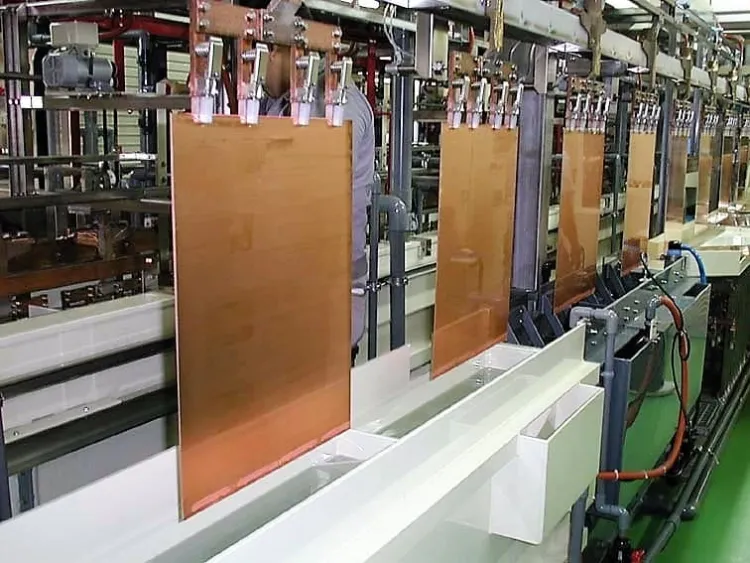
Line format follows the parts: rack lines for bus bars and engineered parts, barrel lines for bulk hardware, and for PCB panel production, vertical continuous plating (VCP) lines that move panels through the copper module continuously for uniform distribution.
Standards and Evidence Boundary
- IPC standards (IPC-4552 family and PCB performance specs) — the electronics industry's reference frame for copper plating quality on boards; follow the class your product sells into.
- MIL-DTL-14550 / MIL standards — engineering copper electrodeposits for non-PCB applications where specified.
- Chemistry supplier datasheets — bath system, additive control and operating windows are defined there.
Evidence boundary: this article covers copper plating at industry-general level. Deposit properties, acceptance criteria and bath windows come from the applicable standards, your customer drawings and the chemistry supplier — not from this page.
FAQ
Why is copper used as an underlayer under nickel and chrome?
Copper levels out surface roughness and provides a ductile, adhesive base — the nickel and chrome layers then sit on a smooth, uniform surface with less thickness needed to reach the same finish quality. On zinc die castings the copper layer is also the adhesion bridge.
Can copper plating be used alone for corrosion protection?
Not usually — copper is corrosion-prone itself. Its corrosion role is as part of a system (typically under nickel), or as a conductive/levelling layer where the top layer handles protection.
What decides acid copper vs alkaline copper chemistry?
The substrate and the adhesion requirement: zinc die castings and reactive substrates typically start with an alkaline strike before acid copper; steel and copper-alloy electronics work commonly run acid copper directly. The chemistry supplier and the part spec decide.
Related Reading
- Pillar guide: What Is Electroplating? — where copper sits among the plating metals.
- Adjacent decision: The Electroplating Process, Step by Step — the sequence a copper line runs.
- Next step: browse plating lines — rack, barrel and VCP formats for copper applications.
Diagnostic CTA: What to Send Us — and What You Get Back
Send your copper-plated part families through our RFQ form — substrate, geometry, thickness or conductivity targets and throughput. ES-PRO returns: a recommended line format and tank sequence for the chosen bath system, the equipment list including rectification and water treatment scope, a quotation, and an explicit list of open questions — we state what is missing rather than assuming it.
References & Authorities
- IPC-6012 — Qualification and performance specification for rigid printed boards (plated copper requirements) — IPC (Association Connecting Electronics Industries).
- MIL-DTL-14550 — Plating, copper, electrodeposited — general requirements — US Department of Defense (MIL-SPEC).
- Chemistry supplier datasheets — bath system, additive control and operating windows are defined by the chemistry supplier.
- Industry associations — e.g., NASF (National Association for Surface Finishing, US) and IMF (Institute of Materials Finishing, UK) publish supplementary guidance and training for the surface-finishing industry.
Standards are cited for identification; always use the current edition from the issuing body. Process parameters are governed by the datasheets for the specific chemistry.